
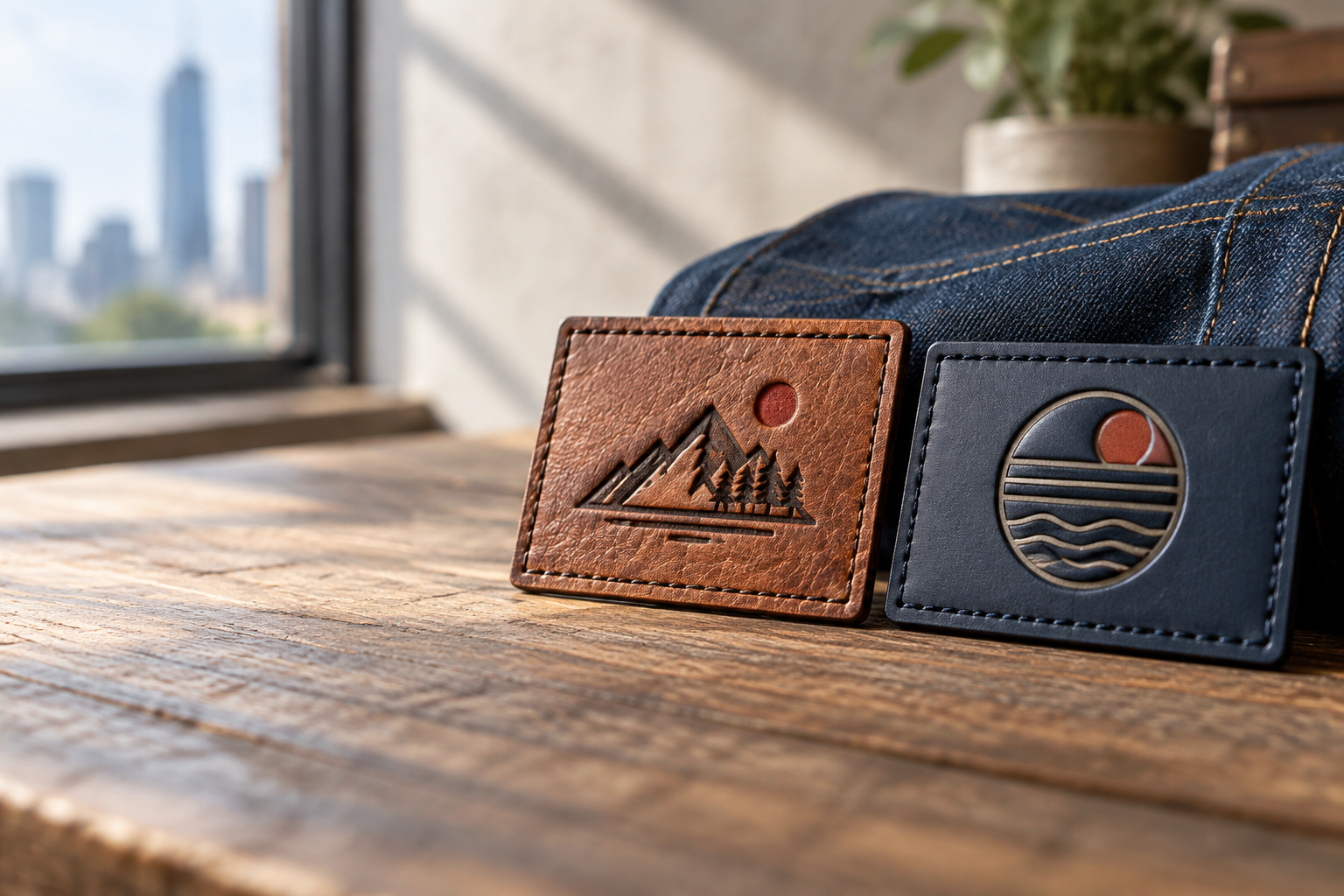
Chicago denim brands choose custom leather patches because a compact label can give jeans, trucker jackets, and caps a recognizable identity without covering the fabric. Leather brings texture and a restrained mark that works well beside denim seams, rivets, and fading. It is a useful choice when the logo stays readable and the patch can handle the garment's intended care.
At GetUSAPatches in Corona, CA, we start with the garment, not just the artwork. We have a 10-piece minimum, provide a free digital mockup before production, and produce only after approval. We ship to all 50 states across the United States, including Chicago brands arranging delivery to a studio, decorator, or fulfillment location.
Why Leather Works on Denim—and Where It Does Not
Denim already has plenty going on: diagonal twill, contrast stitching, hardware, and changes in color through wear. A leather label can sit beside those details without demanding a large graphic. A simple wordmark on the rear waistband often does more useful branding work than a complicated badge squeezed into the same space.
The attraction is not just a rugged appearance. A repeatable patch shape can connect a five-pocket jean, a chore coat, and a canvas tote even when their fabric colors differ. Keep the outer shape and logo consistent, then size the patch for each garment instead of forcing one label onto the whole collection.
Chicago is the delivery market, not a material specification
A Chicago address does not automatically mean the patch needs to survive outdoor work, industrial laundry, or daily snow exposure. A fashion label sold through a neighborhood shop has different requirements from a denim apron worn through restaurant service. Tell us what the wearer actually does and how the garment gets cleaned.
Leather is also not the answer to every branding job. Small multicolor artwork, photographic detail, and a requirement for a very soft label against the skin can point toward another construction. Start with leather patches for texture and a simple mark, but do not sacrifice readability just to keep the material.
Genuine Leather, Faux Leather, and the Finish You Approve
Genuine leather has natural grain and may show differences in shade or surface character between pieces. Some denim brands want that variation because it fits the way their garments age. Others need the patch to look as consistent as possible across a retail display, which makes a more uniform faux leather worth comparing.
Neither material name tells you everything about performance. Thickness, finish, coating, color, and the marking method all affect the result. Ask for the proposed construction in writing rather than assuming every brown leather-look patch behaves the same in a washing machine.
Choose the mark, not just the material color
A recessed debossed mark presses the artwork into the surface; an embossed mark raises it. Laser marking can produce different contrast depending on the material and finish, so a dark logo on a screen does not establish how dark the actual mark will be. Confirm the available method for the material being quoted.
- Genuine leather: useful when natural surface variation fits the brand, but the approved care requirements still control how the finished garment should be treated.
- Faux leather: useful when an animal-free material or a more uniform surface is part of the brief; request composition details rather than relying on appearance.
- Low-contrast marking: subtle at close range, but a small wordmark can disappear against dark denim or under uneven shop lighting.
- High-contrast marking: easier to read at a glance, provided the chosen material and process can produce the requested contrast.
- Thicker construction: can feel substantial on a waistband, but may create an uncomfortable stiff spot on lightweight stretch denim.
Use Leather vs. Faux Leather Patches: Differences, Pros and Cons to narrow the material request. Then separate appearance approval from performance approval. A digital mockup can settle layout and spelling; it cannot prove wash behavior, hand feel, or the exact character of a natural surface.
Custom Leather Patches for Chicago Denim: Size and Artwork
For a waistband discussion, a 3-inch-wide by 2-inch-high paper template is a useful starting point, not a required industry size. Put it on the actual jean and check belt loops, the yoke seam, and the path of the belt. A patch that looks balanced on a flat drawing can collide with construction details on the garment.
A cap might start with a 2.5-inch-wide by 1.5-inch-high template, while a small jacket badge might start at 3 inches wide by 1.5 inches high. Those are layout examples only. Crown curvature, jacket panel dimensions, and sewing access decide the final size.
Make the logo readable at actual size
Print the design at its proposed dimensions and stop zooming in. Fine outlines, tightly spaced letters, and a long founding-date line can turn a good logo into a muddy stamp. If the small text carries essential information, enlarge the patch, simplify the logo, or compare a finer-detail patch type.
The stitch line needs room too. Do not place lettering against the edge and expect the sewing operator to preserve every stroke. Ask the production team to identify a usable sewing margin for the selected thickness, shape, and attachment plan instead of assigning an arbitrary margin from a screen preview.
- Send width and height in inches, not just a photo of a similar patch.
- State whether the dimensions describe the full patch or only the visible logo area.
- Identify lettering that must remain readable and artwork that may be simplified.
- Check the patch on the smallest relevant garment size, not only the medium sample.
- Keep waistband labels clear of belt-loop attachment points and heavy intersecting seams.
- Decide whether the border stitch should contrast with the patch or blend into it.
A clean vector file usually makes revisions easier, but send the best file you have rather than tracing a poor image into rough shapes. The Artwork File Guide for Custom Patches: Vector, PNG, JPG and More explains what to supply. Pair it with the Custom Patch Size Guide: How Big Should Your Patch Be? before settling the dimensions.
Compare Leather with Thread, Woven Detail, and Print
A patch quote should give you a reason to choose a construction, not just a list of materials. Leather is strong visually when the artwork is simple and the surface itself is part of the design. Thread, woven detail, and print solve different problems, especially when the logo has more colors or smaller lettering.
These are practical selection differences, not promises that one style will outlast another in every setting. Care suitability depends on the specific material, backing, attachment, and garment. Test the finished combination if it will be sold with a repeatable laundering requirement.
| Patch construction | Good denim application | Appearance and detail | Main trade-off | What to confirm |
|---|---|---|---|---|
| Genuine leather | Rear waistband label or restrained jacket badge | Natural surface character with a simple marked logo | Shade and grain can vary; laundering needs attention | Material finish, thickness, marking method, and care limits |
| Faux leather | Coordinated jean, cap, and bag labels | Often more uniform in surface and color | Coatings differ and may react poorly to heat or repeated washing | Composition, flexibility, mark contrast, and wash behavior |
| Embroidered | Denim jacket crest or club-style chest badge | Visible thread texture with clear larger shapes | Dense stitching adds bulk and tiny lettering can close up | Letter size, stitch coverage, border, and attachment |
| Woven | Detailed brand badge or compact information-rich label | Finer thread detail and a relatively low profile | Less raised texture than embroidery | Small text readability, finished edge, and available backing |
| Printed | Illustrated jacket patch or multicolor artwork | Flat graphic treatment suited to tonal artwork | Does not provide leather grain or raised thread texture | Print process, surface, color expectations, and care instructions |
| PVC | Workwear-inspired badge or removable panel patch | Molded shapes with a flexible rubber-like feel | Can look too technical for a restrained denim label | Thickness, detail limits, sewing channel, and backing |
Choose embroidered patches when the jacket needs visible thread and a familiar crest construction. Choose woven patches when smaller lettering matters more than a raised surface. Merrowed crests have a rounded thread edge; a leather patch has a different edge treatment, so do not assume the same border vocabulary applies.
For tonal illustrations, printed patches may be the better call. Printed is flatter; that is the point. A denim brand can use leather on jeans and print on a seasonal jacket without making either patch pretend to be something it is not.
Attachment: Start with Sewing Access, Not Adhesive
For a permanent denim waistband or jacket label, sew-on is usually the first attachment method to assess. It avoids relying only on an adhesive bond, but it still needs the right sewing setup and usable access behind the panel. Heavy seam intersections and enclosed pockets can turn a simple-looking placement into a difficult operation.
Ask who will attach the patches before approving the order. A garment factory adding them before final assembly has different access from a local decorator working on finished jeans. Clarify whether the quote covers loose patches, garment application, or a separate installation arrangement.
Iron-on is a compatibility question
Do not carry over heat settings from a cotton T-shirt to a leather patch on stretch denim. The patch face, adhesive, fabric, dyes, and stretch fibers all have their own heat limits. A compatible heat-applied option needs confirmed instructions and a trial on the actual garment.
Iron-on that peels after a dryer cycle is a real failure mode, especially if the bond was incomplete or the care routine exceeded the adhesive's limits. More heat is not automatically the fix. It can damage the patch face or garment before it produces a reliable bond.
Hook-and-loop needs a receiving panel
Velcro panels make sense when a badge must be removable, but the receiving side must be part of the garment plan. Confirm whether the order needs the hook side only or both mating sides. The added thickness and firmer feel may be acceptable on a jacket and annoying at a jeans waistband.
The same caution applies across garments: nylon shells may be heat-sensitive, and lined wool coaches jackets can be difficult to access for sewing without catching the lining. Review Patch Backing Options Explained: Sew-On, Iron-On, Velcro® & More before choosing a back. For sewn applications, How to Sew On a Patch: A Step-by-Step Guide provides a useful starting process, with equipment and technique adjusted for the materials.
Build a Patch Plan for the Whole Collection
One logo does not require one identical patch on every garment. The better approach is a shared visual system: the same mark, related material colors, and consistent proportions. Then let the jean, jacket, and cap have the construction each one needs.
This is the same production-desk distinction that matters across high-school sports teams, fire and public-safety units, hospitality polos, biker vests, and letterman jackets. A sweatshirt chest, a uniform sleeve, and a leather vest do not take decoration the same way. Denim collections deserve that same garment-by-garment attention.
- Rigid five-pocket jeans: check the rear waistband against the belt path and yoke seam. A substantial label can work here if the operator can sew it without crossing bulky construction.
- Stretch jeans: keep flexibility in view. A stiff patch can create a flat spot or resist the fabric's movement even when the attachment holds.
- Denim trucker jacket: use a chest or lower-front badge only after checking pocket access. Sewing through a working pocket is an avoidable mistake.
- Chore coat or hospitality apron: place the patch away from frequent abrasion and assess the actual laundry routine before choosing leather.
- Structured cap: test the patch shape against the crown curve and center seam. A wide, stiff patch may bridge the surface instead of sitting naturally.
- Biker vest or club denim cut: keep the brand label distinct from the club's main artwork and placement plan. Large back pieces need their own sizing discussion.
For a coordinated headwear release, review Custom Hat Patches: How to Choose the Right Style for Caps and Beanies. For club apparel, biker and motorcycle club patches involve different scale and set-planning questions. A small leather maker's label should not be enlarged into a back patch without reviewing flexibility, detail, and attachment again.
Letterman jackets may call for chenille patches on the main letter and a smaller leather detail elsewhere. Hospitality polos usually need a softer, lighter decoration than a stiff denim waistband label. Keeping the logo consistent matters more than insisting on one material everywhere.
What Drives the Quote in USD
There is no honest universal dollar price for a custom leather patch without dimensions, material, artwork, quantity, and attachment requirements. Two brown rectangles can have very different production needs. A simple mark on one size is not the same quote as several shapes, colorways, and separately packed variants.
GetUSAPatches has a 10-piece minimum, which gives a small label a manageable starting quantity. Do not assume several different designs can be combined under one minimum or priced as one design. List the quantity for each version and ask how the proposed split affects the quote.
- Finished size: larger patches use more material and may take more space during marking and handling.
- Material and finish: genuine leather, faux leather, surface treatments, and thickness are not interchangeable cost items.
- Marking process: artwork preparation, tooling where applicable, and the selected marking method can change the setup.
- Design count: a new shape, size, or logo version may require separate preparation rather than counting as a simple quantity increase.
- Backing and application: loose sew-on patches differ from patches needing additional backing components or garment attachment.
- Packing and delivery: size sorting, special packaging, and the requested shipping service should be identified before approval.
Request unit pricing and the full order total in USD, with any applicable setup, delivery, and other charges identified. A lower unit figure is not necessarily a lower finished-garment cost if it leaves out attachment. Use How Much Do Custom Patches Cost? What Drives the Price to compare quotes on matching specifications.
For example, a planning run of 24 jeans and 12 caps may need two patch sizes even if the artwork is shared. Quote those quantities separately before deciding that 36 identical patches will save money. Unused patches in the wrong proportions are not much of a saving.
Wash Testing Belongs Before the Retail Run
Denim brands often specify garment washing, distressing, or other finishing before a product reaches a buyer. Tell the patch supplier if the patch will be attached before those operations. A material suitable for an already-finished jacket may not suit a process involving repeated wet treatment, abrasion, or chemical exposure.
Leather can change with moisture and drying, while faux leather coatings have their own heat and flexing limits. Possible problems include curling, hardening, surface changes, peeling, or color transfer. Those are reasons to test the selected construction, not reasons to assume every leather patch will fail.
Test the complete garment combination
A loose patch in a wash bag is not the same as a patch sewn to stretch denim. Where sampling or test pieces are needed, confirm availability, cost, and timing separately from the free digital mockup. Attach the proposed patch to representative fabric using the intended production method.
- Record the patch dimensions, surface appearance, and garment condition before washing.
- Use the proposed customer care routine, including the intended drying method, rather than a gentler routine chosen only for the test.
- Inspect the patch, thread, attachment points, and surrounding fabric after the full cycle.
- Check for curling, color transfer, coating changes, loose stitches, and puckering against the original photographs.
- Repeat as needed for the brand's intended validation plan; one good cycle does not establish lifetime performance.
- Resolve any conflict between garment care and patch care before producing customer inventory.
There is no single wash instruction that fits every leather and faux leather construction. Follow the approved care requirements for the complete garment. The How to Wash and Care for Patches (Embroidered, PVC, Leather & More) guide is useful background, but it does not replace testing your selected materials.
Ordering and Lead Time from Corona, CA, to Chicago
A useful quote request includes the logo, finished patch dimensions, material preference, attachment method, quantity per version, and delivery ZIP code. Add a photo of the placement and the garment's fabric content if you have it. Those details prevent a layout discussion from turning into a late construction change.
GetUSAPatches ships nationwide from Corona, CA, to all 50 states. For a Chicago launch, give the date the patches must be in your hands, not just the date of the event or store release. If a decorator still needs to sew them onto garments, that work needs its own time allowance.
Separate approval, production, transit, and installation
Ask for the current production estimate and shipping options with the quote rather than relying on a general delivery promise. Artwork revisions, material confirmation, requested physical testing, and multiple design versions can affect the schedule. Carrier transit is a separate stage from patch production.
We provide a free digital mockup before production and produce only after approval. That approval should cover spelling, dimensions, shape, placement of the mark, material description, and the attachment details shown or listed. Approval of a picture does not establish how an untested garment will wash.
- Measure the placement and supply a full-size reference or paper-template photo.
- Send artwork and identify any lettering or design elements that cannot change.
- List the preferred material, patch color, mark appearance, and attachment method.
- Provide quantity by design and size, with the 10-piece minimum in mind.
- Share the in-hand date, delivery ZIP code, and any separate decorator deadline.
- Review the quote and free digital mockup together so the written construction matches the pictured design.
- Approve only after revisions and any required testing decisions are resolved, then confirm the production and shipping plan.
You can include these details in a free mockup quote request rather than sending several disconnected messages. If the deadline is tight, say so in the first note. We can discuss the current options, but an unconfirmed rush date should never become the basis for a retail launch.
Keep the Approved Specification for Reorders
Save the approved artwork, dimensions, material description, color reference, and attachment instructions under a clear version name. Keep a physical reference from the accepted run if available. A phone photo taken under warm lighting is a poor substitute for an actual material reference.
Before reordering, check whether the garment changed. A new denim weight, different stretch content, or revised waistband construction can affect the patch even if the logo is identical. Natural leather variation also means a reorder should be checked against the agreed expectations rather than treated as a perfect visual duplicate.
Related guides for the next specification decision
- Read Leather vs. Faux Leather Patches: Differences, Pros and Cons when material character, consistency, or animal-free requirements drive the decision.
- Use Custom Woven Patches in Chicago, IL: Complete Guide for Clothing Brands if small lettering pushes the logo beyond a practical leather mark.
- Review Bulk Leather Patches in Los Angeles: Ordering Guide for Hat Brands for headwear ordering considerations that also matter to Chicago collections.
The product hubs let you compare the construction itself: leather patches for material texture, embroidered patches for a stitched badge, and woven patches for finer thread detail. Choose the patch that fits the garment and the care routine. Then keep that specification clear enough that the next run does not start from scratch.