
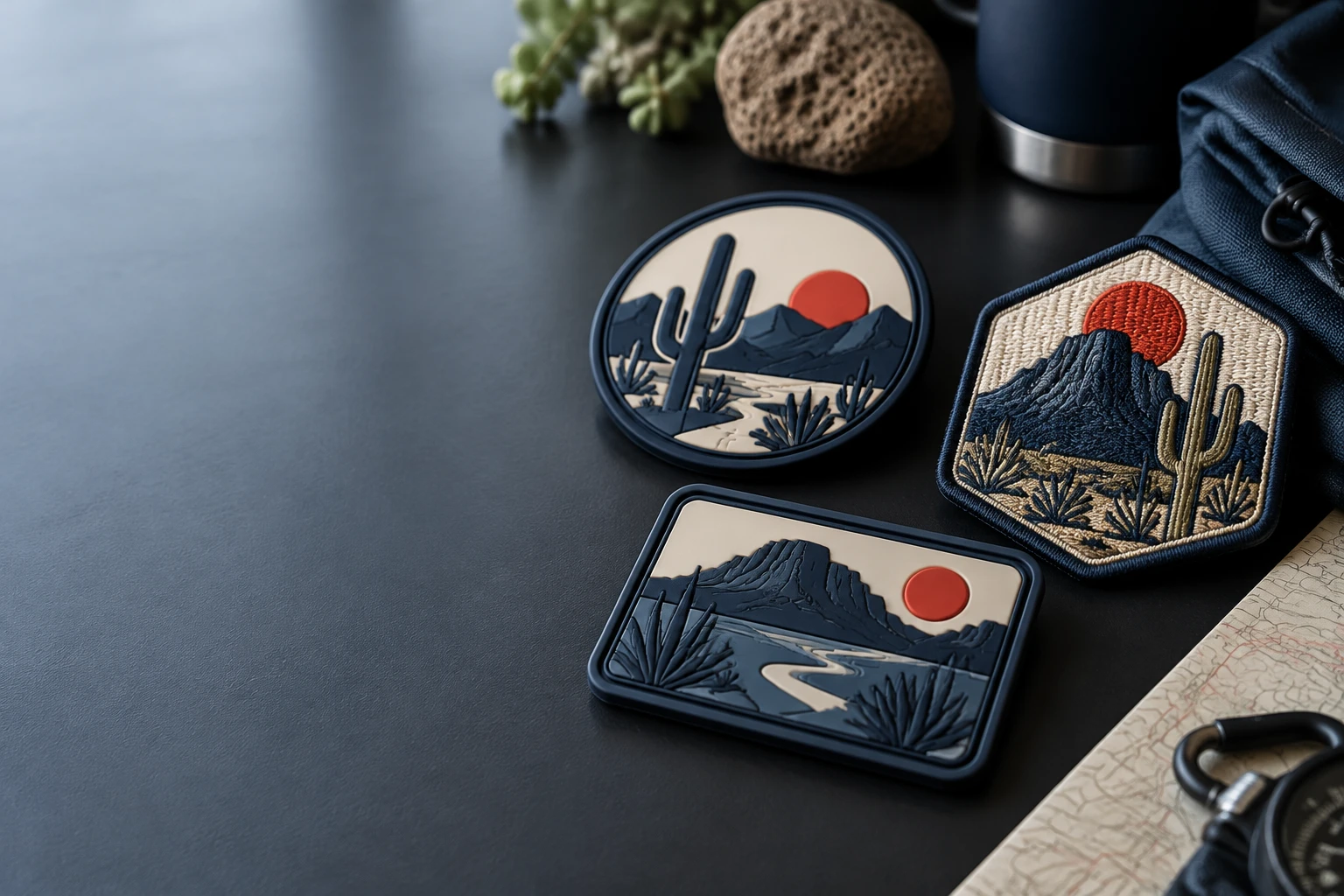
For custom PVC patches Phoenix outdoor brands need by a deadline, start with the date the patches must arrive and confirm artwork, backing, production, and transit before placing the order. Leave separate time for sewing them onto caps or packs. A faster shipping service cannot recover time lost to an unfinished logo or an attachment method that does not fit the garment.
GetUSAPatches has a 10-piece minimum and provides a free digital mockup before production. We produce only after approval and ship from Corona, CA, to all 50 states across the United States. The useful starting point is your artwork, quantity, patch dimensions in inches, garment, Phoenix delivery ZIP code, and actual in-hand date—not just a note saying “rush.”
Custom PVC patches for Phoenix: start with the real deadline
A Saturday trail event does not necessarily mean Friday is an acceptable delivery day. If your decorator needs time to stitch patches onto 80 caps, and your staff needs another day to count and pack them, the loose patches have to arrive earlier. Put those dates on the quote request so the production schedule solves the right problem.
There are three dates worth separating: the event date, the finished-merchandise date, and the patch-arrival date. Buyers often provide only the first one. That leaves the person quoting the job to guess whether the order is loose patches for a giveaway or completed merchandise that needs another round of work.
State what must be in the box
“Patches for 100 hats” and “100 patched hats” are different jobs. Confirm whether the quote covers loose patches, attachment, garments, packaging, or some combination; do not assume installation is included. If a Phoenix sewing shop is doing the attachment, check its capacity before committing to the patch schedule.
- Give a calendar date for required arrival, not “next week” or “before our launch.”
- State the delivery ZIP code and whether the address is a business, residence, hotel, or event venue.
- Identify any receiving restrictions, such as a closed office on Fridays or a warehouse appointment requirement.
- Name one person who can approve the mockup without waiting for a second committee meeting.
- Separate the minimum event quantity from additional stock if you want a split-delivery option evaluated.
The planning questions in How Long Do Custom Embroidered Patches Take to Arrive in Phoenix, AZ? are useful even if you are choosing PVC. The materials have different production requirements, so an embroidered timeline should not be copied onto a molded order. Ask for timing against the exact specification.
Choose PVC for the use, not just the weather forecast
PVC is a flexible molded material that works well for bold logos, raised lettering, and recessed backgrounds. The patch face does not absorb water like a textile face, and ordinary surface dust is generally easier to wipe away than dirt worked into thread. That makes PVC patches a sensible option for daypacks, guide caps, equipment bags, and removable brand identifiers.
Phoenix adds dry dust, strong sun, sweat, and occasional heavy rain to the use case. None of that makes every PVC construction suitable for unlimited exposure. Ask about the intended application and any available material testing rather than assuming a patch is fade-proof, heatproof, or suitable for permanent outdoor installation.
The patch face and the attachment fail differently
A molded face may still look good while its attachment starts lifting. Adhesives, stitching, hook engagement, and the garment fabric are separate parts of the system. A patch used on a hiking pack also faces different loads from one placed on the front of a cap.
Do not use a hot vehicle dashboard as an unofficial durability test, then assume the result covers normal wear. Enclosed-vehicle heat and prolonged direct sun can stress both materials and adhesives. If your product will regularly be stored in vehicles or exposed outdoors for long periods, describe that before the material and backing are finalized.
There are also places where thread simply looks more at home. Merrowed crests on wool coaches' jackets and traditional club insignia on biker vests have an appearance that molded PVC does not reproduce. The comparison in Embroidered vs. Woven vs. PVC Patches: Which Should You Choose? helps separate that style decision from weather resistance.
Simplify the artwork before the deadline gets tight
A logo that looks sharp on a laptop can become crowded on a 2.5-inch patch. Thin lettering, tiny spaces inside letters, and closely packed contour lines need a manufacturing review at the intended size. Send vector artwork if you have it, but do not assume a vector file automatically makes every detail moldable.
For a Phoenix outdoor brand, a bold mountain silhouette with a short brand name is usually a more straightforward molded concept than a topographic map covered in small labels. Keep the identifying shape and the words customers actually need to read. Decorative microcopy can move to the hangtag or packaging.
Review dimensions, color areas, and relief separately
Specify width and height rather than sending “about three inches.” A 3-inch circle, a 3-inch-wide horizontal badge, and a 3-inch-tall shield occupy very different spaces. Print the outline at actual size, cut it out, and hold it against the garment before approving.
Raised and recessed areas also need a clear plan. A raised brand name over a recessed field can create useful contrast, but making every detail prominent can leave the face visually crowded. Confirm the proposed thickness and relief arrangement; do not rely on screen shadows to explain the physical construction.
- Identify essential text and confirm spelling, punctuation, and letter case.
- Supply color references if available, while recognizing that a screen mockup is not a physical color standard.
- Flag gradients, photographic artwork, and fine linework for a material review.
- Keep enough clear space around the design for the proposed edge and attachment construction.
- Ask which small details need widening, simplifying, or removal before approving the layout.
If the design depends on fine lettering, woven patches may preserve it more effectively. If it depends on a photograph or continuous color transitions, compare printed patches. Printed is flatter; that is the point. Choosing the material that carries the artwork cleanly can prevent several rounds of corrections.
Match the backing to the cap, pack, or jacket
Backing is not a final checkout preference. It changes the way the patch is used, how it is attached, and who needs to handle it after delivery. Set it while you are setting the dimensions so the artwork and attachment area are planned together.
For permanent use on a compatible cap or bag, discuss a sew-on PVC construction and a suitable sewing channel. For removable use on an existing loop panel, specify hook backing and confirm whether you need only the hook-backed patch or both mating pieces. “Velcro backing” by itself can leave that second question unanswered.
| Construction | Good fit | Main trade-off | Deadline check |
|---|---|---|---|
| PVC with sew-on construction | Permanent branding on compatible cap fronts, canvas bags, and pack panels | Needs appropriate sewing access; stitches puncture the garment and can affect a coated fabric | Reserve attachment time and confirm the decorator can handle the patch thickness |
| PVC with hook backing | Removable identifiers on existing loop panels | Adds thickness and depends on good engagement with the receiving panel | Measure the panel and confirm whether the matching loop piece is included |
| PVC with an adhesive option, if available | Only applications supported by the specific adhesive and receiving surface | Heat, texture, sweat, and washing can affect bond performance | Confirm suitability and testing needs rather than treating adhesive as a universal shortcut |
| Sew-on embroidery | Traditional cap logos, workwear crests, and club garments | Textile texture suits many uniforms but fine lettering may need simplification | Review stitch detail, edge treatment, and local attachment capacity |
| Woven or printed patch | Small lettering, fine graphics, or artwork better represented on a flatter face | Does not provide the same molded relief as PVC | Get a separate production estimate instead of assuming a material change saves time |
Iron-on is not the automatic answer for PVC or for technical clothing. The old problem of iron-on that peels after a dryer cycle is often an attachment-system mismatch, not proof that every adhesive is bad. Confirm the offered backing, the garment care label, and the application requirements before anyone puts a press on nylon shells.
A hook-backed patch should sit within the receiving loop area without exposed hooks catching nearby fabric. For permanent sewing, use an installer who can assess access, lining, and fabric behavior. How to Sew On a Patch: A Step-by-Step Guide covers the basic operation, but coated shells and assembled caps may need a specialist rather than a home-machine approach.
Fit the patch to the actual garment, not a stock silhouette
A 2.5-inch-wide badge can be a reasonable starting concept for a cap, but it is not a universal cap specification. Crown height, center seams, front-panel stiffness, and curvature all matter. A broad patch can bridge the curve and lift at the edges even when its width looks acceptable in a flat drawing.
On a five-panel camper cap, the usable front area may differ considerably from a structured trucker cap. Keep the patch out of mesh unless the attachment has been planned for it, and check that the lower edge does not crowd the brim seam. The hat patches hub is useful for comparing materials before you commit to one cap construction.
Light clothing exposes weight and stiffness problems
The same concern comes up on hospitality polos and lightweight staff shirts: a patch that looks good by itself can pull the fabric out of shape. A heavier PVC badge may be better on the staff cap or equipment bag, with embroidered patches or another lighter treatment considered for the shirt. Match the decoration to how the garment hangs.
Wool jackets, denim vests, and lined outerwear raise different questions. A high-school letterman jacket may call for chenille patches rather than a molded outdoor badge, while club members may want the traditional appearance of biker and motorcycle club patches. Consistent brand colors do not require identical patch materials across every garment.
For fire and public-safety units, use department-approved placement and attachment requirements rather than guessing from a retail jacket. Decorative PVC should not be presented as protective equipment or attached to specialized protective garments without the appropriate approval. On ordinary gear bags, panel measurements and removal needs are usually the more relevant starting points.
Quote the complete job in dollars, not just the patch price
PVC pricing depends on the specification: quantity, dimensions, color separation, relief, tooling requirements, backing, and finishing. GetUSAPatches has a 10-piece minimum, but that does not mean a 10-piece run and a larger reorder will have the same unit economics. Ask what is included and which costs change with quantity.
Request the quote in USD with shipping, any applicable tax, and any separately charged setup or tooling identified. If your budget is $600 for the whole project, say whether that must also cover blank caps and local sewing. A patch-only quote cannot tell you whether the finished merchandise fits that budget.
- Compare quantities using the same size, design, backing, and shipping assumptions.
- Ask whether multiple designs, sizes, or colorways are treated as separate production runs.
- Confirm whether a rush option is available and what part of the schedule it changes.
- Separate physical-sample charges, if requested, from the free digital mockup.
- Include garment attachment, individual packing, and onward distribution in your own project budget.
- Ask what specifications should be retained to make a future reorder easier.
A larger order can make sense for an established logo, but not if the artwork includes a one-time event date and leftovers will sit unused. For a launch, a simpler main badge plus event-specific packaging may reduce future redesign work. The cost factors in How Much Do Custom Patches Cost? What Drives the Price provide a useful framework without pretending one advertised unit price covers every job.
Build the ordering and lead-time plan backward
There is no responsible universal arrival promise for a custom molded patch without reviewing the order. Artwork readiness, manufacturing capacity, quantity, construction, and the selected shipping service all affect the schedule. Get the estimate for your job in writing and confirm which event starts the production clock.
At GetUSAPatches, production begins only after approval. Sending artwork is not the same as approving the final proof, and an unanswered revision email still consumes calendar time. Keep the reviewer available, especially if your brand owner, designer, and event manager are different people.
Use a backward-planning worksheet
- Record the event date and the earlier date finished goods must be ready for pickup, packing, or staff distribution.
- Ask the installer how much time is needed after loose patches arrive, including inspection and a first attachment check.
- Set the required patch-arrival date and provide the exact shipping ZIP code.
- Confirm transit expectations for the selected service, distinguishing a carrier estimate from any explicit delivery commitment.
- Confirm the production duration for the approved design and ask about the latest feasible approval date.
- Leave time before that approval date for mockup corrections, payment requirements, and any other order-release conditions.
- Agree on a fallback before the schedule becomes too tight to change direction.
For example, suppose an event is Saturday and your cap decorator wants the patches by the previous Monday. That Monday is the date to give the patch supplier; Saturday is useful context, not the delivery target. The decorator's requested interval is an example, not a promised turnaround from GetUSAPatches or any sewing shop.
Keep shipping assumptions separate from production
Orders ship from Corona, CA, and we ship to all 50 states. Phoenix is geographically close, but distance alone does not establish next-day arrival: service level, carrier acceptance, weekends, holidays, and receiving arrangements still matter. A shipping-label notification also does not necessarily mean the carrier has the package yet.
During daylight saving time, Corona and Phoenix generally show the same clock time; during standard time, Phoenix is one hour ahead. Put the time zone on any approval cutoff instead of relying on “end of day.” Small ambiguities become expensive when the order has no spare day left.
If the proposed schedule does not fit, ask about fewer revisions, a simpler design, a different confirmed material schedule, or a smaller first delivery if feasible. None of those is an automatic shortcut. Expedited transit changes the shipping leg, not the time needed to make the patch correctly.
Approve the proof like a production document
A digital mockup is for checking the proposed artwork and specifications before manufacturing. It is not a physical test of softness, cap curvature, color under sunlight, or long-term wear. If any of those decides whether the product is acceptable, ask about a physical sample and the added time and cost before setting the final deadline.
Review the proof on a larger screen if possible, then check the design again at actual size. The zoomed-in view catches spelling and alignment; the actual-size view catches lettering that no one will read on a cap. Both checks matter, and neither replaces measuring the garment.
- Match the proof dimensions to the measured attachment area in inches.
- Confirm the logo version, essential text, colors, and raised or recessed areas.
- Check that the specified backing matches the purchase request and garment.
- Confirm whether a matching loop piece, sewing channel, or other construction detail is included.
- Verify the quantity and any split between designs or colorways.
- Keep the final approved proof version with the order record so everyone refers to the same document.
Send one consolidated correction list rather than several overlapping emails from different people. “Use the larger type from version two, but the border from version three” invites confusion unless a new combined proof is issued and approved. Late changes can affect the production schedule, so ask before assuming an approved design can still be altered.
Inspect the delivery before the sewing run starts
Open the carton promptly and compare the patches with the approved specification. Count the pieces, check the dimensions, confirm the backing, and look over the molded details. Set aside any questions and document them before the entire batch goes to an installer.
For hook-backed patches, test fit on the actual receiving panel rather than a random piece of loop material. For sew-on patches, have the decorator attach one first and check placement, edge behavior, and garment distortion. That first attachment check can catch a problem before it appears on every cap.
Care instructions should follow the finished product
A wipe-clean face does not mean the whole garment can be washed or dried without restrictions. Follow the garment care label and the instructions for the patch and attachment system. Remove removable patches before laundering when appropriate, and avoid aggressive solvents unless the material supplier has confirmed compatibility.
If you are selling the finished item, give customers a care note that matches the actual construction. Do not advertise unlimited sun resistance, dryer safety, or waterproof garment performance based only on the PVC face. Sewing through a shell can affect its water resistance even though the patch itself does not absorb water.
Three Phoenix outdoor-brand orders and the trade-offs
These are planning examples, not customer reviews or completed-order claims. Each starts with the garment and deadline because those two details usually narrow the options faster than a long list of patch styles.
A trail club ordering removable pack badges
A trail club wants a bold cactus emblem for members' existing backpack loop panels. Hook-backed PVC is worth evaluating, but the club should collect panel measurements before choosing one common size. A 3-inch-wide design does not help members whose panels are only 2.5 inches wide.
Because the badges are removable, no local sewing slot may be needed for compatible packs. The club still needs time to count, sort, and distribute the order. Members without loop panels need a separate attachment plan rather than a promise that the same patch will fit every bag.
An outdoor retailer launching structured caps
A retailer wants a raised wordmark on structured trucker caps for a weekend pop-up. The practical sequence is cap selection, actual-size artwork review, attachment review, then production approval. Reversing that sequence can leave the retailer with attractive patches that are too tall for the selected crown.
The retail launch also needs receiving and merchandising time. If there is no room in the schedule for sewing, ask about a confirmed alternative before ordering loose patches. The fit issues discussed in Are Custom PVC Patches Worth It for Hat Brands in Los Angeles? apply to Phoenix cap programs too.
A guide service branding mixed staff gear
A guide service has nylon shells, lightweight polos, and canvas equipment bags. One PVC specification is unlikely to be the best answer for all three. A removable badge may work on a shell's existing loop panel, a sew-on patch may fit the bag, and a lighter textile treatment may suit the polo.
Keep the logo recognizable across those applications, but allow different construction. The deadline plan should account for separate installation needs and any separate production runs. That is usually more useful than forcing every garment into the same backing just to make the purchase order shorter.
Send a brief that can be quoted without another guessing round
A useful first message can be short: “We need 75 PVC patches, 2.75 inches wide by 1.75 inches high, for structured caps. Please review sew-on construction; our Phoenix decorator needs the loose patches by this date, and the artwork is attached.” Add the ZIP code, cap photo, and any details that cannot change.
Then ask for the complete cost, the approval-dependent production schedule, and the shipping assumptions. If the design or garment is still undecided, say so rather than presenting a guess as a final specification. Clear information at the start leaves more time for the decisions that actually need a mockup.
- Artwork file and the exact wording that must appear.
- Quantity, including any separate designs or colorways.
- Finished width and height in inches, plus a garment or panel photo.
- Backing request and whether a matching loop piece is needed.
- Required loose-patch arrival date and finished-merchandise date.
- Delivery ZIP code, receiving restrictions, and approval contact.
- Total budget in dollars and whether it includes garments, sewing, and shipping.
For a deadline order, the best specification is the one your team can approve confidently and your installer can use without improvising. Keep the artwork readable, the attachment appropriate, and the arrival date explicit. Those choices do more for a Phoenix launch than adding decorative detail at the last minute.