
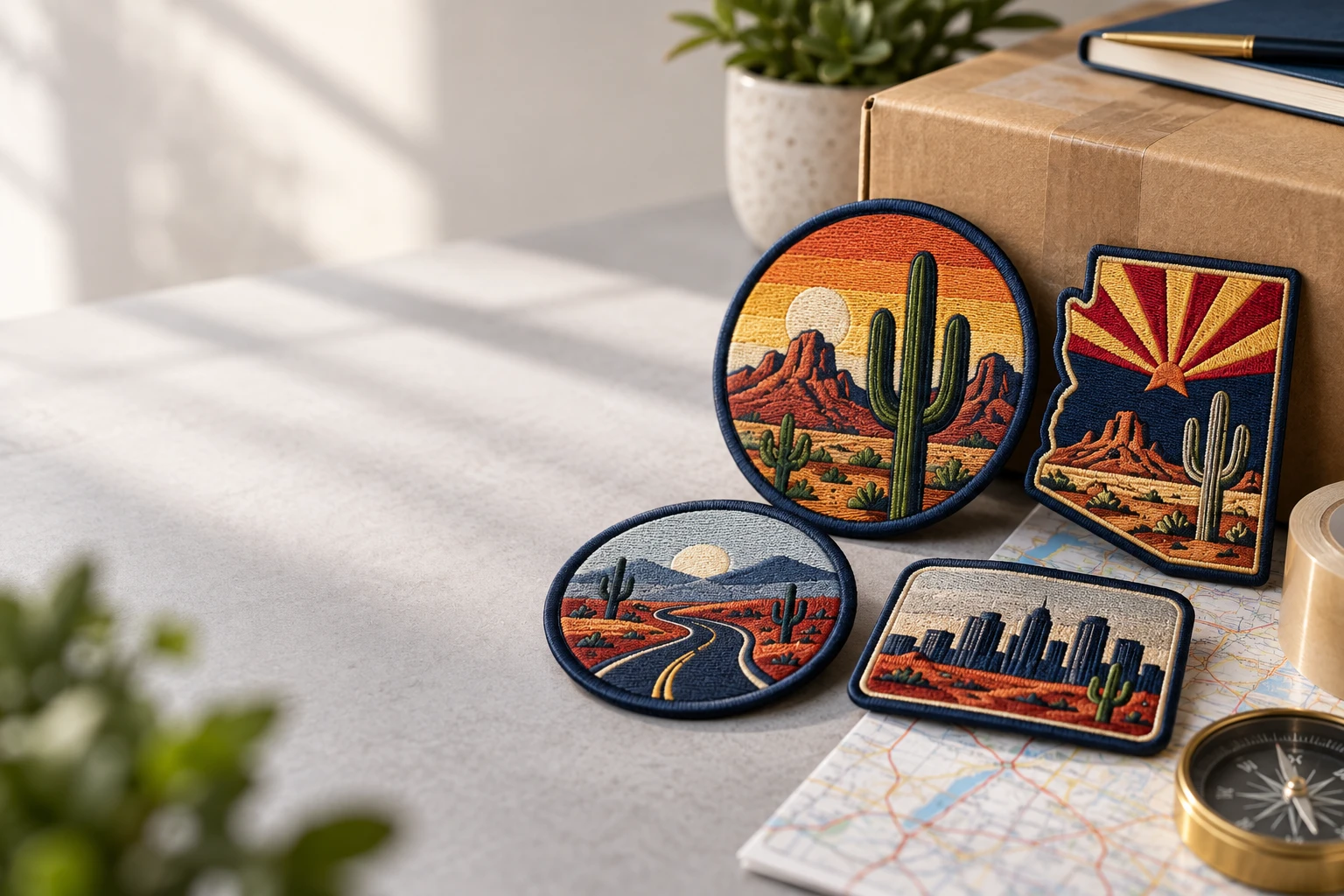
For custom embroidered patches Phoenix teams need by a fixed date, allow several weeks for planning, then confirm the actual schedule on the quote. Arrival includes artwork approval, production, and shipping from Corona, CA—not shipping alone. That planning allowance is not a published turnaround guarantee; the design, quantity, approval date, and selected carrier service determine the order-specific estimate.
GetUSAPatches has a 10-piece minimum and provides a free digital mockup before production. We produce only after approval and ship to all 50 states in the United States. If your Phoenix event is close, send the deadline with the artwork so feasibility can be checked before you commit to a patch construction or delivery service.
Planning Custom Embroidered Patches for Phoenix: Count the Whole Job
The first question at the production desk is not just “What day is the event?” It is “What day do the loose patches need to be in your hands?” A Friday football game may require delivery the previous week if someone still has to sew crests onto warm-up jackets, sort sizes, and get everything back to the equipment room.
Use this sequence: artwork and specification approval, production, outbound shipping, receiving, then attachment or distribution. Some tasks can overlap, such as reserving a sewing appointment while artwork is reviewed. Production itself does not start while the design is still being debated.
- Event date: when the team, staff, riders, or customers must have the finished item.
- Garment-ready date: when sewing, pressing, inspection, and sorting must be complete.
- Patch receipt date: when the shipment needs to reach the person handling attachment.
- Target ship date: the dispatch date needed for the quoted transit estimate and your chosen buffer.
- Approval deadline: the date final artwork and order details must be approved to support the proposed production schedule.
That distinction matters for high-school sports teams and hospitality uniforms alike. A box arriving at a Phoenix front desk on Thursday afternoon is not the same as 80 patched polos being ready for a Friday morning shift. Tell us which outcome you need, and keep the local decorator's schedule in the same calendar.
What Happens Between Your Artwork and the Delivery Truck?
A custom patch is not a stock item waiting for an address label. Artwork has to work at the requested size, embroidery needs a stitch plan, and the finished pieces need the agreed border and backing. The schedule should account for those operations rather than borrowing a delivery estimate from an unrelated order.
The table below separates the stages that buyers often combine into one number. It is a scheduling comparison, not a promise that every stage takes a fixed number of days. Ask for current timing on your actual design and quantity.
| Stage | What must happen | What can change the timing | What to confirm |
|---|---|---|---|
| Artwork and specifications | Size, lettering, colors, shape, border, and backing are reviewed. | Missing dimensions, unclear logos, multiple decision-makers, or garment changes. | Who gives final approval and which version is final. |
| Digital mockup approval | The buyer checks the proposed appearance and accompanying order details. | New wording, revised colors, or a switch from a sleeve patch to a cap patch. | Written approval of the final design and specifications. |
| Production scheduling | The approved order is placed into the applicable production schedule. | Current capacity, quantity, material requirements, and order-release conditions. | The production start conditions and expected ship date. |
| Embroidery and finishing | Patches are stitched, edged, backed, checked, and packed. | Large stitched areas, specialty construction, separate designs, or required corrections. | Whether the quoted timing covers the complete finished patch. |
| Carrier transit | The parcel moves from Corona, CA, to the Phoenix delivery address. | Shipping service, pickup cutoff, holidays, routing, and delivery exceptions. | The service name and destination-specific transit estimate. |
| Local attachment | A decorator or team member attaches patches to garments. | Sewing capacity, garment access, pressing tests, and sorting requirements. | The installer appointment and finished-garment handoff date. |
GetUSAPatches supplies the free digital mockup before production, but a digital approval is not a physical stitch-out in your hand. If your organization needs a physical sample, ask whether it is available and what it adds to the schedule and cost. Do not assume sample shipping is already included in a standard quote.
Does Shipping from Corona, CA, Make Phoenix Delivery Faster?
Corona and Phoenix are in neighboring states, which makes regional shipping worth checking before paying for an upgraded service. Distance alone still does not establish a delivery commitment. The carrier, service, pickup date, ZIP code, and current operating conditions control the transit estimate.
Ask for the ground estimate and the available expedited estimate for the same ready-to-ship date. If they support the same practical receipt deadline, the higher shipping charge may buy little benefit. If the order is not finished until after a carrier pickup cutoff, paying for faster transit does not recover that missed pickup.
Business days, receiving hours, and Phoenix time
Check whether each quoted stage uses business days or calendar days. Weekends, holidays, and service-specific delivery rules can change the calendar result even when the stated day count sounds short. For a school, municipal facility, or warehouse, include receiving hours and any closure dates with the address.
Phoenix does not observe daylight saving time, while Corona does. The cities share the same clock time during California's daylight saving period, but Phoenix is one hour ahead during California's standard time. If an approval or pickup cutoff is close, confirm which local time the quote uses rather than assuming “by 3 p.m.” means the same thing to everyone.
Use a complete street address, suite or department, contact name, and phone number. A downtown hotel may route packages through a receiving room instead of the guest desk, and a campus may have one central delivery location. Those last few yards can matter more than the highway distance.
Artwork Decisions That Keep Approval from Dragging On
Clean artwork helps, but a production-ready decision matters just as much. A sharp logo file does not tell us whether you want a 3-inch sleeve crest or a 10-inch vest back. Send the intended width and height in inches, the garment, the quantity, and the required receipt date together.
Small lettering is a common revision point on embroidered patches. As a rough design starting point, letters around 0.25 inch tall are easier to assess for thread reproduction than tiny legal lines or condensed slogans, but the font and stitch construction still need review. A mockup should not be treated as proof that every fine line will sew exactly like a screen graphic.
- Send a vector file when available, or the clearest original image you have. A blurry screenshot leaves more interpretation than a clean source file.
- Write all wording separately in the brief, including punctuation, unit numbers, school names, and chapter locations.
- Identify the one person authorized to approve the order. Collect committee feedback before that person sends a final response.
- State whether colors are general preferences or must follow a brand reference. Screen appearance alone is not a reliable physical thread match.
- Separate distinct designs and size variants in the quantity list. Do not assume one total quantity covers every variation under identical terms.
For fire and public-safety units, verify the approved insignia and exact department wording before the first proof goes around. For a club run, settle the chapter name and rocker dimensions before members vote on thread shades. One complete revision is easier to manage than five emails that contradict each other.
Choose the Patch Construction Before You Choose the Rush Option
Embroidery works well for bold school letters, recognizable crests, business logos, and club artwork that benefits from visible thread texture. It is less forgiving of miniature text, soft gradients, and crowded illustrations. Removing unnecessary detail can improve the patch and shorten the approval conversation, although it does not automatically create an earlier production slot.
If detail is doing the heavy lifting, compare woven patches and printed patches before locking the design. Woven construction can hold finer detail than conventional embroidery, while printed is flatter; that is the point. Neither option should be called faster without checking its own current production schedule.
| Specification | Useful application | Trade-off | Schedule question |
|---|---|---|---|
| Standard embroidery | Bold crests on polos, work shirts, jackets, and club garments. | Thread texture can crowd small text and fine gaps. | Does the artwork need simplification before approval? |
| Woven construction | Detailed badges and smaller lettering on brand merchandise. | A flatter surface gives up some raised embroidered texture. | What is the current lead time for this construction? |
| Printed construction | Gradients, illustrations, and detailed promotional artwork. | The image is printed rather than formed from raised embroidery stitches. | Can the chosen print construction meet the same receipt deadline? |
| Merrowed border | Traditional crests with a thick wrapped edge. | Tight internal corners and complicated outlines may need another edge treatment. | Is the shape suitable without an artwork revision? |
| Heat-cut or other suitable cut edge | Detailed outlines that do not suit a conventional wrapped border. | The perimeter has a different appearance from a merrowed crest. | Which edge treatment is included in the approved specification? |
| Hook-and-loop backing | Removable identification on compatible garment or equipment panels. | It adds thickness and requires the correct mating surface. | Does the order include the hook side only or a matching loop piece too? |
Large stitched fields, metallic thread, and raised effects should be named in the original request. 3D embroidered patches need artwork suited to the raised construction; converting a fine-line crest at the last minute is not just a backing change. The broader Embroidered vs. Woven vs. PVC Patches: Which Should You Choose? guide can help narrow the material before you request timing.
Match the Backing to the Garment, Not Just the Deadline
A patch arriving early does not help if the chosen backing will not work on the garment. We would rather see the jacket or cap specification at quote time than hear later that a heat-sensitive shell was ordered with an unsuitable attachment plan. Sew-on, iron-on, and hook-and-loop each solve a different problem.
An iron-on that peels after a dryer cycle is a familiar failure when fabric compatibility, pressing conditions, or care instructions were ignored. An adhesive backing is not permission to press every textile at one universal temperature. Follow the supplied application instructions and the garment manufacturer's restrictions, then test before committing the whole batch.
Nylon shells and public-safety outerwear
Nylon shells may have coatings, linings, or heat restrictions that make direct ironing unsuitable. Sewing may be the practical route, but stitches can affect a weather-resistant garment and may require guidance from its manufacturer or decorator. Do not press or sew protective clothing in a way that conflicts with its approved care and modification requirements.
For existing Velcro panels, measure the actual receiving area and confirm the mating sides. A 3.5-inch patch does not belong on a 3-inch-wide panel just because both are called sleeve patches. The Velcro® attachment guide explains the hook-and-loop relationship without treating every uniform as identical.
Wool jackets, biker vests, and hospitality polos
Wool coaches' jackets and letterman jackets need an attachment plan that accounts for lining access, placement, and the finished appearance. If the design is a large varsity letter rather than a detailed crest, chenille patches may be the more suitable choice. Confirm that construction early because changing materials changes the quote.
For biker and motorcycle club patches, check pockets, seams, and liner access before scheduling the sewing. Hospitality polos bring another issue: a dense patch can pull or stiffen lightweight knit fabric. Use the actual shirt fabric and placement area to decide size, rather than copying dimensions from a heavy work jacket.
Caps need their own check, too. A tall crest may bridge the crown seam or fight the curve of a structured front, so review the usable area before ordering hat patches. Your decorator's test and the garment shape are more useful than a flat artwork preview alone.
How to Order Around a Phoenix Deadline
Put the deadline near the top of the request, not in a follow-up after the price has been accepted. Include both the event date and the earlier date when you need loose patches delivered. That lets production timing, shipping, and attachment be evaluated as one job.
A useful brief could read: “60 embroidered crests, 3 inches wide, sew-on, for navy hospitality polos. Deliver to our Phoenix office by the requested date; the decorator needs three business days after receipt.” That is far easier to schedule than “Need patches soon,” and it avoids spending the first exchange collecting basic details.
- Set the receipt deadline. Work backward from the event through local sewing, inspection, sorting, and handoff. Ask the installer for its actual availability rather than assuming attachment happens the day the box arrives.
- Send the design and garment details. Include dimensions in inches, quantity, separate versions, backing, border preference, and any color references. Mention specialty thread or raised embroidery now.
- Provide the complete destination. Include the Phoenix ZIP code, suite or department, contact person, receiving hours, and any known closure. State whether the shipment is going to your office or directly to the decorator.
- Ask for a written schedule. Separate production timing from carrier transit, and ask which approvals, payment steps, or other order-release requirements must be completed before the clock starts.
- Review the free digital mockup. Check spelling, proportions, colors, and the stated specifications at the actual intended size. A screen zoom can hide that lettering will be very small on the finished patch.
- Approve one final version. Make sure the approved artwork and order details agree on size, backing, border, quantity, and variants. GetUSAPatches produces only after approval.
- Confirm dispatch and receiving arrangements. Review the expected ship date and shipping service, then follow the carrier tracking after handoff. Tell the decorator if the estimated arrival changes.
What a rush request can—and cannot—change
Ask about production and shipping separately. A production rush, if available for the order, addresses the manufacturing schedule; expedited shipping addresses the trip after dispatch. Neither removes the need for approval, and neither should be assumed available until the quote confirms it.
For a tight date, send the artwork immediately and stay available for questions. An unanswered backing question can consume the same day you hoped to save with upgraded shipping. If the schedule is not workable, it is better to know before approval than to build an event plan around an unsupported promise.
Two Calendar Examples: Why the Approval Date Matters
The examples below use hypothetical day counts to show the scheduling math. They are not GetUSAPatches standard lead times, current carrier estimates, or rush offers. Replace every assumed interval with the timing on your actual quote.
Suppose an approved order is quoted at 10 business days for production and two business days for shipping. That creates a 12-business-day path after the required release conditions are complete, before any local sewing. If the installer needs another three business days, your usable planning path becomes 15 business days, plus whatever buffer you choose.
Example one: a school crest with a ready decision-maker
The equipment manager sends the school crest, final wording, 3-inch width, sew-on backing, quantity, and a complete delivery address in one request. One person reviews the mockup and returns a complete approval. The production schedule can then be confirmed against a clear design rather than a chain of unresolved choices.
The school reserves the jacket sewing appointment separately and leaves room to inspect the shipment first. Nothing about the patch has become magically faster. The difference is that avoidable waiting has been removed from the front of the job.
Example two: a club back patch with late changes
A riding club approves a layout, then asks to enlarge the back patch and change the lower rocker wording before production release. Those changes need a revised review, and the previous schedule must be checked again. The original inquiry date does not hold the production clock in place while specifications change.
The same problem occurs when a business approves a polo crest and later switches to a narrow cap panel. The new placement may require a different size, simplified lettering, and another mockup. The deadline advice in Need Biker Patches by a Deadline? Tips for Los Angeles Veteran Riders is also useful for Phoenix clubs managing member approvals and local sewing.
Compare the Total Cost, Not Just the Patch Price
A useful quote separates the patch cost from shipping and any optional services. Size, quantity, stitched coverage, backing, border, and specialty construction can affect the price. There is no reliable universal dollar amount for a Phoenix order without those details.
For the budget, compare the total delivered cost in USD, then add local attachment if someone else is doing it. A lower patch unit price can lose its advantage if the order requires expensive delivery upgrades or an emergency sewing appointment. The custom patch pricing guide explains the main specifications that change a quote.
- Confirm what the quoted unit price includes: patch construction, border, backing, and any specified variants.
- Ask whether digitizing, specialty thread, physical sampling, or other optional services carry separate charges.
- Request shipping as a separate line so ground and expedited options can be compared fairly.
- Ask about rush charges only after production feasibility has been checked for the actual artwork and quantity.
- Include applicable taxes and the decorator's attachment charge when comparing the full project budget.
GetUSAPatches has a 10-piece minimum, which gives small teams and businesses a starting point without requiring a large launch run. A small order still needs artwork review, production scheduling, and finishing; it is not automatically a same-day job. For several designs, ask how the minimum and pricing apply to each version before dividing the total among them.
Inspect the Shipment Before the Sewing Appointment
Open the box when it arrives, not on the morning of the event. Count the pieces and check the design, dimensions, border, backing, and obvious workmanship against the approved order. If anything appears wrong, photograph it and contact GetUSAPatches promptly before attaching the patches.
Lay one patch on the actual garment at the intended position before the installer starts the batch. A crest can be the correct size and still sit too close to a zipper, pocket opening, or cap seam. This is the last useful moment to catch a placement problem without removing stitches from finished garments.
For sew-on work, use How to Sew On a Patch: A Step-by-Step Guide alongside your decorator's garment-specific advice. For suitable heat-compatible garments, review How to Iron On a Patch the Right Way and the supplied application instructions. Neither method should override the garment's care label.
Keep the approved artwork, dimensions, backing details, and order reference for the next run. A repeat order can reduce design discussion when nothing has changed, but current capacity and shipping still need confirmation. The practical goal is simple: approve a patch that fits the garment, establish a realistic receipt date, and leave enough time to turn a delivered box into finished uniforms or merchandise.