
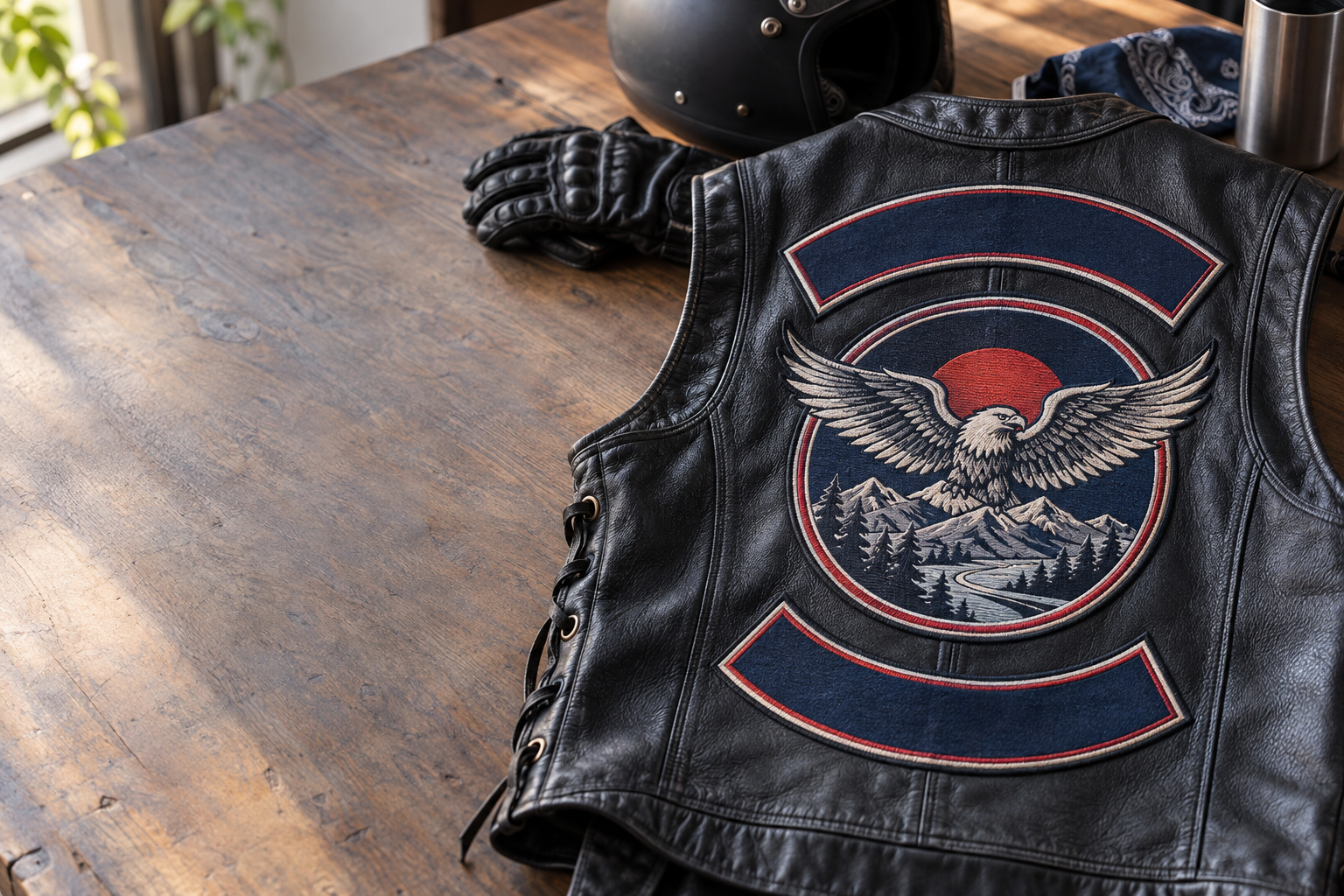
For custom biker patches Los Angeles veteran riders need by a deadline, start with the date the finished vests must be ready, then work backward through sewing, delivery, production, and artwork approval. Send the design, quantity, dimensions, backing, and delivery ZIP code together so the quote can address the actual schedule.
GetUSAPatches has a 10-piece minimum and provides a free digital mockup before production; we produce only after approval. We ship from Corona, CA, to all 50 states across the United States. A nearby Los Angeles address helps define the shipping route, but it does not remove production time or make an unconfirmed arrival date a promise.
Start with the day the vest needs to be ready
A Saturday memorial ride does not mean Friday afternoon is a sensible patch delivery target. Someone still has to open the carton, count the pieces, check the spelling, and get them attached. If twelve riders use three different sewing shops, the attachment schedule can be harder to coordinate than the shipment.
On a production desk, the useful question is simple: what happens after the box arrives? Loose commemorative patches handed out at registration have one deadline. A matching set sewn onto every leather vest for a Friday group photograph has an earlier one. Put that distinction in the first quote request.
- Event date: the ride, reunion, fundraiser, or presentation itself.
- Garment-ready date: when every participating rider needs an attached and inspected patch.
- Required delivery date: when the package must arrive to leave room for inspection and sewing.
- Approval target: the date artwork must be finalized to support the quoted production schedule.
- Contingency: extra calendar room for a revision, shipping disruption, or unavailable sewing appointment.
Do not assume a rush request can recover time spent waiting for committee approval. The approval clock is part of the order, even though it is not machine time. Our Custom Patch Production Timeline: From Artwork to Delivery explains why those stages should be discussed separately rather than rolled into one vague turnaround number.
Specify custom biker patches Los Angeles riders can actually wear
A patch can look balanced on a screen and still crowd a vest. Start with the smallest relevant garment, not the largest rider's back panel. Lay the vest flat and measure between seams, then check existing insignia, belt adjustment tabs, and any curved shoulder area that could distort a wide design.
For an initial paper test, you might try a 3-inch chest patch or a 10-inch-wide back design. Those are planning examples, not required biker sizes. Print or cut the shape at actual size and place it on the garment; a wide rectangle and a circle with the same width occupy very different amounts of usable space.
Count pieces, designs, and complete sets separately
A three-piece arrangement for 20 riders means 60 physical patches, not 20. It can also mean three separate designs, each with its own dimensions and production setup. Ask how minimums apply to each design or variation rather than assuming the 10-piece minimum can be divided across unrelated artwork or individual names.
Write the full bill of materials: top rocker, center emblem, bottom rocker, optional name strip, and any event patch. Keep those quantities separate from spare pieces. The Biker Vest Patches: Sizes, Styles and How to Design a Club Set guide is useful for planning the layout before the club votes on a finished drawing.
- State finished width and height in inches for every component, including borders.
- Identify the garment: leather vest, denim cut, textile motorcycle jacket, nylon shell, cap, or display jacket.
- Provide quantities by exact design and size, with personalized wording listed separately.
- Include a placement photo showing pockets, seams, existing patches, and available attachment space.
- Confirm whether riders need identical sets or different layouts for different garment sizes.
Make the artwork readable before asking for speed
The quickest approval is not necessarily the first proof sent back with an enthusiastic yes. It is the proof that has been checked carefully enough to avoid a correction after production starts. Memorial names, chapter wording, service dates, and ride years deserve a separate review by someone who was not responsible for typing them.
Embroidery builds a design from stitches. A thin line in a screenshot may need more width, and tightly spaced lettering may need more room. Enlarging the patch, simplifying the emblem, or moving secondary wording to a separate rocker can solve the problem without forcing tiny details into a construction that cannot represent them clearly.
Give the production team usable source material
Send vector artwork if you have it, or the clearest original image available. A screenshot of a screenshot leaves everyone guessing at small shapes and letter edges. Consult the Artwork File Guide for Custom Patches: Vector, PNG, JPG and More before exporting, and include the wording as plain text alongside the image.
For veteran riding groups, confirm the exact insignia and permissions rather than substituting a similar-looking symbol. Do not assume an emblem found online is approved for the group's use. Club officers should also approve rocker wording and the overall arrangement before the design reaches production; the manufacturer should not be deciding those matters for the riders.
- Read every name and date against the source list, not from memory.
- Review the design at its intended physical size, not only zoomed in on a phone.
- Separate required details from details that can be simplified if they crowd the design.
- Supply color references where consistency matters; a screen preview is not a physical thread sample.
- Name one final approver so comments from several riders become one clear revision request.
Choose the patch construction before locking the deadline
For a traditional vest emblem with bold lettering and visible stitch texture, embroidered patches are a practical starting point. They suit many club crests and commemorative designs. Dense stitching adds body, though, so a large fully stitched patch may feel noticeably stiffer than a smaller design with exposed background fabric.
Fine lettering can point toward woven patches, while shaded portraits or detailed illustrations may be better candidates for printed patches. Printed is flatter; that is the point. Choosing it to preserve artwork is sensible, but choosing it solely because someone assumes it must arrive faster is not a scheduling plan.
| Construction | Useful biker application | Main trade-off | Deadline question to ask |
|---|---|---|---|
| Embroidered | Bold club emblems, rockers, service-themed crests, and traditional vest patches. | Visible thread texture and body; small text and fine gaps need careful review. | Can this design run clearly at the requested size, or will artwork need revision? |
| Woven | Compact lettering, intricate linework, and smaller commemorative patches. | Flatter than embroidery, without the same raised stitch character. | Does the current woven production schedule fit the required arrival date? |
| Printed | Portraits, shading, multicolor illustrations, and event artwork. | Keeps image detail but does not reproduce embroidered texture. | What print construction, edge finish, and backing are included in this quote? |
| PVC | Flexible relief designs for compatible hook-and-loop panels or selected gear. | Molded construction changes the feel and may introduce tooling requirements. | What tooling and approval stages apply before production can proceed? |
| Leather | Restrained cap branding, small labels, and designs suited to the chosen marking method. | Fine detail, contrast, and care depend on the material and finish. | Is the requested material and marking method available within this schedule? |
Match the border to the actual outline
A merrowed edge gives a rounded, wrapped finish that works well on many simple shapes. Merrowed crests are familiar on uniforms and club garments, but tight inside corners and intricate silhouettes may call for a cut edge. The artwork should show the finished outline, not leave the border decision until the last email.
Raised effects are another separate decision. 3D embroidered patches can suit broad, simple forms, but small memorial text is not a reason to add puff. Compare the physical result you want using Embroidered vs. Woven vs. PVC Patches: Which Should You Choose?, then ask about current availability for that construction.
Pick backing for the garment, not for the fastest installation
Sew-on is generally the practical starting point for leather and denim riding vests. A qualified sewing shop can assess the leather thickness, lining access, and needle requirements before committing to the job. Ask the shop to confirm placement too; stitching through a useful pocket is an avoidable mistake that a patch proof will not catch.
Iron-on looks convenient until heat meets the wrong material. Leather finishes, nylon shells, coated textiles, and laminated riding gear may not tolerate the application conditions. An iron-on that peels after a dryer cycle can reflect an unsuitable garment, incomplete bonding, or care conditions outside the adhesive's limits; extra heat is not a universal remedy.
Existing Velcro panels need a matching plan
For garments with Velcro panels, specify hook-and-loop backing and confirm which side is supplied. A hook-backed patch needs a compatible loop surface; bare denim does not become a mounting panel by itself. Measure the actual panel because an oversized patch can leave scratchy hook material exposed around the edges.
The garment questions change across orders. Hospitality polos need attention to drape, high-school team nylon shells need heat caution, and wool coaches' jackets or letterman jackets need different handling from thick leather vests. Those are attachment decisions, not just decoration preferences, and they belong in the quote before anyone selects backing.
- Leather vest: discuss sew-on with a shop equipped for leather; do not assume heat application is suitable.
- Denim vest: sew-on is a straightforward starting point, but inspect pockets and lining before stitching.
- Textile motorcycle jacket: consult garment guidance before adding heat or needle holes that could affect its construction.
- Existing loop panel: specify a matching hook-backed patch and confirm panel dimensions.
- Cap or beanie: review curvature and placement separately rather than shrinking a back patch without an artwork check.
For a closer comparison, use Patch Backing Options Explained: Sew-On, Iron-On, Velcro® & More. If the order includes a cap for each rider, quote the hat patches separately from the vest pieces. The same emblem may need different dimensions, detail, and attachment on those two garments.
Read the quote as a complete job, not a unit-price contest
A low per-patch figure means little if one quote includes the full three-piece set and another includes only the center emblem. Compare matching quantities, dimensions, construction, borders, backing, and delivery requirements. Ask for the order total in USD and identify shipping, applicable tax, setup, and any approved rush charges rather than guessing what is included.
Size, stitch coverage, construction, quantity, and design variations can all affect cost. More pieces of one design may reduce its unit cost, but buying surplus stock only makes sense if the group can use it. A dated reunion patch has a shorter useful ordering window than a standing club crest.
Separate personalization from the main club run
Twenty identical center patches and twenty different name strips are not equivalent production tasks. Send a spreadsheet or clean text list for personalized wording and ask how each variation affects pricing and minimums. Do not let one late nickname hold up artwork that is otherwise ready unless the entire order truly must remain together.
For simple budget math, if a hypothetical patch order totals $300 and the sewing shop quotes another $100, the group needs $400 before any other applicable costs. That is an arithmetic example, not GetUSAPatches pricing. Use How Much Do Custom Patches Cost? What Drives the Price to build a fair comparison before collecting money from riders.
Place the order around a confirmed approval and shipping plan
There is no responsible universal arrival promise for an unseen design. Construction, quantity, artwork readiness, current production capacity, and shipping service all matter. Ask for a written estimate tied to the actual specification, and clarify whether the stated turnaround ends at shipment or arrival at the destination.
GetUSAPatches provides a free digital mockup before production and produces only after approval. That approval should cover the artwork and the written order specification, including size, backing, quantity, and border. A digital mockup helps verify the plan; it does not let you physically feel stiffness, thread texture, or adhesive performance.
- Send one complete brief with artwork, garment details, dimensions, quantities, backing, deadline, and delivery ZIP code.
- Review the proposed construction and quote, including any deadline-dependent production or shipping options.
- Check the free digital mockup against a written spelling list and an actual-size placement test.
- Consolidate revisions through one authorized club contact instead of sending conflicting messages from several riders.
- Approve the final artwork and order details in writing; confirm any required payment steps and the resulting production schedule.
- Track delivery, inspect the patches promptly, and keep the sewing appointment separate from the carrier's arrival estimate.
Local shipping is still shipping
Orders ship from Corona, CA, and GetUSAPatches ships to all 50 states. A Los Angeles delivery should still be planned around the carrier, service level, address, weekends, and any holiday interruptions. Do not plan around pickup, same-day service, or a particular arrival window unless that arrangement has been explicitly confirmed.
Ask whether each timeline is expressed in business days or calendar days. Then ask what happens if approval moves by a day or two. Faster transit does not shorten embroidery time, and a rush production option, if available for the order, does not automatically include faster shipping.
Groups coordinating service-themed reunions can also use How Long Do Custom Military Patches Take to Arrive in Los Angeles, CA? to frame the scheduling questions. The useful comparison is between confirmed plans for your order, not unrelated delivery claims for different materials or quantities.
Three deadline situations that need different decisions
A memorial ride with a fixed date
Consider a hypothetical group ordering 30 commemorative patches for a Saturday memorial ride. If the patches will be handed out loose, the main tasks after delivery are inspection and packing. If every patch must be attached before the opening photograph, the organizer needs a separate garment collection and sewing plan.
Protect the details that matter most: the person's name, the date, the approved tribute wording, and a readable emblem. If the full illustration does not suit the available size, discuss simplification or a different construction before approval. Do not change the tribute wording just to make a rushed layout fit.
A new club set with several reviewers
A hypothetical 18-rider club ordering three-piece sets has 54 patches to account for before adding spares or name strips. The biggest schedule risk may be agreement on the design, not the quantity itself. Set a feedback cutoff and have one officer return a consolidated revision list.
Approve the full layout on a representative vest, but review each component's dimensions independently. A rocker that looks right above the center emblem may still need a different curve. The broader biker and motorcycle club patches hub is a useful starting point for defining which components belong in the order.
Replacement patches for riders joining late
A replacement run benefits from a saved specification: finished size, thread references, border, backing, artwork version, and previous order identification. Send clear photos of an unworn reference patch if one exists. A sun-faded vest patch is useful for identification but is not a dependable color target for a fresh production run.
GetUSAPatches has a 10-piece minimum, so ask how that applies before assuming a single replacement can be produced. A modest reserve of an evergreen club emblem may be useful for new members or damaged garments. Keep dated ride patches separate so the reorder discussion does not accidentally mix versions.
Inspect the delivery before anybody starts sewing
Open the shipment promptly and compare it with the approved order. Count each component separately, then check dimensions, wording, colors, backing, and the overall edge finish. For a multi-piece set, arrange one complete set on a flat surface so a missing rocker or mismatched version is easy to spot.
Photograph a concern clearly and contact the production team before attaching or altering the affected pieces. Do not try to repair a questionable edge or cut a loose-looking thread without first checking what you are seeing. Clear photos, the order reference, and a precise description are more useful than a message saying the patches look wrong.
- Sort complete rider sets into labeled envelopes or bags after inspection.
- Keep personalized strips with the correct rider's set and check their spelling again.
- Give the sewing shop an approved placement photo and measured spacing where consistency matters.
- Ask the installer to check pocket function, lining access, and rider comfort before stitching.
- Retain the final artwork and specification for future orders rather than relying on phone photos.
For ordinary sew-on work, How to Sew On a Patch: A Step-by-Step Guide covers the basic process. Thick leather, inaccessible linings, and specialized riding garments can justify professional installation. A good patch does not compensate for a crooked placement or a seam sewn through the wrong layer.
Care for the finished vest and save a usable reorder record
The garment's care instructions come first. A patch attached to leather should not send the whole vest into a washing machine, and a removable patch should be handled according to its own construction. Heat, abrasion, cleaners, and drying methods can affect the garment and patch differently.
Use How to Wash and Care for Patches as a starting point, then account for the actual garment. For hook-and-loop pieces, inspect the attachment periodically and remove debris that interferes with engagement. For sewn pieces, check the attachment stitches without pulling at the border.
Save the order in a folder a future club officer can understand. Include the final approved artwork, dimensions in inches, backing, construction, quantities, and approval contact. Fire and public-safety units, school teams, and riding clubs all benefit from the same discipline: the next person should not have to reconstruct the specification from a faded patch.
- Quote subject: veteran rider patch order, quantity, and required arrival date.
- Artwork: original file plus confirmed wording, names, dates, and permission to reproduce the design.
- Specification: finished dimensions, construction, border, backing, and quantities by component.
- Garment: material, placement photo, and any existing loop panel or attachment restrictions.
- Schedule: event date, garment-ready date, delivery ZIP code, and the final approver's contact.
- Budget: requested USD order total with shipping and any applicable additional charges identified.
That is the information that turns a deadline question into a workable quote. Keep the design readable, choose attachment for the garment, and leave time after delivery for the hands-on work. The box arriving is one milestone; the riders being ready is the real finish.