
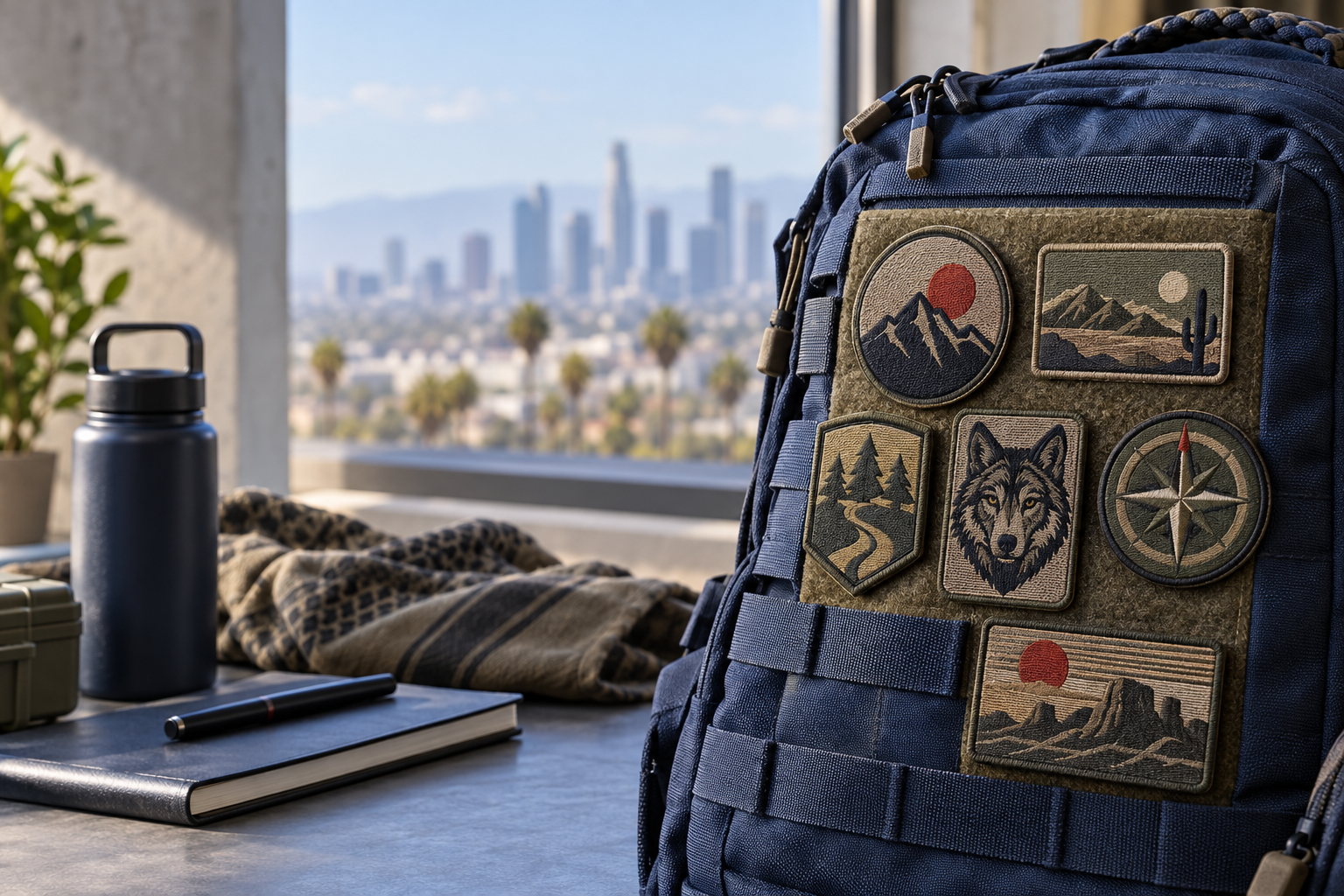
For custom military patches Los Angeles teams order, arrival time is the approved production schedule plus carrier transit from Corona, CA—not just the drive between the two cities. GetUSAPatches confirms timing against your artwork, quantity, construction, and delivery ZIP code. Do not treat a general turnaround estimate as a confirmed arrival date.
GetUSAPatches has a 10-piece minimum and provides a free digital mockup before production. We produce only after approval and ship from Corona, CA, to all 50 states in the United States. If your patches need to be on uniforms for a reunion, training weekend, or presentation, include time for receiving and attachment as well as manufacturing.
What determines the arrival date for custom military patches in Los Angeles?
There are several clocks running on a custom order, and they do not all start together. The first inquiry starts the conversation. Production approval establishes that the design and specifications are ready to make, subject to the scheduling and order requirements confirmed in your quote.
A useful delivery estimate names the starting point. Does the production period begin after final artwork approval, after all order requirements are complete, or on a scheduled production date? Ask that question before comparing two quotes that both appear to promise the same number of days.
- Artwork and specification review: time to resolve size, lettering, colors, borders, backing, and design variations.
- Customer approval: time for your authorized contact to review the free digital mockup and return consolidated corrections or approval.
- Production and inspection: the quoted manufacturing period for the actual patch construction and quantity.
- Carrier transit: the estimated movement from Corona, CA, to the Los Angeles delivery address after carrier acceptance.
- Receiving and installation: time to count the shipment, sort sets, sew patches onto garments, or distribute them to members.
The practical formula is straightforward: preproduction review plus the confirmed production period plus shipping plus your own handling time. Some factory tasks may overlap, so do not add an extra inspection period if the quote already includes it. What matters is that every stage has an owner and a clear place on the calendar.
An example calculation—not a published turnaround promise
Suppose a written quote allowed 10 business days for production and inspection after approval, followed by two business days of carrier transit. That example would require 12 business days after approval, before any receiving buffer. If your committee spent another three business days approving the artwork, the inquiry-to-arrival calculation would become 15 business days.
Those numbers illustrate the math; they are not GetUSAPatches service commitments or a statement of current availability. Weekends and holidays also matter when a schedule is expressed in business days. For a broader explanation of these stages, see the Custom Patch Production Timeline: From Artwork to Delivery.
Corona to Los Angeles: nearby shipping still needs a real transit estimate
Corona and Los Angeles are both in Southern California, but a parcel moves through a carrier network rather than following your personal driving route. Pickup timing, sorting, service level, and the destination ZIP code all affect delivery. A short geographic distance does not establish next-day service.
Separate the ship date from the arrival date on your purchase order. A ship date describes when the order is expected to leave; an arrival date describes when you expect to receive it. If someone says the patches will be ready Friday, ask whether that means production complete, carrier pickup, or delivery at your door.
Give the address details before the order is scheduled
A Los Angeles apartment, a staffed business, and a secured receiving facility can have different delivery requirements. Include the suite number, receiving contact, business hours, and any access instructions the carrier needs. For a reunion at a hotel, check that the property accepts packages for your group and how it wants them addressed.
- Use the final destination ZIP code when requesting transit options; do not substitute a nearby city.
- Identify a receiving cutoff if the site closes early or accepts deliveries only on certain days.
- Ask what shipping service the estimate uses and whether its arrival window is estimated or specifically guaranteed by the carrier.
- Do not assume local pickup, courier delivery, Saturday delivery, or a split shipment is available; ask before building the schedule around it.
- If members are spread across the country, distinguish delivery to one organizer from delivery to multiple individual addresses.
GetUSAPatches ships to all 50 states, but a Los Angeles estimate should not be reused for every United States destination. Alaska, Hawaii, and other shipping addresses need their own service check. A reunion organizer who receives one carton and mails individual sets also needs to budget for that second distribution step.
Artwork approval is often the part you can control
An unfinished design cannot be rescued by a nearby shipping address. Small lettering, an unclear unit crest, or three competing color references can keep an order in review. Before sending the brief, decide who has final authority over spelling, artwork, and the finished dimensions.
A free digital mockup is the place to catch the wrong year, reversed orientation, or missing rocker—not after a carton arrives. We produce only after approval. A late artwork change may require another review and a revised schedule, especially if the change affects size, construction, or backing.
Send useful artwork, not just a larger attachment
A clean vector file is useful when available, but an organized brief matters too. If the only reference is a photograph of an old patch, photograph it straight on and include its measured dimensions. A larger file does not automatically reveal lettering that was blurred in the original image.
Label written text separately so there is no need to guess at an abbreviation or motto. Mention any details that must remain, and identify artwork you are authorized to reproduce. The Artwork File Guide for Custom Patches: Vector, PNG, JPG and More explains how to prepare common file types.
- Check every name, date, abbreviation, punctuation mark, and line of text against a written source.
- Confirm finished width and height in inches, including the border—not just the center artwork.
- Review orientation explicitly for directional emblems and flag designs rather than assuming the reference will be interpreted correctly.
- Identify the desired background and thread colors; distinguish a subdued palette from a full-color commemorative version.
- Confirm which details are essential and which can be simplified if they will not reproduce clearly at the requested size.
Screen approval is not the same as holding a physical sample. A digital mockup helps establish the agreed design and specifications, but thread texture, surface relief, and color under different lighting cannot be judged completely on a monitor. If you need a physical sample, ask about availability, cost, and its effect on the schedule before approving the order.
Choose the material, size, and backing before locking the schedule
The right patch construction starts with the artwork and the garment. A traditional shoulder crest on a uniform shirt has different requirements from a removable morale patch on a pack. Do not choose a material solely because someone assumes it will arrive faster; current production availability still needs confirmation.
For familiar stitched texture, embroidered patches are a sensible starting point. Dense detail may be better suited to woven patches, while printed patches can reproduce gradients and photographic artwork without turning everything into thread. Printed is flatter; that is the point.
| Construction or specification | Useful application | Trade-off to review | What to settle before approval |
|---|---|---|---|
| Embroidered patch | Traditional crests, bold insignia, reunion patches, and uniform identification | Raised thread gives texture, but fine lettering and narrow gaps may need simplification | Finished size, lettering, background fabric, thread colors, border, and backing |
| Woven patch | Detailed linework and compact designs with text that needs careful reproduction | Flatter than embroidery; still subject to practical limits at small sizes | Smallest text, line separation, finished dimensions, cut shape, and backing |
| Printed patch | Gradients, complex illustrations, and commemorative artwork | A flatter image-based appearance rather than traditional stitched relief | Image resolution, color expectations, dimensions, border treatment, and backing |
| PVC patch | Dimensional morale designs and wipe-clean surfaces for packs or outer gear | Different feel and flexibility from a textile patch; manufacturing requirements need a separate schedule check | Relief, thickness, color areas, shape, attachment method, and any tooling requirements |
| Hook-backed patch | Removable identification on an existing compatible loop panel | Needs the correct mating surface; hook backing alone does not attach properly to every garment | Hook side only or both sides, usable panel dimensions, and intended orientation |
| Sew-on patch | Long-term attachment on suitable uniform shirts, vests, and jackets | Requires sewing time and access to the garment; may pierce technical shell materials | Attachment area, garment construction, installer availability, and stitch clearance |
Measure the panel and leave room for the border
If an existing loop panel measures 3 inches by 2 inches, do not approve a 3.5-inch-wide patch and hope it will work. Measure the usable area, then check the entire finished patch against it. A paper cutout is enough to reveal interference with a pocket flap, seam, zipper, or curved cap front.
Merrowed crests have a familiar wrapped edge, but that edge uses space and is not the right answer for every sharp corner or tight internal cut. Review the Custom Patch Size Guide and Merrowed vs. Hot-Cut vs. Laser-Cut Borders before finalizing a complicated silhouette. Changing the edge late can change the appearance and require another approval.
Match the attachment to the actual garment
Nylon shells can be heat-sensitive, and waterproof constructions deserve a garment-specific attachment plan. Wool coaches' jackets and lined letterman jackets need a different installation discussion than hospitality polos. An iron-on that peels after a dryer cycle is not a shipping failure; it is often a compatibility, application, or care problem.
For existing Velcro panels, specify whether you need the hook side only or a matching loop piece as well. For caps, consider curvature and the available sewing area. The Patch Backing Options Explained guide helps compare these choices, but the final specification should name your garment rather than just saying universal backing.
Quantity, design variations, and price can change the plan
GetUSAPatches has a 10-piece minimum. That makes a small club or reunion order possible, but it does not mean ten patches are already sitting on a shelf. Each custom run still requires the approved design, the correct materials, and a place in the production schedule.
A larger quantity can affect the production plan, but ten pieces are not automatically faster than a hundred. Material availability, construction, and the current workload also matter. Ask for the schedule associated with your actual quantity rather than applying a timing claim from a different order.
One design with several versions is not always one simple run
A request for 60 pieces could mean 60 identical patches, or 20 full-color patches, 20 subdued patches, and 20 individually named patches. Those are different specifications. Separate each version in the brief and ask how minimums, setup, pricing, and scheduling apply to the configurations.
If a reunion roster is still changing, consider whether a shared commemorative design can be approved independently from personalized elements. That is a design decision, not a promise of split production. Avoid approving an incomplete name list simply to start the clock; replacing misspelled personalized pieces can defeat the original schedule.
- Request a quote in USD showing quantity, finished dimensions, construction, backing, and the artwork version.
- Ask whether any setup, tooling, sampling, or shipping charges apply and whether they are included in the total.
- If expedited production or shipping is being discussed, request its price and feasibility separately.
- Identify any planned overage for new members or replacements instead of assuming a later reorder will arrive immediately.
- Keep the approved specifications for reorders, while allowing the new run to receive its own schedule and price confirmation.
A $/piece comparison is incomplete if one quote includes backing and shipping while another does not. The lowest unit price also does little good if the order misses the installer appointment. Use How Much Do Custom Patches Cost? What Drives the Price to separate construction costs from the delivery decisions.
Build the deadline around the day the patches must be usable
An event date and a delivery deadline are not necessarily the same. If a veterans' group meets Saturday but the jackets go to a sewing shop Wednesday, Wednesday is already too late for first receipt unless the installer has agreed to that handoff. Work backward from the finished garment, not just from the carton.
The same problem shows up in high-school sports team orders, fire and public-safety uniform runs, and biker vests prepared for a club event. The patch may be correct and on time at the shipping address while the overall project is still late. Installation capacity and distribution need their own space on the calendar.
Three practical Los Angeles ordering scenarios
- Reunion handouts: A coordinator wants 75 identical commemorative patches to place in registration envelopes. Set receipt before the envelope assembly session, confirm the emblem and year with one approver, and leave time to count the shipment.
- Removable team patches: A group needs 30 hook-backed patches for existing loop panels. Measure every panel style in use, confirm whether members have different mounting sizes, and avoid assuming a cap panel matches a pack panel.
- Jacket presentation: A club orders 24 embroidered crests for wool jackets. Coordinate the finished patch size with the installer, identify lining access, and set the delivery target around the sewing appointment rather than the presentation ceremony.
Build a buffer that reflects the consequences of being late. A casual mail-out can tolerate more flexibility than a one-day ceremony with out-of-town attendees. There is no universal buffer that makes every project safe, but planning to receive the carton on the morning of the event leaves no useful recovery time.
For current uniform use, have the responsible unit or organization confirm the required design and wear specifications before approval. A morale patch or commemorative crest is not automatically suitable for a prescribed uniform position. The Custom Military and Morale Patches guide provides additional ordering context without replacing your organization's requirements.
How to order and confirm a realistic lead time
The fastest useful inquiry is a complete one. You do not need to know every manufacturing term, but you should know the destination, desired quantity, approximate size, and the date the patches must be in your hands. Send the event date too, so there is no confusion about which deadline is flexible.
Use one order brief and one approval contact whenever possible. Scattered corrections across email threads can create contradictions: one person approves black thread while another asks for charcoal. Consolidated feedback protects both the appearance and the schedule.
- Send the artwork and explain the use. Include a clear reference image, written text, and a photograph of the garment or mounting area if fit is uncertain.
- List quantity and specifications. State dimensions in inches, preferred patch style, backing, border, and any separate names or color versions.
- Provide the Los Angeles ZIP code and required receipt date. Include receiving restrictions and any installation appointment that occurs before the event.
- Review the written quote. Confirm what starts the production clock, whether days are business or calendar days, and which shipping service supports the estimate.
- Check the free digital mockup. Review spelling, orientation, dimensions, colors, border, and backing; return one consolidated correction list if needed.
- Give clear final approval. We produce only after approval, so an unanswered mockup should not be treated as an order already moving through manufacturing.
- Confirm the expected ship and arrival windows. Ask whether the stated production period includes inspection and what happens to the estimate if specifications change.
If the deadline is close, ask what can actually change
Expedited shipping can reduce the transit portion when an appropriate service is available. It does not reduce the time spent waiting for artwork approval, and it does not automatically shorten manufacturing. Ask separately about production feasibility and carrier options instead of using rush as a catch-all instruction.
A simpler outline, fewer variations, or a different material may be worth discussing, but none should be presented as a guaranteed shortcut. The production desk has to check the actual schedule. If the deadline cannot be supported, it is better to know before approval than to base an event plan on a hopeful estimate.
What to check when the shipment reaches Los Angeles
Receiving is the last practical checkpoint before patches are handed out or attached. Open the shipment while there is still time to sort it, and compare the contents with the approved specifications. Count each version separately if the order includes multiple colors, names, or sizes.
Measure a finished patch, check the backing, and compare the text and orientation with the approved mockup. A quick photograph of the group of patches and their packaging can help document what arrived if a question comes up. Report a concern promptly with the order details rather than waiting until after installation.
Test the mounting method before committing every garment
Place a removable patch on its intended loop panel and confirm coverage and orientation. For sewn applications, have the installer check positioning on one garment before repeating it across the set. This is especially useful on lined jackets, narrow sleeves, and cap fronts where a small placement difference is visible.
For heat-applied backing, follow the supplied application guidance and the garment care restrictions; there is no single temperature suitable for every fabric. Review How to Iron On a Patch the Right Way or How to Sew On a Patch before scheduling the work. Keep installation and garment care decisions separate from the patch's delivery estimate.
Related guides and product hubs for the next decision
Once the deadline is understood, narrow the remaining questions to artwork, construction, and attachment. Comparing every patch style at once usually creates more revisions than it solves. Start with the garment and the smallest detail that must stay readable.
- Custom Patch Production Timeline: From Artwork to Delivery explains the stages to confirm on a time-sensitive order.
- Custom Military and Morale Patches: What to Know Before You Order covers the brief for commemorative, morale, and organization-specific designs.
- Patch Backing Options Explained: Sew-On, Iron-On, Velcro® & More helps match the patch to the mounting surface.
- Compare embroidered patches for stitched texture, woven patches for finer textile detail, and PVC patches for molded relief.
For a Los Angeles order, the useful answer is a dated plan tied to approved specifications—not simply a claim that Corona is close. Set the real receipt deadline, settle the construction, and get the production and transit assumptions written down. That gives your team something it can schedule around.