
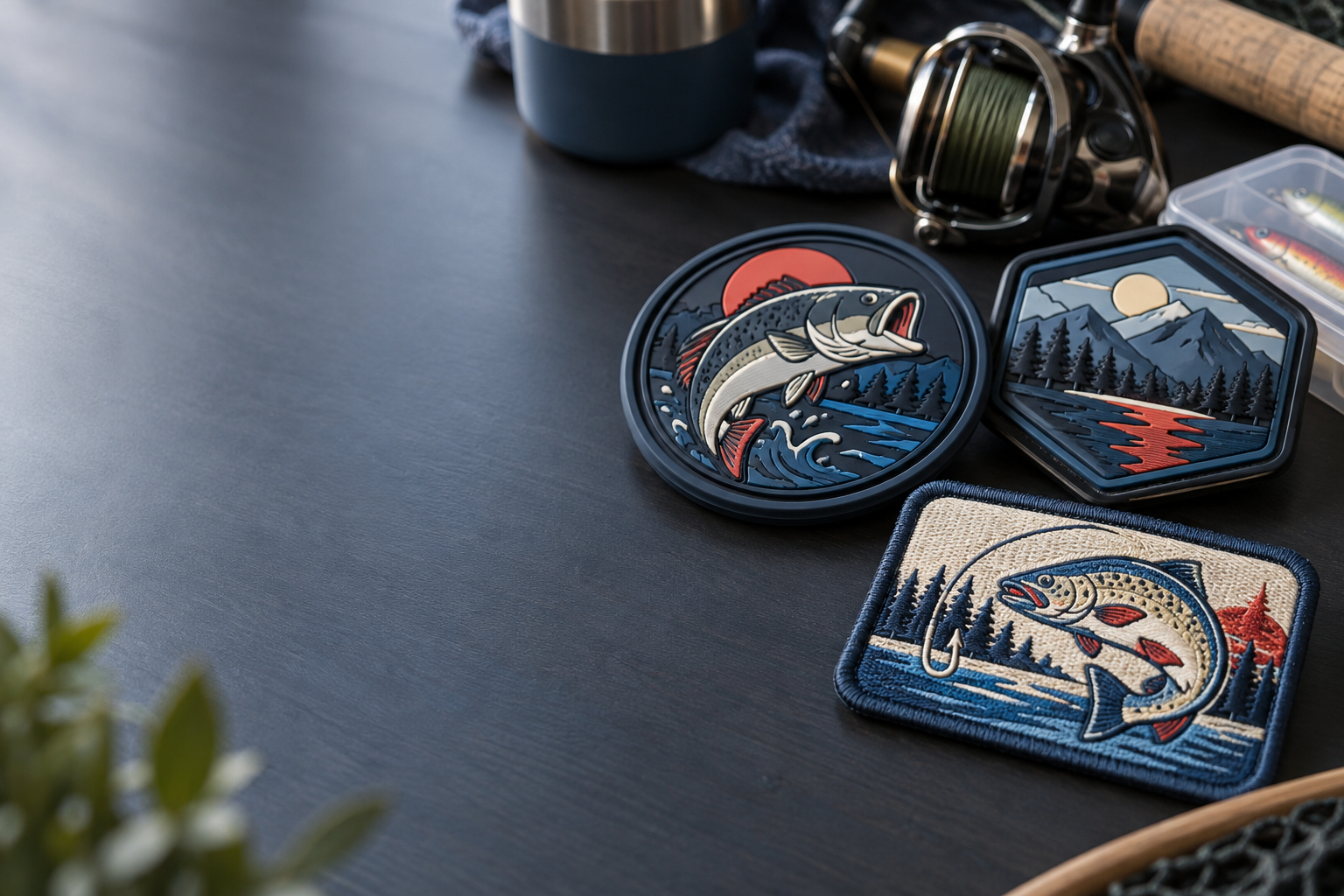
GetUSAPatches supplies custom PVC patches Houston fishing clubs can order for caps, tackle bags, and removable gear panels, with a 10-piece minimum. PVC is a practical choice for a bold club emblem exposed to spray and frequent handling, provided the backing suits the item. We provide a free digital mockup before production and produce only after approval.
Orders ship from Corona, CA, to Houston and all 50 states across the United States; this is not a Houston walk-in pickup service. The first questions on a useful quote are simple: what is the patch going on, how big is the usable area, and when do you need the finished pieces? A molded redfish badge on a structured trucker cap is a different job from the same artwork on a lightweight fishing shirt.
Custom PVC Patches for Houston Fishing Clubs: What Works on the Water?
PVC patches use molded polyvinyl chloride rather than stitched thread to form the design. Raised and recessed areas separate the fish, lettering, border, and background, giving a simple emblem a clear shape. The face does not soak up water like fabric, and ordinary surface dirt is usually easier to wipe off.
That makes PVC patches worth considering for Galveston Bay fishing-club caps, Lake Conroe tournament bags, and crew gear that gets handled with damp hands. It does not make the whole attachment waterproof. Thread holes, backing layers, and the garment underneath still have their own limits.
Water resistance is not a promise about every exposure
Salt spray, sunscreen, fish slime, fuel, and months of direct sun are different exposures. A patch that tolerates splashes should not automatically be described as chemical-resistant, fadeproof, or suitable for permanent outdoor mounting. If those properties matter, ask what documentation or testing is available for the quoted construction.
- Good starting applications: structured caps, removable bag identifiers, club gear organizers, and sturdy vest panels with enough support for a molded badge.
- Applications needing closer review: thin performance shirts, unstructured nylon caps, coated rain shells, and unusually small front panels.
- Poor assumptions: calling a patch flotation equipment, claiming it restores a shell's waterproofness, or treating decorative PVC as certified reflective safety identification.
For a fishing club, the useful question is not simply which material survives water. It is which complete patch-and-garment combination stays readable, comfortable, and attached through the way members actually use it. The backing often decides that answer before the fish artwork does.
Start With the Cap, Shirt, or Bag—not the Logo
The production-desk lesson is the same across high-school sports teams, fire and public-safety units, hospitality polos, biker vests, and letterman jackets: the surface controls the attachment. A patch that sits well on a firm vest can make a soft shirt sag. A cap front that looks roomy in a catalog can have less usable space once its center seam and curve are included.
Structured trucker caps versus soft fishing caps
A structured trucker cap usually supports a molded patch better than a very light, unstructured cap. Still, a wide rectangular patch can bridge the front curve and leave its corners standing away from the fabric. A smaller oval or rounded rectangle may settle better without forcing the cap front into a flat shape.
Measure the actual cap while it has its normal shape, not crushed flat on a table. Check clearance above the bill and below the crown, and keep the proposed sewing line off mesh if the attachment shop needs solid fabric. Our hat patches hub and cap and beanie patch guide help separate material selection from cap fit.
Performance shirts, shells, and gear bags
On a thin polyester fishing shirt, a thick PVC emblem may pull at the chest or feel stiff against the wearer. A lighter woven patch can be the better choice even if PVC is used on the club's caps. Nylon shells need special caution because heat can distort the fabric or damage a coating, while sewing can create leakage paths.
Tackle bags often offer more support, especially where a manufacturer has already provided a loop panel. Do not assume that every black rectangle is loop fabric, though; some are plain reinforcement panels. Wool coaches' jackets, denim layers, and sturdy canvas bags can support different constructions, but lining access and needle clearance still need a check before attachment.
PVC, Embroidered, Woven, or Printed: Compare the Actual Job
The club does not need one material for every item. Matching the fish silhouette, color family, and lettering can keep a collection consistent while allowing each garment to use the right patch construction. That is often more practical than forcing a heavy molded badge onto every shirt.
Traditional embroidered patches give a crest visible thread texture. Woven patches suit finer lines with less bulk, while printed patches can carry photographic artwork and gradients more directly. Printed is flatter; that is the point, especially when raised texture would fight the design.
| Construction | Useful fishing-club application | Artwork strength | Trade-off to check |
|---|---|---|---|
| Molded PVC | Structured caps, supported bags, removable gear badges | Bold fish silhouettes, separated color areas, raised lettering | Adds thickness and weight; tiny details and wide shapes need review |
| Embroidered | Club jackets, substantial shirts, traditional crests | Thread texture, simple lettering, familiar stitched appearance | Small text can close up; fabric and thread need drying after wet use |
| Woven | Light shirts, smaller labels, detailed club badges | Fine lines and compact lettering in a relatively low-profile face | Less raised texture than embroidery or PVC; attachment remains garment-dependent |
| Printed | Tournament art, illustrated fish, sponsor-heavy designs | Gradients, multicolor illustration, photographic detail | Does not recreate molded relief; print construction and care instructions matter |
| Chenille | Letterman jackets and indoor club recognition pieces | Large letters with a soft, dimensional surface | Not the first choice for a small, frequently wet tackle-bag identifier |
Merrowed crests belong in the embroidery conversation: their stitched overlock edges produce a familiar finished border. A PVC patch normally uses a molded edge rather than that thread finish. If the reference photo shows a fuzzy letterman emblem, review chenille patches instead of asking PVC to imitate a different material.
For clubs comparing two realistic options, the embroidered, woven, and PVC comparison guide is a useful companion. Start with the intended use, then compare appearance. Choosing by a close-up product photo alone can hide the weight and fit differences that show up on a real garment.
Specify Size, Relief, Border, and Backing Together
A 2.5- to 3-inch-wide patch is a reasonable first template for many adult cap fronts, not a fit guarantee. A 3-inch circle uses more vertical space than a 3-inch-wide oval, and a tall fish illustration may need a different outline again. Cut the proposed shape from paper and hold it against the actual cap before approving dimensions.
Specify both width and height in inches, measured at the outermost finished edges. Also ask the quote to identify overall thickness and the intended raised areas; the word 3D alone does not describe a complete construction. The custom patch size guide is helpful when a committee is comparing a screen preview with an actual wearable size.
Choose the back before approving the front
- Sew-on: useful for permanent placement on suitable fabric. Request a sewing channel where appropriate and leave a clear route around the design so the attachment stitch does not cut across letters or the fish.
- Hook-and-loop: useful for removal and swapping between compatible panels. Specify the hook side on the patch and say whether a matching loop piece is needed; an existing loop panel may make that extra piece unnecessary.
- Heat-applied backing: request only after confirming that the offered patch construction and garment can use a documented application method. Do not treat a household iron as the default method for molded PVC.
- Temporary adhesive: do not assume it replaces sewing or hook-and-loop for repeatedly wet, flexing fishing gear. State the intended duration and surface so suitability can be reviewed.
An iron-on that peels after a dryer cycle may reflect incompatible fabric, incomplete bonding, an unsuitable application process, or later care that exceeded the adhesive's limits. Guessing at higher heat can make the garment damage worse. Read patch backing options before ordering, and use the specific instructions supplied for the approved patch rather than generic heat settings.
For Velcro panels, match the patch footprint to the actual usable loop area. Exposed hook edges can catch sleeves and rub skin, while a badge larger than its panel is easier to snag. A small, well-supported patch is usually a better working item than a large badge attached only at its center.
Build Fish Artwork That Still Reads at Cap Size
A redfish illustration that looks strong across a laptop screen can turn into a crowded shape at 2.75 inches wide. Start with the outline, the most recognizable fins, and one or two identifying features. Scales, lure hardware, water splashes, and a full tournament slogan compete for the same small area.
Give the club name priority, followed by the fish and then the location or founding year. If the club name is long, a simpler two-line arrangement can be more readable than tight lettering around a small circle. There is no universal minimum letter size that works for every font and relief pattern; ask for a production review of the actual artwork.
Keep relief useful rather than decorative
Raised fish shapes and raised main lettering can help separate important elements from a recessed background. Extra relief is not automatically better, particularly on a curved cap where unnecessary thickness adds stiffness. A flatter treatment may be the stronger production choice for a wide badge or one that gets pushed into a crowded gear locker.
- Supply vector artwork when available, but send a clear PNG or JPG if that is all the club has. A screenshot can communicate an idea, though it may not contain enough information for precise recreation.
- Replace gradients with distinct color areas if the design is staying in molded PVC. If the gradient carries the identity of the artwork, compare a printed version instead.
- Check the contrast between text and its immediate background. Raised dark letters on a dark field can disappear in shade even though the relief is visible in a studio image.
- Keep sponsor names and seasonal dates separate from the permanent club emblem where possible. Confirm permission before reproducing third-party logos.
A digital mockup checks layout and communicates the specification; it is not a physical color chip or a test of cap curvature. Screens also display colors differently. Use the artwork file guide to prepare the source files, and ask about a physical sample if fit or exact color matching is a deciding requirement.
What Goes Into the Price of a Houston Club Run?
GetUSAPatches has a 10-piece minimum, but that does not mean every 10-piece project has the same price. Finished dimensions, quantity, artwork complexity, relief, backing, and any tooling or setup requirements all affect a PVC quote. Several separate emblems can cost differently from one emblem ordered in a larger quantity.
Ask whether a proposed split between backings, sizes, or color versions changes the minimum or requires separate setup. Ten pieces total should not be assumed to cover unlimited design variations. A club that needs eight captain badges and two sponsor badges should describe both designs before treating the order as a single minimum run.
- Request the delivered total in USD, not only a per-patch figure. Have the quote identify applicable setup, shipping, tax, and optional services so the treasurer can compare complete totals.
- Separate patch supply from garment supply and attachment. Do not assume caps, shirts, sewing, or individual member shipments are included unless they appear in the written quote.
- Compare the same specification across quantities. Changing size and backing while comparing 25 versus 50 pieces makes the apparent savings hard to interpret.
- Ask how reorders are handled, including any retained tooling, artwork changes, or applicable repeat-order charges. Do not assume the first order's price remains fixed indefinitely.
A budget example can help without pretending to be a current price list. If a club sets aside $300 for 30 members, that is a $10-per-member spending ceiling—not a GetUSAPatches patch price. Caps, attachment, shipping, and any reserve pieces have to fit inside that same budget if the club intends to cover them.
Often the sensible saving is a simpler outline, fewer separate designs, or one reusable club emblem without a year molded into it. Read what drives custom patch pricing before removing useful backing just to reduce a line item. A less expensive patch that cannot attach to the chosen gear does not solve the club's order.
How to Order and Plan Delivery From Corona, CA
Give the required in-hand date, not just the tournament date. If a Houston sewing shop needs the patches before it can finish the caps, that shop's receiving date is the meaningful deadline. Artwork approval, manufacturing, carrier transit, and local attachment are separate parts of the schedule.
There is no responsible universal delivery promise for every PVC design and quantity. Ask for the current production estimate and shipping options for the approved specification and destination ZIP code. Faster shipping changes transit time; it does not automatically shorten artwork revisions or manufacturing.
- Send the artwork and application details. Include garment model or photos, finished width and height, quantity, preferred backing, Houston delivery ZIP code, and required arrival date.
- Resolve the construction. Confirm the shape, relief, sewing channel if needed, and whether hook-and-loop includes a matching loop piece. Ask who will handle final attachment.
- Review the free digital mockup. Check spelling, fish orientation, phone numbers if used, dates, border spacing, colors, dimensions, and the backing notes rather than reviewing only the front image.
- Approve a final version through one club contact. GetUSAPatches produces only after approval, so collect committee feedback before authorizing the production file.
- Confirm production and shipping details. Check the delivery address, receiver availability, quoted schedule, and any separate garment-finishing arrangements.
- Inspect the shipment before distributing it. Count pieces, compare them with the approved specification, and test the intended attachment on a representative item before processing the whole batch.
We ship from Corona, CA, to all 50 states, including Texas, Alaska, and Hawaii. That nationwide service does not mean every address uses the same shipping method or transit estimate. Tell us about split destinations or unusual receiving arrangements while the quote is being prepared, rather than after the carton is ready.
For an event order, give one person authority to consolidate changes. A treasurer approving one file while a captain emails a different fish image can stall the job or create uncertainty about the final version. Keep the approved mockup and written specification together so future club officers know exactly what was ordered.
Attach and Care for the Finished Patches Without Guesswork
For sew-on PVC, follow the approved stitch path and have the attachment shop assess access behind the fabric. Sewing through a pocket, cap sweatband, or bag lining can close an opening or create an uncomfortable ridge. Start with one representative item before attaching the entire club run.
The step-by-step sewing guide covers the basic workflow, but a thick molded patch and a curved cap may require equipment that a home sewing setup cannot handle comfortably. Coated shells deserve a separate conversation about punctures and weather protection. A sewing channel guides the needle; it does not seal the holes afterward.
Hook-and-loop needs a clean, supported contact area
Seat a removable patch across the full loop panel instead of pressing only its center. Keep grass, thread, and lint out of the hooks so they can engage the receiving fabric. If the garment permits it, remove the badge before washing to reduce catching and abrasion against other clothing.
Our hook-and-loop attachment guide explains the two mating sides. Confirm the panel construction on the actual bag or vest before assuming compatibility. A worn or contaminated loop field may hold less securely even when the patch itself is new.
- After ordinary salt spray, wipe or rinse the PVC face with fresh water as allowed by the complete item's care instructions. Let the backing and surrounding fabric dry before storing gear.
- Use mild soap for routine dirt if compatible with the supplied care guidance. Avoid aggressive solvents, stiff scraping tools, and untested cleaners.
- Follow the more restrictive instructions for the patch, backing, and garment. A washable shirt does not automatically make every attached decoration suitable for a hot dryer.
- Do not store a damp cap or removable badge sealed inside a tackle compartment. The nonabsorbent patch face does not prevent moisture from remaining in the fabric behind it.
Nobody can give a meaningful fixed lifespan without knowing exposure, attachment, storage, and cleaning habits. Weekend use on a shaded bag is different from daily sun on a charter cap. Report lifting corners, torn stitches, or declining hook engagement early, before a small attachment issue turns into a lost badge.
Three Fishing-Club Specifications Worth Comparing
These are planning examples, not customer case studies or claims about completed orders. They show how the specification changes with the item. None should replace a fit check on the club's actual garments.
A small Galveston Bay club ordering its first caps
For 12 structured trucker caps, start by testing a 2.75-inch-wide oval with a bold redfish and a short club name. Compare a sew-on version with a clearly defined sewing channel, and have the cap decorator check the front curve and bill clearance. Keeping the founding year off the first badge may leave more room for readable letters.
A Lake Conroe group identifying shared bags
For 30 bag identifiers, measure the existing loop panels before selecting a nominal 3-inch-wide badge. Use hook backing only if the bags already have suitable loop material, and confirm whether the club needs a few matching loop pieces for other gear. A bright border can help members spot club property without claiming the patch is reflective or safety-rated.
A sponsor-supported tournament with caps and shirts
For a larger event, use a simplified PVC fish emblem on caps and compare woven or printed patches for lightweight shirts carrying more sponsor information. Keep the key colors and club name consistent rather than demanding identical construction. If sponsors change each year, separating their panel from the permanent club badge can make later orders easier to manage.
The sports teams and clubs buyer's guide is useful for coordinating shared approvals and member counts. For a Houston fundraiser or conservation group, nonprofit patch ideas for Houston offers another application angle. In both settings, the order goes better when the patch specification and the distribution plan are settled together.
A Final Production Check Before the Club Approves
A clear proof should let another club officer understand the order without reading the entire email thread. That means the important instructions belong on the approved specification, not only in a casual message about making the border a little wider. Screen size and memory are not reliable production references.
- Confirm finished width and height in inches, patch count, outline, and the intended item or items.
- Read every letter and number at the proposed finished size, including small city names, years, and sponsor text.
- Confirm colors, raised and recessed areas, border treatment, and any sewing channel.
- Name the backing explicitly and identify whether matching loop material is included.
- Check the quoted USD total, delivery address, schedule, and any separate attachment work.
- Save the final approved version for inspection and future reorders; do not rely on an earlier draft.
The strongest fishing-club patch is not necessarily the thickest one or the one with the most molded detail. It is the badge members can read, wear comfortably, clean sensibly, and keep attached to the right gear. Set those requirements first, and the artwork has a much better chance of doing its job.