
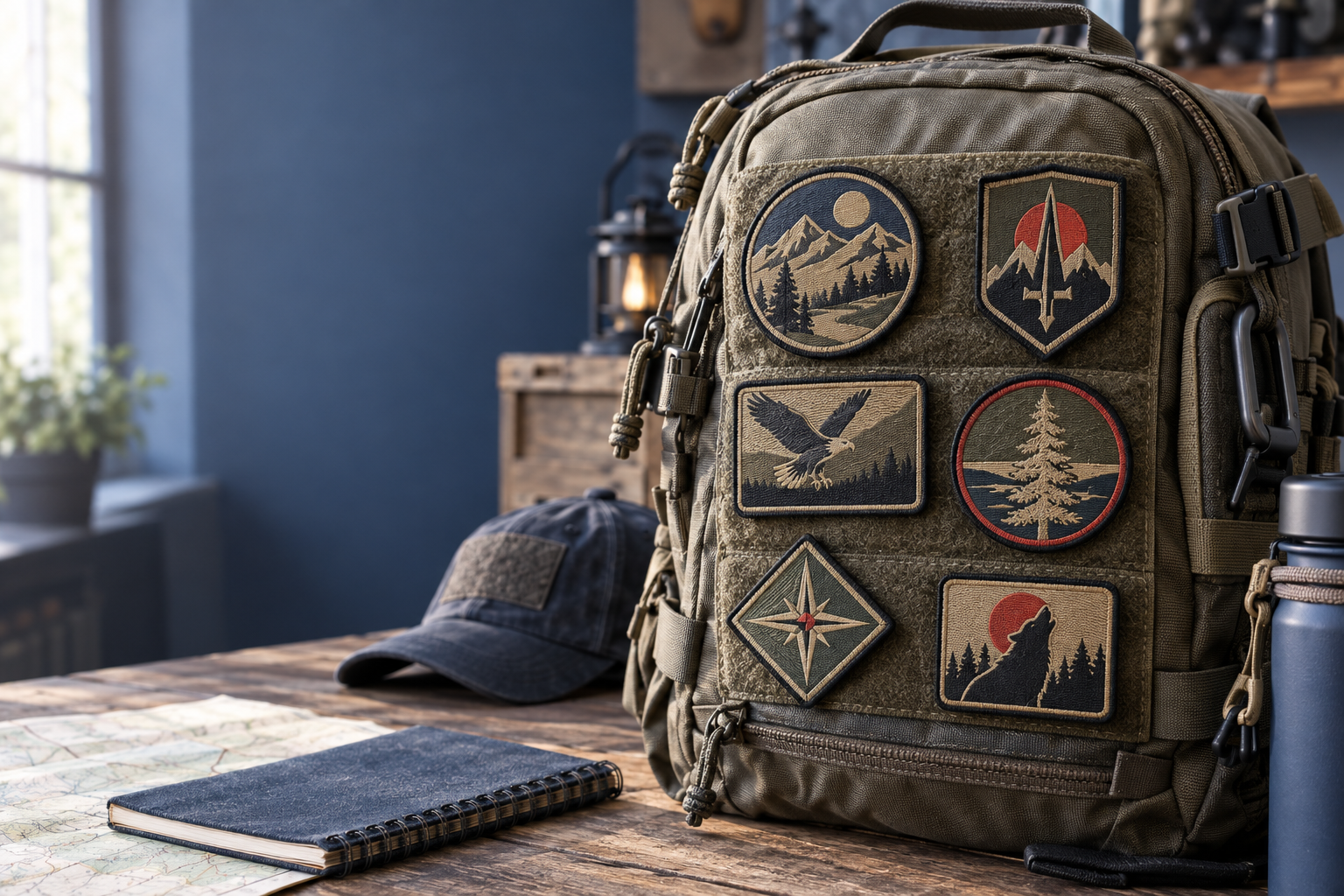
For custom military patches Houston veterans groups can use on caps, reunion jackets, and riding vests, start with the artwork and the garment: embroidery handles bold crests, woven construction helps finer lettering, and PVC works for dimensional designs on compatible gear panels. The price depends on finished size, quantity, construction, and backing, so compare the complete specification rather than a headline per-piece number. GetUSAPatches has a 10-piece minimum and provides a free digital mockup before production.
We produce only after approval and ship from Corona, CA, to all 50 states across the United States. For a Houston chapter, the useful first question is not just which patch looks military; it is where members will wear it, how often it will be washed, and which words must remain readable. A cap patch and a vest back patch can share an identity without using identical artwork.
Custom Military Patches Houston Veterans Groups Can Match to Real Use
Begin with the job. A reunion keepsake needs a clear date and group name, while a volunteer crew may need fast recognition across a parking lot. A veterans riding group needs placement that respects existing vest patches, pockets, and the club's own layout rules.
The same quoting discipline applies to high-school sports teams, fire and public-safety units, hospitality polos, and veterans chapters: identify the garment before selecting the backing. A thick crest that sits nicely on a wool jacket can make a lightweight polo sag. Hook backing that belongs on a gear panel can snag knit fabric when it is left exposed.
- Reunion and anniversary runs: prioritize the group name, year, and a simple central symbol. Keep the event schedule on a card rather than squeezing it into the patch.
- Volunteer shirts and jackets: choose a readable shape and clear contrast. Ask who handles laundering, because frequent washing changes the attachment discussion.
- Riding vests: measure around existing patches and check the inside of the vest before sewing. A convenient outside location may sit directly over a pocket.
- Caps and gear bags: treat them as separate placements. A curved cap front usually needs a smaller, less crowded design than a flat bag panel.
Civilian veterans-group patches are not automatically approved for wear on an active-duty uniform. If the intended use involves a regulated uniform, confirm the applicable requirements with the responsible organization before artwork approval. Keeping commemorative merchandise separate from official identification avoids an expensive redesign.
Compare Military Patch Styles Before Choosing the Finish
For a traditional crest, embroidered patches are a sensible starting point. The thread adds texture and makes broad lettering, shields, stars, and simple silhouettes feel substantial. The compromise appears in small details: a tiny aircraft designation or a ring of miniature words can turn into an unreadable band.
Woven patches use finer yarn construction and generally handle smaller lettering and more intricate linework than embroidery at the same size. Printed patches are useful for gradients, photographic imagery, and artwork that depends on many color transitions. Printed is flatter; that is the point, especially when the image matters more than raised thread.
| Construction | Best starting use | Useful advantage | Trade-off to review |
|---|---|---|---|
| Embroidered | Chapter crests, reunion jackets, vest badges | Visible thread texture and strong treatment of broad shapes | Small text and narrow gaps may require simplification |
| Woven | Compact cap badges and text-heavy commemorative designs | Finer detail with a relatively flat face | Less raised texture than a traditional embroidered crest |
| Printed | Memorial artwork, gradients, detailed event illustrations | Keeps tonal artwork without translating every detail into stitches | Flat appearance; ask about the specific material and care requirements |
| PVC | Gear bags and compatible hook-and-loop panels | Dimensional molded areas and a wipe-clean face | Mold preparation, thickness, and fine-detail limits need review |
| 3D embroidered | Large, simple initials on suitable caps | Raised treatment makes a bold central element stand out | Not a good default for dense crests or small surrounding words |
| Leather | Restrained cap badges and commemorative accessories | Distinct material character with an understated appearance | Substrate, decoration method, and cleaning requirements vary |
PVC and Raised Thread Solve Different Problems
PVC patches suit simplified artwork with separated color areas and deliberate raised or recessed features. The face is easy to wipe, but that does not make the garment beneath it waterproof. Dirt can still collect around edges, stitching, and hook-and-loop attachment.
3D embroidered patches work best when the raised area has room to breathe. Think broad chapter initials, not a complete service history wrapped around a two-inch circle. Ask for a flat-thread comparison if the design contains a central emblem plus several lines of text.
Leather patches can suit a low-key cap program, while chenille makes more sense for large letterman-style treatments than a detailed military crest. No construction wins every comparison. The practical breakdown in Embroidered vs. Woven vs. PVC Patches: Which Should You Choose? helps narrow the choice before the quote becomes a list of unrelated options.
Set the Size, Lettering, and Border Together
Measure the actual placement in inches. Reasonable starting points might be a 2.5-inch-wide cap badge, a 3- to 4-inch jacket crest, or an 8- to 12-inch vest back design, but these are planning examples, not universal fit limits. The usable area depends on the cap construction, garment size, seams, and surrounding decoration.
Print the proposed outline at actual size, cut it out, and place it on the garment. This catches problems that a large screen preview hides: a shield crossing a zipper, a rectangle fighting a curved cap front, or a crest swallowing the entire chest of a smaller jacket. The Custom Patch Size Guide is useful for checking proportions before you settle on dimensions.
Readable Lettering Beats a Complete Paragraph
For embroidered lettering, around 0.25 inch tall is a useful starting point for a production review, not a promise that every font will sew cleanly. Thin scripts, tight curves, and letters with small enclosed spaces may need more room. A simple block font usually gives a compact crest a better chance than a compressed decorative face.
Keep the chapter name strongest, the location secondary, and the date smaller but readable. If every word matters equally, the patch probably needs more space or a different construction. Moving a motto to a separate tab can be better than reducing every letter until nothing carries.
Choose an Edge That Fits the Outline
Merrowed crests have a wrapped thread edge that gives simple circles, ovals, and shields a familiar finished look. That edge occupies space, so lettering should not be pushed against it. Intricate outlines, narrow projections, and tight inside corners may be better suited to an appropriate cut-edge construction.
Ask the quote to name the border treatment rather than assuming every sample uses the same one. A pointed star and a round reunion badge do not necessarily need the same finishing method. Check both the visible outline and the room left for the artwork inside it.
Match the Backing to Houston Heat, Laundry, and the Garment
Houston's warm, humid conditions make garment care worth discussing, but outdoor temperature alone does not decide the backing. Fabric type, coating, stretch, laundering, and attachment method matter more. There is a big difference between a cotton vest worn occasionally and a synthetic volunteer shirt washed after every event.
- Sew-on: a useful permanent choice for many denim vests, work shirts, and substantial jackets. Confirm needle access, lining construction, and pocket locations before stitching.
- Iron-on: convenient only when the garment and patch adhesive are compatible with the required application conditions. Follow the supplied instructions and the garment care label.
- Hook-and-loop: useful for removable patches on matching panels. Specify hook on the patch and state whether a separate mating loop piece is needed.
- Unattached keepsakes: backing may be less important for a patch displayed in a frame, but thickness and edge finish still affect how it sits.
Nylon shells need caution. High heat can damage some fabrics or coatings, while sewing can puncture a weather-resistant barrier. If the jacket manufacturer does not permit either treatment, move the patch to a compatible bag or use an existing attachment panel rather than risking the garment.
Wool coaches' jackets and letterman jackets bring a different problem: thick layers and linings can make placement awkward. On leather biker vests, a stitch hole is permanent, so the patch should be positioned and approved before sewing starts. Lightweight hospitality polos often need a smaller, lighter patch to avoid a stiff rectangle pulling at the chest.
Iron-on that peels after a dryer cycle is a familiar failure pattern, but the cause is not always the patch. Incompatible fabric, insufficient pressure, an uneven pressing surface, or laundering outside the care instructions can all contribute. For a frequently washed item, ask whether perimeter stitching is appropriate rather than treating adhesive as the answer for every garment.
For Velcro panels, measure the usable loop area and keep the patch inside it so exposed hooks do not rub nearby fabric. The Patch Backing Options Explained guide compares attachment methods, and Velcro® Patches: How to Attach and Use Hook-and-Loop Backing explains the two mating sides. Hook-and-loop is an attachment system, not a patch material.
Military Patch Prices: Build a Budget Without Guessing at Rates
An accurate dollar quote requires the design, finished dimensions, construction, quantity, and backing. There is no responsible single price for a small woven cap badge and a large embroidered vest back. GetUSAPatches has a 10-piece minimum; ask how that minimum applies if the order contains different designs, sizes, or personalized versions.
Quantity often changes the unit price because preparation costs can be spread across more pieces. However, doubling the number does not guarantee a particular percentage reduction, and changing the artwork between pieces can change the calculation. Ask for prices at realistic quantities such as 25, 50, and 100 only if your group could actually use those totals.
| Quote variable | Why it affects the budget | What to specify |
|---|---|---|
| Finished dimensions | Larger patches usually require more material and production work | Width and height in inches, not just small or large |
| Artwork and construction | Dense stitching, molds, fine detail, and special effects change preparation and production | Preferred material plus any acceptable alternative |
| Backing and border | Attachment components and finishing steps can change the total | Sew-on, heat adhesive, or hook-and-loop; border treatment |
| Quantity and versions | One repeated design differs from multiple names, years, or chapter variations | A count for every distinct version |
| Delivery and services | Freight, rush service, packaging, or attachment may be separate | ZIP code, arrival deadline, and requested additional work |
Use Delivered Cost for the Comparison
Here is budgeting math, not a GetUSAPatches price offer: if a hypothetical quote lists 50 patches at $5 each plus $20 shipping, the subtotal is $270 before any applicable tax or other stated fees. That works out to $5.40 per patch delivered at that stage. A second hypothetical offer at $4.80 each plus $45 shipping totals $285, despite the lower unit price.
Use the same arithmetic for a chapter fundraiser. If the approved delivered total is $270 and the group collects $10 for each of 50 patches, gross receipts are $500 and the difference is $230 before payment fees, packaging, unsold pieces, or other expenses. Calling that difference final profit would hide costs the treasurer still has to cover.
Ask whether artwork preparation, digitizing or mold preparation, backing, shipping, and any sample charges are included. Do not assume a free digital mockup means a free physical sample. For more cost variables, use How Much Do Custom Patches Cost? What Drives the Price.
The cleanest way to reduce cost is usually to remove unnecessary complexity, not weaken the patch's purpose. A simpler silhouette, fewer versions, or a standard shape may make more sense than cutting the lettering size. Buy useful extras for new members, but do not order twice the needed quantity solely to chase a lower unit price.
Patch Ideas That Work for Houston Veterans Groups
The strongest group patch has a clear hierarchy: one identifying symbol, one readable name, and only the supporting information people actually need. Houston can appear as text or a restrained local reference without making the design compete with several different landmarks. Keep chapter identity ahead of decoration.
- Anniversary crest: use the chapter name around a simple center and place the anniversary year on a short bottom line. A shield or circle gives the edge a straightforward path.
- Reunion series: retain a consistent main design and change the year in one controlled location. Keep a record of each version so future committees do not rebuild the artwork from a photograph.
- Volunteer crew badge: use high-contrast lettering and a plainly worded role. Avoid a layout that could be mistaken for official public-safety credentials.
- Veteran rider chest patch: choose a compact shape that fits the vest without crowding existing club identifiers. Coordinate larger layouts with the group's patch rules before quoting.
- Memorial keepsake: prioritize the approved name and dates, then choose a respectful central image. A printed version may preserve portrait artwork better than trying to recreate facial detail in a small embroidered area.
- Cap-and-jacket pair: simplify the cap version while retaining colors and the main symbol. Let the larger jacket version carry the longer chapter name or motto.
- Recognition patch: reserve a small design for a specific volunteer milestone or reunion role. Define eligibility within the group rather than putting a long explanation on the face.
- Bag-panel identifier: use a clear chapter mark with hook-and-loop backing sized to the existing panel. Put personal contact information on a separate tag rather than a public-facing group patch.
For biker and motorcycle club patches, do not assume that a familiar three-piece layout is appropriate for every riding group. Placement, wording, and club conventions deserve an internal discussion. Resolve that before asking members to vote on thread colors.
For hat patches, leave enough margin around the design to accommodate the cap's shape and attachment area. An unstructured cap can react differently from a firm-front trucker cap even when both appear to have similar space. Send a photo of the actual cap model rather than a generic catalog image if fit is uncertain.
Prepare Artwork That Can Be Quoted and Approved
A vector file is helpful, but a clear image or sketch can start the discussion. Send the best available original rather than a screenshot of a screenshot. Type every name, date, abbreviation, and motto separately in the brief so nobody has to guess at a blurry letter.
Identify what cannot change. That may be a chapter's approved symbol, a particular spelling, or the order of names on a memorial design. Then identify what can change for production, such as removing a tiny background line, increasing a gap, or switching to a clearer font.
- State finished width and height in inches, plus the intended placement.
- Provide quantities by design, size, backing, and any personalization.
- Name preferred colors and supply recognized color references if available.
- Attach garment photos, especially for nylon shells, curved cap fronts, lined jackets, and existing hook-and-loop panels.
- Identify the person authorized to approve wording and the person authorized to approve spending.
- Confirm you have permission to reproduce protected logos, seals, insignia, and other artwork supplied for the order.
Do not imply military endorsement just because a commemorative design uses military themes. Ask the relevant rights holder or organization about restricted marks when needed, and keep the design's purpose clear. This is especially useful when a patch combines a veterans chapter identity with a fundraiser sponsor.
A digital mockup is for reviewing the proposed design and specifications; it is not a physical guarantee of texture or screen-to-thread color matching. If an exact color relationship or unusual material is critical, ask what physical verification options are available and what they would add to cost and timing. The How to Design a Custom Patch guide can help the committee resolve artwork questions before approval.
Order Around the Arrival Date, Not Just the Event Date
Put the required arrival date in the first message. If the reunion starts Saturday but volunteers need Wednesday evening to sort packets, Wednesday is the useful deadline. If patches must be sewn onto 40 jackets locally, build in attachment time before the group leaves for the event.
There is no single honest turnaround promise for every custom order. Construction, quantity, artwork revisions, optional sampling, production capacity, and shipping service all affect the schedule. Request current production timing and estimated transit separately, then ask when approval is needed to support the proposed arrival date.
- Send the brief: include artwork, dimensions, material preference, backing, quantity, delivery ZIP code, and required arrival date.
- Review the quote: confirm what is included, what is optional, and whether different versions affect the price or minimum.
- Check the free digital mockup: review wording, placement, proportions, colors, border, and the written backing specification.
- Collect one consolidated revision list: a single chapter contact should combine feedback instead of sending conflicting instructions from several members.
- Approve the final version: GetUSAPatches produces only after approval. Keep the approved file and written specification together.
- Confirm shipment and receiving plans: check the address, recipient, tracking process, and who will inspect the order before distribution.
Keep Committee Review from Consuming the Schedule
Give reviewers a defined task. One person checks names and dates, another checks the group identity, and the garment coordinator checks size and attachment. Asking everyone to redesign the patch after each revision can use up the time that should have been reserved for production and delivery.
A late change from a sew-on crest to a hook-backed version is not just an artwork edit. It can affect the specification, cost, and schedule, so request written reconfirmation rather than assuming the original quote still applies. The same goes for adding individual names or changing the finished dimensions.
GetUSAPatches ships nationwide from Corona, CA, including Houston and all 50 states. Shipping from California does not create a fixed arrival time for every Texas address, and a U.S. shipping origin alone is not a country-of-manufacture certification. If your group has a domestic-origin purchasing requirement, state it before quoting and request confirmation for the specific product.
For a tight event schedule, ask what is feasible before collecting member payments on a promised delivery date. Use Need Biker Patches by a Deadline? Tips for Los Angeles Veteran Riders as a planning reference; the approval and attachment checkpoints apply just as well to Houston runs. Faster transit cannot recover time spent waiting for an undecided committee.
Inspect the Delivery and Test the Attachment Before Distribution
Open the shipment before members arrive to collect it. Count pieces by version, compare wording with the approved file, and check overall dimensions, border consistency, and backing. A quick receiving check is easier than trying to sort mixed chapter years after patches have been handed out.
For an unfamiliar garment or attachment method, test one appropriate item before treating the whole run. Follow the supplied application instructions and garment care guidance; do not invent a heat setting because it worked on another shirt. Where a test could damage an expensive jacket, have a qualified decorator assess compatibility first.
- Check readability at normal viewing distance, not only under a phone camera.
- Confirm hook-backed pieces fit inside the intended loop panel and that any ordered mating loop pieces are present.
- Inspect the inside of vests and jackets before sewing so pockets and linings are handled correctly.
- Keep a few unissued patches clean, dry, and labeled for replacements or future members.
- Save the approved artwork, dimensions, backing notes, order reference, and a clear photo for the next reorder.
For attachment planning, How to Sew On a Patch covers the basic sequence, while How to Iron On a Patch the Right Way explains why application and fabric compatibility matter. Do not apply heat to leather, coated shells, or other sensitive materials unless the relevant instructions specifically support it. A patch should not cost the group a jacket.
Related Guides for the Next Chapter Decision
Keep the next decision narrow. If the committee agrees on embroidery, compare embroidered specifications rather than reopening every possible material. If the budget remains unsettled, compare two complete quotes with the same size, backing, and delivery requirements.
- Budget vs. Premium Custom Military Patches for Chicago Military Families offers another way to frame cost and finish decisions.
- 10 Military Patch Ideas for Reunion Planners in New York can help a reunion committee narrow its artwork direction.
- Need Biker Patches by a Deadline? Tips for Los Angeles Veteran Riders is useful when approval, sewing, and travel must fit the same calendar.