
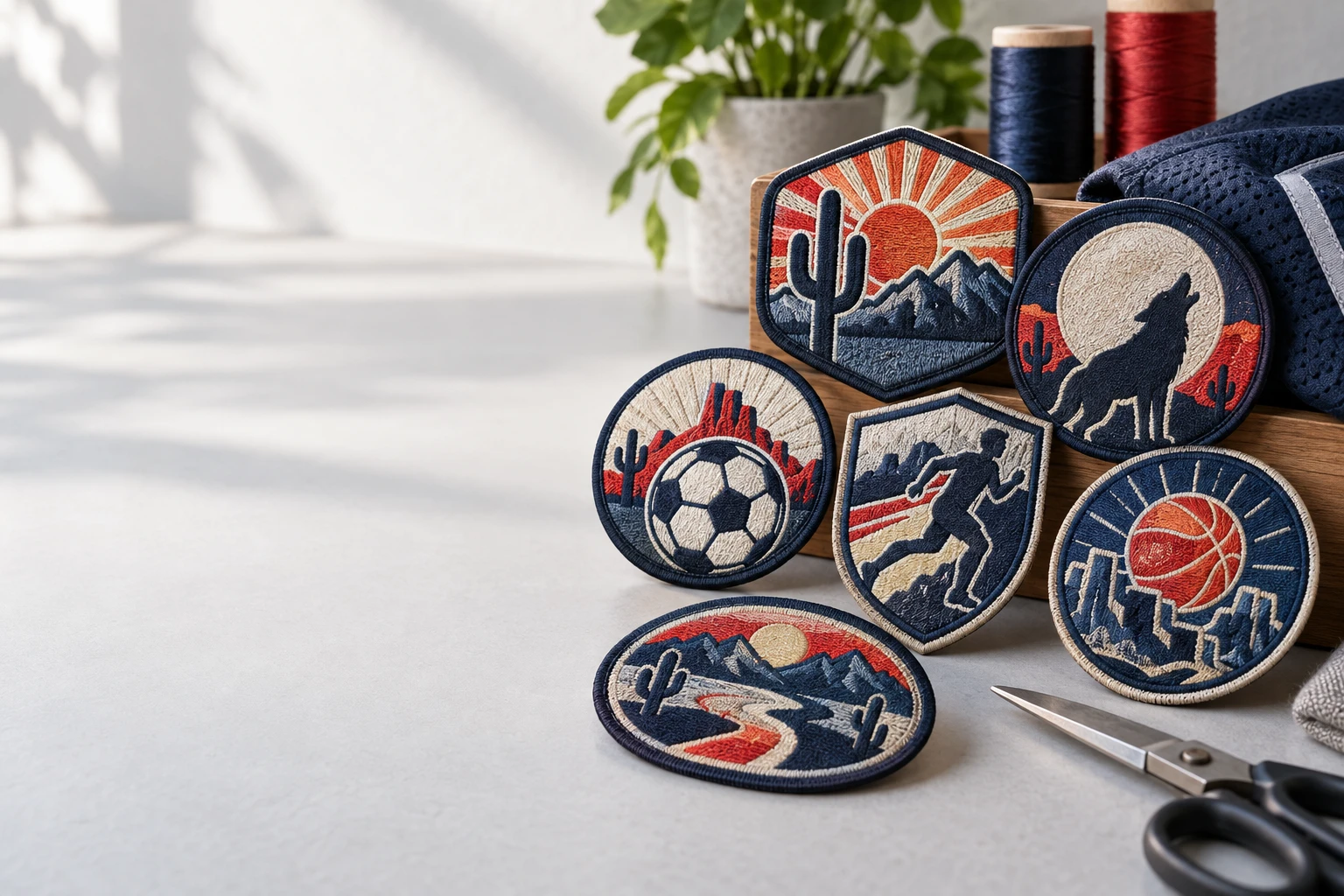
Custom printed patches for Phoenix youth leagues are a good fit for detailed mascots, shaded artwork, sponsor marks, and tournament badges that need a flat finish. Start with the smallest jersey in the roster, then choose the patch size and attachment around that garment. Printing can preserve detail that raised embroidery would require you to simplify.
GetUSAPatches has a 10-piece minimum and provides a free digital mockup before production; we produce only after approval. We ship from Corona, CA, to all 50 states, serving teams throughout the United States. For a useful quote, send the artwork, quantity, finished size, garment information, and the date the patches must arrive—not just opening day.
What custom printed patches for Phoenix youth leagues do well
A printed patch puts the artwork on a fabric patch face rather than building every visual element with stitches. That makes it worth considering for a desert sunset behind a mascot, a multicolor anniversary badge, or a tournament logo with several small graphic elements. Printed is flatter; that is the point.
At the production desk, the first question is where the badge will live. A permanent chest crest on a polyester baseball jersey has a different job from a keepsake on a backpack. A removable coach identifier needs another specification again, even if all three carry the same league logo.
Decide what must be readable
A youth league name should usually read before the tiny founding date. Give the mascot and main wording the available space, then decide whether the division, season, and sponsor all belong on the same badge. Being able to print a detail does not mean someone can read it from the bleachers.
- Permanent league crest: keep the core identity stable so replacement uniforms can use the same design.
- Tournament patch: include the event and year, but remove secondary wording that makes the main name too small.
- Sponsor patch: use approved artwork and confirm the placement with the league before ordering.
- Bag identifier: consider visibility, abrasion, and whether the bag already has a loop panel.
- Keepsake patch: a larger face may work because it does not have to fit a youth sleeve.
Start with the printed patches hub if the artwork depends on shading or many colors. If the mark is a bold two-color shield, printing is still possible, but compare a thread version before settling the specification. More detail is not automatically a better uniform badge.
Size the patch on the smallest uniform, not the adult sample
A 3-inch crest can look balanced on an adult coach polo and crowded on a youth small jersey. Cut paper to the proposed dimensions and place it on the smallest garment available. Check it with the sleeve hanging naturally, because a flat shirt on a table hides the way a badge wraps around an arm.
For an initial layout, a 2.5- to 3-inch-wide crest is a reasonable size to test on a youth chest or sleeve, not a universal recommendation. A bag badge might start closer to 3.5 or 4 inches. The actual garment, logo proportions, and league placement rules decide the finished dimensions.
Give the edge and attachment some room
Do not run small lettering right against the finished edge. A border and any attachment stitching need their own space, and the usable artwork area is smaller than the outside dimensions. Ask the proof to show the finished size and the border treatment rather than judging a floating logo on a white screen.
Caps require a separate fit check. A tall badge can run into the crown shape, while a wide one may fight the curve or bridge a center seam awkwardly. The hat patches hub is useful if the league is ordering caps with jerseys; one patch size rarely fits both equally well.
Send artwork that can survive reduction
An editable vector file is helpful for logos, although a clean, high-resolution raster image can also be suitable for printed artwork. For raster files, 300 pixels per inch at finished size is a useful starting target, subject to artwork review. Enlarging a blurry screenshot does not restore the missing edges.
Print the design on paper at actual size and read it at arm's length. If the sponsor line already looks muddy, it needs adjustment before a production proof. Use clear contrast, avoid hairline outlines, and identify brand color references; a bright phone screen is not a reliable physical color standard.
Printed, embroidered, woven, or PVC: compare the actual job
The best patch type is the one that matches the artwork, garment, and wear pattern. High-school sports programs often want thread texture for tradition, while tournament organizers may need a complicated event mark reproduced in a small space. Neither requirement makes the other construction wrong.
Compare the same artwork at the same finished size. A large embroidery rendering beside a small printed rendering tells you very little about the final result. The table below is a selection guide, not a promise that every design or backing is available in every construction.
| Patch type | Useful youth league application | Main advantage | Trade-off to check |
|---|---|---|---|
| Printed | Detailed tournament badges, shaded mascots, multicolor sponsor artwork | Flat face supports detailed color artwork | No raised thread texture; tiny wording still needs adequate size |
| Embroidered | Traditional league crests, coach polos, bold cap marks | Visible stitches and a familiar athletic badge appearance | Fine type and gradients may need simplification |
| Woven | Compact text-heavy crests and detailed flat logos | Fine woven yarns can retain detail with less bulk than embroidery | Not the same effect as printed photographic shading |
| PVC | Equipment bags and removable outdoor gear identifiers | Molded face can be wiped clean | More body and weight may be awkward on a light youth jersey |
| Chenille | Award letters and varsity-style jackets | Soft pile gives a traditional letterman appearance | Not a substitute for a small, detailed printed badge |
Compare embroidered patches for a bold mascot with simple lettering, and woven patches for a flat mark with fine linework. For a bag that spends weekends against dugout fencing, PVC patches may be worth discussing. That does not mean a molded badge belongs on a lightweight soccer sleeve.
Keep awards separate from playing uniforms. Chenille patches fit letterman jackets, while 3D embroidered patches can suit bold cap artwork when the design and cap structure support the added height. Choosing one construction for every item often creates a compromise nobody intended.
Choose backing and borders around the garment
Sew-on is often the starting point for a permanent uniform patch because attachment does not depend on a heat-activated adhesive bond. It still needs proper installation. A large, relatively stiff badge can restrict stretch or pucker a thin jersey if the garment is pulled out of shape while sewing.
Iron-on needs more than a household iron and optimism. The patch backing requires compatible temperature, pressure, and dwell time, while the garment has its own heat limits. An iron-on that peels after a dryer cycle may have been applied incorrectly, bonded to an unsuitable finish, or washed outside the approved care instructions.
Match the backing to a real uniform
- Light polyester baseball jerseys: review heat sensitivity, stretch, dye migration risk, and whether sewn attachment will distort the fabric.
- Sublimated soccer jerseys: ask the decorator to test the actual garment before applying heat; the printed fabric may react differently from a plain swatch.
- Nylon shells: do not assume iron-on compatibility. Heat and needle holes can both create problems, especially on coated outerwear.
- Cotton or cotton-blend coach polos: inspect the knit and backing requirements rather than treating every polo like a stable woven shirt.
- Wool coach jackets: a sewn crest may be appropriate, but account for lining access, cleaning instructions, and the weight of the patch.
- Bags with Velcro panels: specify hook backing and confirm that the existing panel is loop material and large enough for the finished badge.
Hook-and-loop is useful for removable identifiers, but ask whether the quote includes the hook side only or both mating sides. That detail comes up constantly with public-safety units and carries straight over to coach bags. Exposed hook material can catch a performance jersey, so a removable patch is not automatically the best choice on a player's sleeve.
A merrowed edge can give a simple crest a familiar stitched outline, where the construction supports it. Intricate shapes may need a different edge finish because tight corners and narrow projections complicate an overlocked border. Ask which border suits the actual shape instead of requesting a complex cutout and a heavy stitched edge by default.
Phoenix heat, dust, and laundry change the specification
Phoenix teams deal with sun, sweat, dusty fields, and equipment left in vehicles between activities. Those conditions make care and attachment worth discussing, but outdoor heat alone does not establish a patch's service life. Ask about the proposed material and backing rather than accepting a general claim that a badge is weatherproof.
No honest quote should promise that all printed patches remain unchanged through unlimited sun exposure and washing. Color retention depends on the print system, materials, exposure, and care. If the league has a demanding wash routine, describe it before ordering and ask whether a physical sample or application test is appropriate.
The dryer can be the harder test
Repeated laundering combines water, detergent, flexing, and heat. Follow the patch and garment instructions, using the more restrictive care requirement when they differ. Do not improvise a high-heat dryer test and assume a passed first cycle predicts an entire season.
For bags, look beyond washing. A badge rubbing on a rough bench or dragging against a fence sees abrasion at the face and edge. Place it away from the bag's usual contact points when possible, and keep any removable patch fully supported by its mating panel instead of leaving corners hanging loose.
Build a usable budget in dollars, not a guessed unit price
There is no responsible single price for a custom printed youth league patch without dimensions, quantity, artwork, edge, and backing. Ask for the patch cost and any separate charges in writing. Shipping, tax, attachment labor, and optional services can matter as much as a small difference in the unit price.
Compare identical specifications across quotes. A sew-on patch delivered loose is not the same purchase as a hook-backed patch with a matching loop piece, and neither is an installed uniform badge. The lowest patch price may produce the higher finished-uniform cost if installation is difficult.
Use roster math before asking for quantity pricing
Suppose a team has 14 players with two jerseys each, four coaches needing one patch each, and six planned spares. That is 38 patches before keepsakes or sponsor samples. Count garments, not just people, and separate items that need different sizes or backs.
For an illustrative budget only, a hypothetical $190 delivered patch total divided by 38 patches equals $5 per patch before installation. That is arithmetic, not a GetUSAPatches quote. Keep an installation allowance separate so the board can see what the finished project actually costs.
- Request the intended quantity first, then ask whether a nearby quantity changes the total enough to justify useful spares.
- Confirm how minimums apply to different designs, sizes, and backing combinations; do not assume ten unrelated designs qualify as one run.
- Identify individual player names or numbers early because variable artwork changes the job.
- Ask whether reorders require a fresh quote and whether prior artwork remains available.
- Use the same delivery ZIP code and required arrival date in every comparison.
GetUSAPatches has a 10-piece minimum, which can support smaller team projects without requiring a league-wide purchase. For more budgeting questions, see How Much Do Custom Printed Patches Cost in Chicago? Prices and Minimums. The city changes, but the need to compare matching specifications does not.
Three practical youth league patch plans
The following are planning examples, not customer stories or reviews. They show why we ask about the garment before choosing a patch construction. A detailed logo can work well in one location and need a simpler companion version somewhere else.
A baseball league with a shaded desert mascot
Start by testing a 3-inch printed crest on the smallest jersey, then reduce the size or simplify the wording if the sleeve becomes crowded. Keep the permanent league badge separate from a dated tournament badge. That way, spare league patches can remain useful next season instead of becoming obsolete with the event year.
A soccer club with thin performance uniforms
A flat printed face may suit the club's detailed shield, but attachment is the decision that deserves the most attention. Ask the uniform decorator to review the fabric, patch stiffness, and proposed application. Test on a spare garment before treating a whole roster's jerseys as the experiment.
A tournament team with bags, caps, and coach jackets
Use the shared mascot as the visual connection, not a requirement to make every patch identical. The bag may take a larger hook-backed printed badge, while the cap needs a smaller, simpler mark. A coach jacket can carry a stitched crest with enough space for the full league name.
The same production distinction applies across hospitality polos, biker vests, and letterman jackets: fabric weight and placement change the job. A heavy crest that sits well on denim can pull at a light knit. For jacket awards rather than game uniforms, read What Are the Best Chenille Patches for Varsity Teams in Phoenix?.
Ordering and lead times: plan backward from uniform handout
The important date is usually the day your decorator needs the patches, not the first game. Build the schedule backward through installation, delivery, shipping transit, production, and artwork approval. A package arriving the afternoon before opening day leaves no useful margin for sewing or checking a full team order.
Do not assume Phoenix delivery means local pickup or same-day turnaround. GetUSAPatches ships from Corona, CA, and serves all 50 states. A Southern California shipping origin does not establish a delivery promise; request timing for the actual quantity, construction, destination ZIP code, and shipping service.
- Send one complete brief with artwork, finished dimensions in inches, quantity, proposed backing, garment information, and delivery ZIP code.
- Name the required arrival date and the uniform installation date separately. Mention tournament travel if the team leaves before the event begins.
- Identify one decision-maker for artwork approval. Collect coach, board, and sponsor feedback before requesting the next revision.
- Review the free digital mockup for spelling, year, mascot orientation, colors, border, finished size, and backing specification.
- Approve only the version you want produced. GetUSAPatches starts production only after approval.
- Confirm the production estimate, shipping method, and any deadline assumptions in writing, then reserve time for receiving and installation.
Separate proof review from physical verification
A digital mockup is valuable for layout and specifications, but it cannot demonstrate fabric feel, adhesive performance, or exact physical color under stadium lights. If one of those is decisive, ask about a physical sample and any added cost or time. Do not treat a screen approval as a garment application test.
For scheduling questions to put on the quote, see How Long Do Custom Embroidered Patches Take to Arrive in Phoenix, AZ?. Printed and embroidered production schedules can differ, so use that guide for planning questions rather than transferring an embroidery estimate to a printed order.
Install one correctly before doing the entire roster
Give the installer the approved placement and any application instructions supplied for the order. On sew-on work, check that the badge lies flat without stretching the garment underneath. Sleeves, pockets, and linings need care so the attachment does not accidentally close an opening or catch fabric behind the patch.
For iron-on work, use the specified equipment and settings for that backing and garment combination. There is no safe universal temperature to print here for every jersey and patch. Stop if the approved bonding conditions exceed the garment's limits rather than lowering the heat and hoping the adhesive still works.
Make placement repeatable
Measure from a stable reference such as a seam, then check the position on the person or an appropriate form. Using the same distance from an unstable fold can produce a row of crooked badges. Youth sizes may need placement adjustments even when the patch dimensions stay the same.
Set aside one properly installed garment as the placement reference. If a wash test is part of the plan, follow the agreed care instructions and allow enough time to evaluate it before completing the batch. Photograph the accepted result so a volunteer or second decorator is not working from memory.
Receive, document, and reorder without losing the specification
Open the delivery before uniform handout day. Count patches, separate any variants, and compare the finished pieces with the approved proof and written order details. Check dimensions, wording, border finish, and backing; report discrepancies before installation changes the condition of the patches.
Store spares clean, flat, and away from prolonged heat or direct sun, following any supplied storage guidance. Keep them with an order record rather than loose in a coach's vehicle. An unmarked envelope of similar crests becomes surprisingly hard to identify after the board changes.
- Save the approved artwork and revision date, not just the first logo file sent for a quote.
- Record finished width and height, patch construction, border, and backing.
- Keep the garment brand, style, fabric details, and accepted placement photo.
- Document the quantity installed, spare inventory, and care instructions issued to families.
- For reorders, ask about current minimums, price, timing, and possible batch variation instead of assuming the previous terms remain unchanged.
For another look at dimensions and attachment, read Custom Woven Patches for Boutiques in Phoenix: Backing and Size Guide. A youth league has different garments, but the central habit transfers: approve a complete specification, not just an attractive logo. That is what makes the next order easier to quote and easier to install.