
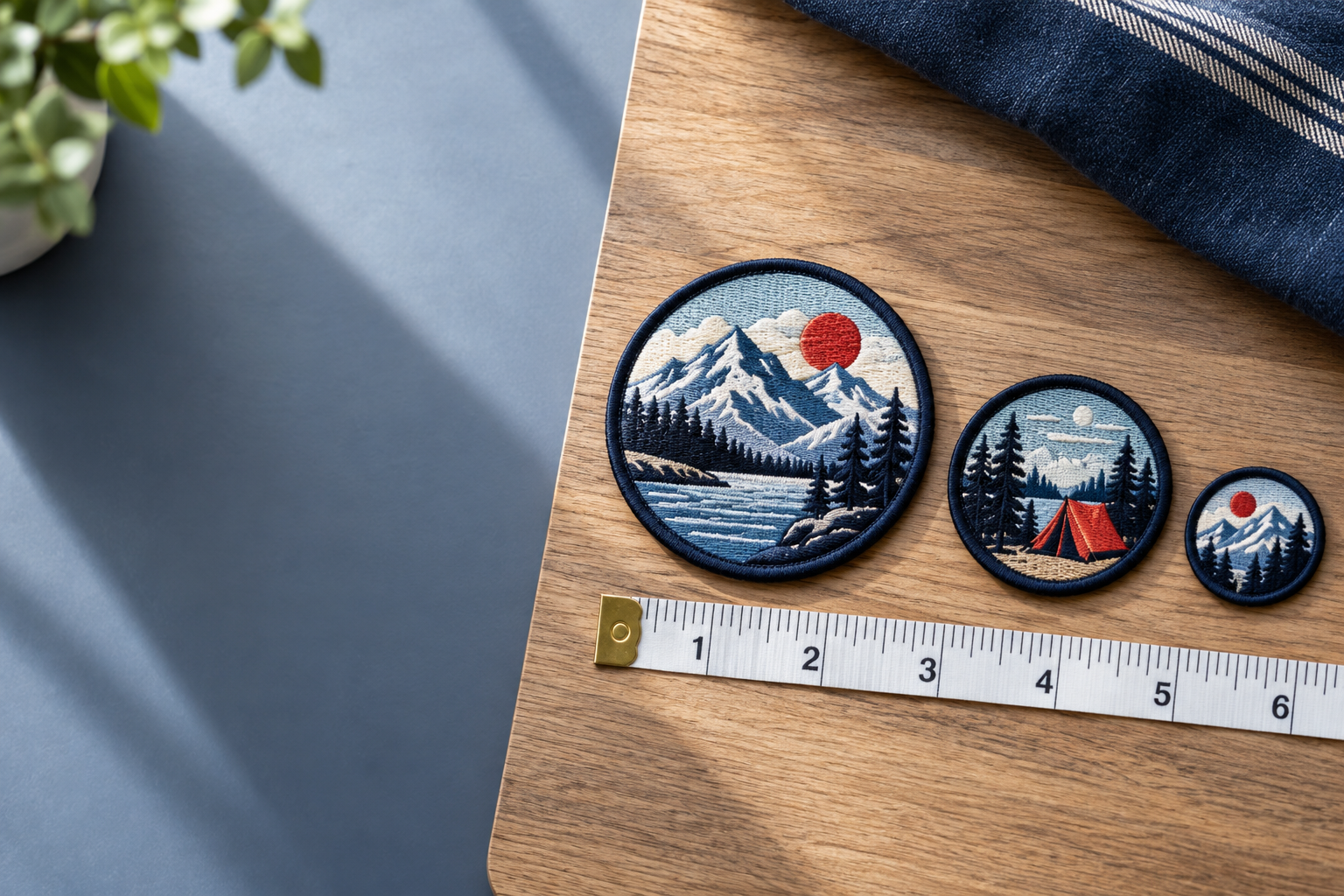
Custom printed patches in Chicago are priced by quantity, finished size, artwork, border, and backing—not by the city name on the shipping label. GetUSAPatches has a 10-piece minimum, and your exact price requires a specification-based quote. As a budgeting example only, 50 patches at an assumed $5 each would cost $250 before shipping, applicable tax, attachment, or any separately quoted charges.
GetUSAPatches provides a free digital mockup before production and produces only after approval. We ship from Corona, CA, to all 50 states, serving buyers throughout the United States. For a Chicago school, restaurant group, clothing brand, or riding club, the useful number is the delivered cost of a patch that actually fits the garment.
Custom Printed Patches Chicago Buyers Can Budget for Accurately
Start with a distinction that gets lost on quote sheets: an example budget is not a price offer. There is no verified GetUSAPatches rate card in this guide, so the dollar figures below are deliberately labeled assumptions. Use them to understand the arithmetic, then replace them with your written quote.
A 2-inch cap patch and a 5-inch jacket crest are not the same job. Neither are 100 identical pieces and several small batches with different department names. A useful quote keeps the design, dimensions, backing, and quantity together so you know exactly what the number buys.
Illustrative patch budgets—not published prices
| Budget exercise | Quantity | Assumed unit price | Patch subtotal | What still needs confirmation |
|---|---|---|---|---|
| Small-run calculation | 10 identical patches | $8, used only for illustration | $80 | Actual construction price, shipping, applicable tax, and any separate charges |
| Team-order calculation | 50 identical patches | $5, used only for illustration | $250 | Actual unit price at 50 pieces and whether the requested backing is included |
| Event-order calculation | 100 identical patches | $3, used only for illustration | $300 | Actual unit price at 100 pieces, deadline feasibility, and delivery cost |
| Two-option comparison | 50 identical patches | $5 versus $6, both assumed | $250 versus $300 | Which specification changes explain the $50 difference |
Those assumed prices do not establish volume discounts or promise a particular price at any quantity. Their purpose is to show how quickly a small unit-price difference changes the order total. At 50 pieces, another $1 per patch adds $50; at 300 pieces, it adds $300.
Work backward if the team treasurer has given you a firm ceiling. With a hypothetical $300 total budget and 50 required patches, your maximum delivered cost is $6 per patch before any garment attachment paid from that same budget. The broader patch pricing guide explains why dimensions and construction must stay attached to every price comparison.
What the 10-Piece Minimum Means for a Chicago Order
The GetUSAPatches minimum is 10 pieces. That makes a small club run or a replacement batch possible without immediately committing to hundreds. It does not mean 10 individually different logos will necessarily be quoted as one identical production run.
List each design, size, and version separately when asking for pricing. If a high-school athletics department wants one crest for coaches and a second version with a championship year, show both quantities. Ask how the minimum applies to those versions rather than assuming the totals can be combined.
Order for actual use, not just the lower unit price
A lower unit price can still produce a larger invoice. Suppose two hypothetical quotes were $200 for 40 patches and $320 for 80; the second costs less per piece but requires another $120 now. That only makes sense if the extra 40 have a realistic job.
- For a school team, count athletes, coaches, managers, and known replacement needs before setting the quantity.
- For hospitality polos, count issued garments rather than employees; one employee may receive several shirts.
- For a public-safety unit, separate permanent uniform patches from removable patches used on existing panels.
- For a dated fundraiser or rally, be careful with surplus stock that becomes difficult to use after the event.
- For a clothing brand, check how many garments are actually in the production batch before buying patches for a projected launch.
A reorder also needs its own current quote and schedule. Keep the approved artwork, finished dimensions, backing specification, and previous order reference so the next request is clear. Do not assume a future batch will carry the same price, especially if the quantity or materials change.
The Specifications That Move a Printed Patch Quote
On the production desk, “a standard patch” is not enough information to price responsibly. A useful starting brief might say: 50 identical printed patches, 3 inches wide by 2 inches high, rounded rectangle, sew-on backing, for cotton twill work shirts. That gives the quote a shape.
Size affects material use, but it also changes what the artwork can do. Increasing a crest from 2 inches to 3 inches may make a lower line of text readable without redesigning the whole badge. Shrinking the patch solely to reduce cost can leave you paying for details nobody can read.
Artwork, shape, border, and backing
- Finished dimensions: give both width and height in inches, including the border, rather than only the longest side.
- Artwork: identify gradients, photographic elements, fine lettering, and any brand colors that require discussion.
- Outline: a simple circle behaves differently from a narrow lightning bolt or a crest with several tight inside corners.
- Border: name the desired finish and ask whether it suits the material and outline instead of treating every edge as interchangeable.
- Backing: specify sew-on, iron-on, or hook-and-loop, including whether a matching garment-side loop piece is required.
- Versions: separate different names, dates, colors, and sizes so they are not mistaken for one identical run.
Merrowed crests have a familiar stitched edge that works well with many conventional badge shapes. Fine points and deep cutouts can call for a different edge treatment, and the available finish depends on the selected construction. Review merrowed, hot-cut, and laser-cut borders before choosing an outline just because it looks good on a screen.
Full-color printing handles color differently from thread-based construction, so do not assume every added artwork color creates a separate charge. Ask which print process and face material are proposed and which features actually affect your quote. “Printed” describes a broad category, not a complete material specification.
Make the patch fit the garment first
Cut a paper rectangle or crest to the proposed finished dimensions and place it on the actual garment. A 3.5-inch design may work on a jacket chest but crowd the front panel of a low-profile cap. The custom patch size guide helps with placement, but the garment in your hands gets the final say.
Check stitch access too. A patch can fit visually over a polo pocket while being awkward to sew without closing that pocket, and a lined jacket may require a different attachment plan than an unlined overshirt. Installation problems are real costs even when they do not appear on the patch invoice.
Printed vs. Embroidered vs. Woven: Buy the Right Surface
Printed is flatter; that is the point. It is often the sensible direction for gradients, illustrated mascots, photographic elements, and artwork that would lose information if converted into stitches. If the main goal is a raised thread finish, start by comparing a different construction rather than asking print to imitate it.
For a Chicago neighborhood festival graphic with several color blends, printed patches deserve a close look. A bold school crest may suit embroidered patches, while a clothing label with compact lettering may favor woven patches. None of those choices is automatically the lowest-cost option once the specifications are matched.
| Construction | Useful for | Surface and detail trade-off | What to compare on the quote |
|---|---|---|---|
| Printed | Gradients, illustrations, photographic artwork, and multicolor graphics | A flatter image surface; tiny details still depend on size, source quality, and process | Face material, print process, border, backing, and approved artwork |
| Embroidered | Bold crests, school identity, business uniforms, and traditional club marks | Visible thread texture; very small lettering and intricate detail may need simplification | Dimensions, stitch coverage, border, backing, and readability |
| Woven | Compact brand marks and fine linework suited to a thread-based appearance | Flatter than embroidery; not a substitute for every photographic effect | Lettering size, color treatment, edge finish, and attachment |
| PVC | Molded designs for selected outdoor gear and removable panel applications | A flexible molded surface with different thickness and detail constraints | Thickness, molded detail, backing, any separate tooling charges, and quantity |
Letterman jackets are another good reminder that the garment influences the choice. A small printed anniversary badge can sit beside a large chenille school letter without trying to replace it. For the traditional fuzzy letter itself, chenille patches are the more relevant product to discuss.
Biker vests bring a different set of expectations: broad lettering, visible borders, and pieces that work as a set across the back. An illustrated memorial insert might be printed, while the surrounding rockers call for another construction. Check the complete layout through biker and motorcycle club patches rather than choosing every piece in isolation.
Backing Costs Matter Less Than a Patch That Stays Attached
Backing belongs in the first quote request, not in a note added after approval. It affects the patch build, the installation method, and sometimes the suitability of the whole order. A low patch price does not help if the buyer must replace failed attachments after the uniforms are issued.
For regularly washed hospitality polos and work shirts, sew-on attachment is often worth discussing first. Stitching makes a mechanical connection, though the operator still needs suitable thread, stitch placement, and access to the garment. The sew-on patch guide explains the practical preparation.
Iron-on: convenient, but not universal
Iron-on that peels after a dryer cycle is a familiar failure pattern, but the cause is not always the patch itself. Insufficient pressure, incompatible fabric finishes, incorrect heat, incomplete bonding, or later care outside the recommended limits can all matter. Confirm the patch instructions and garment care label before applying heat.
Nylon shells, coated rainwear, and heat-sensitive performance garments need particular caution. Wool coaches' jackets and lined letterman jackets also deserve an attachment plan that accounts for their construction, not a guess with a household iron. Use the iron-on application guide as background, then follow the instructions supplied for the actual patch and garment.
Hook-and-loop: specify both sides of the connection
A patch with hook backing needs a compatible loop surface on the garment. If a jacket already has Velcro panels, measure the usable panel rather than ordering a badge from memory. If the garment has no panel, confirm whether a matching loop piece is included and who will attach it.
That distinction matters for fire and public-safety units ordering removable identification. A decorative patch is not evidence of any protective rating, and modifications to certified protective gear should follow the garment manufacturer's requirements and department policy. Review hook-and-loop attachment before approving the backing specification.
Compare Delivered Cost, Not Just the Price Beside the Quantity
The patch subtotal is quantity multiplied by the quoted unit price. The delivered order total may also include separately listed charges, shipping, and applicable tax. Garment attachment can be another expense if it is not part of the agreed scope.
Compare two quotes using the same destination, dimensions, quantity, border, and backing. Otherwise, a lower figure may simply describe a different product. One quote might include hook backing while another includes hook backing plus loose loop pieces; those are different packages.
- Ask whether the quoted unit price includes the specified backing and border.
- Ask whether any artwork preparation, setup, sampling, or other charges apply, and have them listed separately.
- Confirm the shipping service and cost to the actual Chicago-area ZIP code.
- Confirm applicable tax rather than estimating it from another buyer's invoice.
- Identify whether attachment to caps, jackets, or polos is included or handled separately.
- Request the full order total and any conditions attached to the quote.
For illustration, assume 50 patches have a $250 subtotal and shipping is quoted at $20. That is $270, or $5.40 per patch, before tax and attachment. If a separate installer charges an assumed $2 per garment, the combined patch, shipping, and installation spend becomes $370 before tax.
Those shipping and installation numbers are examples, not GetUSAPatches fees or local sewing rates. The lesson is the calculation: divide the relevant total by the number of usable finished garments. That is more useful to a restaurant manager than a low unit price that leaves installation out.
Artwork Preparation That Prevents Paid Mistakes
Send the best original file you have, not a screenshot of a logo inside a text message. Vector artwork is useful for clean shapes and lettering; a high-resolution raster file may be appropriate for photographic or painted artwork. The artwork file guide explains the differences without requiring you to become a designer.
For raster art, approximately 300 pixels per finished inch is a common starting target, subject to the selected process and artwork review. A 3-inch-wide image at that target would be about 900 pixels wide. Increasing the pixel count of a blurry file does not restore missing detail.
Review the image at physical size
A crest can look excellent enlarged on a laptop while its motto disappears at 2.5 inches. Print the proposed layout at actual size and look at it from the distance people will normally see it. If the year, unit number, or sponsor name matters, it needs more space than a decorative flourish.
Check spelling, punctuation, Chicago neighborhood names, and the exact year before approving the mockup. For a school or club order, appoint one person to collect corrections and send the final approval. Three overlapping email threads are an easy way to approve yesterday's version.
Understand what a digital mockup can prove
A digital mockup is useful for layout, wording, dimensions, shape, and documented construction choices. It is not a physical wash test or a promise that every screen will display color identically. If a particular brand color is critical, provide a reference and discuss realistic production expectations.
Ask about physical sampling if the project requires checking hand feel, color, or attachment before a larger commitment. Availability, added cost, and added time need confirmation; a free digital mockup does not automatically include a physical sample. Keep those two approval tools separate in the budget.
How to Order and Plan Delivery to Chicago
Build the schedule backward from the day the garments must be ready to wear. Patch production, shipping, receiving, sewing, and distribution are separate tasks. A box arriving on Friday afternoon does not help much if 70 jackets must be patched for a Saturday morning event.
GetUSAPatches ships nationwide from Corona, CA, including Chicago and the rest of Illinois. We ship to all 50 states, but the shipping statement is not a fixed transit-time promise. Request a current production estimate and shipping estimate for your specifications, destination, and required arrival date.
- Send the artwork and list the required quantity for each design and size. Include at least the 10-piece minimum and identify any versions that need separate review.
- Give the finished width and height in inches, preferred border, and backing. Name the actual garment, fabric, and placement rather than saying only “uniform patch.”
- Provide the delivery ZIP code and required arrival date. State whether sewing or other attachment must happen after the patches arrive.
- Review the quote for the complete specification and itemized total. Confirm any separate charges and the proposed production and shipping schedule.
- Check the free digital mockup for wording, size, orientation, color references, border, and backing notes. Send one consolidated correction list if anything needs changing.
- Approve the final mockup and order details. GetUSAPatches produces only after approval; confirm how the approved order's production start and shipment timing will be handled.
- Inspect the received patches against the approved specification before attaching the entire batch. If heat application is appropriate, test an inconspicuous or spare garment first.
Do not count the day you first send a rough logo as the confirmed production start. An unanswered spelling question or a revised size can keep the artwork in review. Give the approver a clear deadline and settle the garment placement before the final approval.
If the date is tight, say so at the beginning and ask what is feasible before paying for a plan built on assumptions. Faster shipping cannot recover every production delay, and any rush option needs written confirmation. Leave room for the person who will receive, count, and attach the patches in Chicago.
Three Chicago Buying Scenarios and the Trade-Offs Behind Them
The following are planning scenarios, not customer stories or reported orders. They show why two buyers asking for a “3-inch printed patch” can need different quotes. The garment and use usually explain the difference.
High-school coaches and letterman jackets
Picture a school ordering an illustrated anniversary badge for coaches' jackets and student letterman jackets. Printing may preserve the detailed mascot, but the placement must work beside existing letters, sleeve numbers, and merrowed crests. Measure both garment types before assuming one size is right for everyone.
A slightly simplified design may serve the whole group better than separate sizes with different readability problems. For the main school crest, compare the options in the Chicago school embroidery guide. Keep the anniversary badge and the permanent school identity as separate design decisions.
Hospitality polos and staff overshirts
A restaurant group might want a colorful neighborhood illustration on staff overshirts and a small chest logo on polos. The same artwork may not remain readable at both sizes, and lightweight polo knit can react differently from heavier woven cloth. Compare the patch's weight and stiffness against the garment before committing.
Budget by garment count and cleaning routine. A short event run and a uniform washed repeatedly need different discussions about attachment and care. The uniform and workwear guide is useful for putting those requirements into the quote.
Public-safety panels and club outerwear
A removable unit badge must fit the usable loop panel without hanging over the edge. A club badge sewn to denim or a biker vest has a different attachment problem, even if the artwork dimensions match. Specify the use rather than asking for the same backing on everything.
For equipment exposed to wet or dirty conditions, compare materials and cleaning needs instead of assuming print is always the right answer. The Chicago rescue-team PVC guide covers another construction worth discussing. Any modification to protective gear still needs the appropriate garment and departmental approval.
A Final Quote Checklist and Useful Next Guides
A good patch quote can be short, but it cannot be vague. Keep the approved specification and the dollar total together so a purchasing manager, coach, or club treasurer can understand the order without reconstructing an email chain. The same record will make a later reorder much easier.
- Design and quantity: identify every version and the number of each.
- Finished size: list width and height in inches, including the border.
- Construction: identify printed material and process as confirmed in the quote.
- Attachment: name sew-on, iron-on, or hook-and-loop and any required loop pieces.
- Approval: keep the final digital mockup and written specification together.
- Cost: record the patch subtotal, separate charges, shipping, applicable tax, and attachment scope.
- Timing: record the agreed production estimate, shipping plan, and required arrival date.
For more detail on construction choices, read Custom Woven Patches in Chicago, IL: Complete Guide for Clothing Brands. For event spending decisions, Budget vs. Premium Custom Printed Patches for New York Event Organizers offers another useful buying angle. Pair either with the general patch cost guide when you compare quotes.
The best budget is not necessarily the smallest invoice. It is the price of the right number of readable patches, with a suitable backing, delivered early enough to get them onto the garments. Set those specifications first and the price comparison becomes much cleaner.