
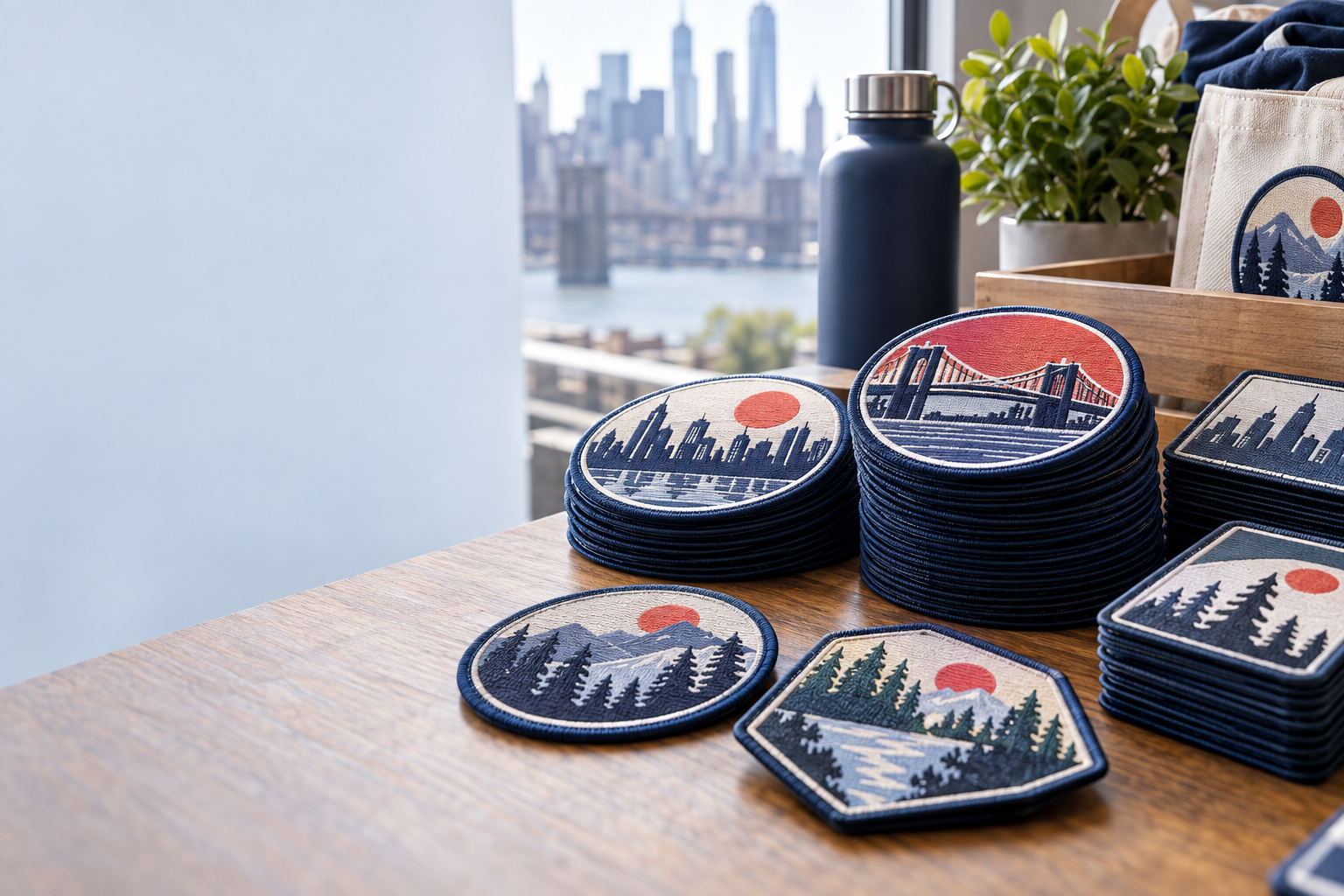
For organizers comparing custom printed patches New York events will use, the best budget option is usually a straightforward shape with readable artwork and the right backing. Premium spending makes sense when it solves a specific problem, such as removable staff identification, a demanding garment, or retail presentation. Compare the finished specification and delivered cost, not the label on the quote.
At GetUSAPatches in Corona, CA, the useful starting questions are simple: what does the patch go on, how many do you need, and when must it arrive? We have a 10-piece minimum, provide a free digital mockup before production, and produce only after approval. We ship to all 50 states, so New York orders need a realistic cross-country delivery plan rather than an assumption of local pickup.
Budget vs. premium custom printed patches New York organizers can actually compare
Budget and premium are purchasing labels, not universal manufacturing grades. One quote might call a hook-backed patch premium, while another uses that word for individual packaging or a more involved border. Ask what changes physically before accepting a price difference.
A sound budget specification removes unnecessary work without sacrificing the patch's job. That might mean one 3-inch round design, one backing, and bulk packing for a volunteer giveaway. It should not mean unreadable sponsor text, a poorly finished edge, or an attachment method that fights the garment.
Printed is flatter; that is the point
With printed patches, the visual detail comes primarily from the printed image rather than rows of stitches. That makes the format useful for gradients, illustrations, and artwork that would need substantial simplification in thread. The exact surface feel and reproduction depend on the specified material and print method.
Printed is flatter; that is the point. If a committee expects the raised texture of embroidered patches, a more expensive printed version will not automatically satisfy that expectation. Choose the construction first, then decide where extra finishing or service is worth paying for.
Build the event budget around delivered, usable patches
The unit price is only one line. A 200-piece order can also involve artwork preparation, attachment labor, freight, applicable tax, and sorting into staff kits. Some costs may be included in the quote; others may not, so request a written breakdown instead of guessing.
Use this planning formula: total patch cost equals production plus any setup, attachment, packaging, freight, and applicable taxes. Divide that total by the number of usable patches you need for the event. Keep spare inventory visible in the calculation instead of treating every ordered piece as a confirmed sale.
A hypothetical 200-piece comparison
Suppose a budget option is quoted at $2.75 each and another option at $4.25 each. For 200 pieces, those hypothetical production totals are $550 and $850, a $300 difference before other charges. These are arithmetic examples, not GetUSAPatches prices or a market price range.
That $300 needs a job. If it buys a backing your crew can reuse across several events, it may be reasonable; if it buys packaging that staff immediately discard, it may not. A higher-priced patch also does not eliminate sewing labor unless the chosen attachment system genuinely changes the installation plan.
- Hold the finished dimensions constant. A 2.5-inch patch and a 4-inch patch are not equivalent quotes.
- Separate artwork versions. Ask how different sponsor logos, staff roles, or dates affect quantities and setup.
- Identify the complete backing. Hook material alone is different from hook material supplied with a matching loop receiver.
- Request the shipping destination and service on the quote. Freight assumptions can change the delivered total.
- Budget for installation and checks. Someone still has to position patches, inspect counts, and distribute them.
For a broader explanation of quote variables, use How Much Do Custom Patches Cost? What Drives the Price. A useful cost comparison names the specification behind the dollar amount. Price without that context is not much help to the person approving the purchase order.
Comparison table: what a higher specification can change
This table compares purchasing approaches, not fixed GetUSAPatches product tiers. Both columns can result in a good patch, and some features in the higher-spec column are unnecessary for a one-day event. Availability and suitability should be confirmed for the exact printed construction.
| Specification | Budget-minded approach | Higher-spec approach | Practical decision |
|---|---|---|---|
| Finished size | Use the smallest size that keeps the main artwork readable. | Allow more room for fine illustration or a more visible retail piece. | Measure the garment first; extra area costs money and may not fit. |
| Shape | Use a circle, rectangle, or uncomplicated crest. | Consider a custom contour with carefully reviewed narrow areas. | Avoid fragile-looking points and shapes that are awkward to sew. |
| Printed artwork | Use one clean, high-contrast layout. | Spend review time on demanding gradients, sponsor colors, and small detail. | Extra review is useful; price alone does not establish print resolution. |
| Border | Choose a compatible standard finish. | Specify an edge for a particular appearance or garment application. | Confirm which border works with the substrate and outline. |
| Backing | Use plain sew-on where permanent attachment is planned. | Consider a removable hook backing and matching receiver when needed. | Permanent and removable attachment solve different problems. |
| Color approval | Review the digital layout and written color references. | Ask about a physical sample if color risk justifies the added time and cost. | A screen mockup is not a physical color or texture proof. |
| Packing | Bulk-pack by design for internal distribution. | Request individual presentation or role-based sorting if available. | Packing should save event labor or support retail, not create waste. |
| Schedule | Approve early and use the agreed standard schedule. | Ask about expedited options only if the deadline requires them. | An expedited schedule is not a quality grade or automatic availability. |
| Best fit | Giveaways, volunteer kits, and simple commemorative runs. | Reusable staff gear, retail merchandise, and detail-sensitive branding. | Match the specification to use rather than choosing the longest feature list. |
Notice what is missing: a blanket promise that premium lasts twice as long. Service life depends on the print system, material, edge, attachment, wear, and care. If repeated washing or outdoor exposure is central to the project, request relevant construction details and discuss a physical test instead of accepting a vague durability claim.
Set the size, border, and backing before choosing a price tier
Start with the available space, not the largest version of the logo. A 3-inch crest may sit well on a tote but crowd a small jacket chest panel, while a cap front must accommodate curvature and construction seams. Print the proposed outline at actual size and place it on the garment.
Measure width and height in inches, including the border. For placement checks and common applications, consult the Custom Patch Size Guide. A mockup enlarged on a laptop can hide the fact that a website address becomes nearly invisible at finished size.
Edges should fit the outline
Merrowed crests have a familiar wrapped-edge look, but that finish is not suitable for every tight corner or intricate contour. A compatible cut edge can follow more complicated artwork without the same visual bulk. Ask which finish is appropriate for the selected printed material rather than assuming every edge is interchangeable.
The guide to Merrowed vs. Hot-Cut vs. Laser-Cut Borders helps explain the visual differences. Neither a wrapped edge nor a cut edge is automatically the premium answer. The right choice keeps the outline clean and the attachment practical.
Backing is a garment decision
- Sew-on: a practical permanent option when stitching is allowed and the garment construction can accept it.
- Iron-on: convenient on compatible fabrics, but dependent on correct adhesive instructions, heat tolerance, pressure, and access.
- Hook-and-loop: useful for removable role patches when the garment has the correct receiver or can accept one.
- Temporary adhesive, if offered for the project: discuss the surface and duration; do not treat it as a laundering solution.
One avoidable failure is iron-on that peels after a dryer cycle because the application or garment was unsuitable. Another is ordering hook-backed patches for jackets with no loop panel. Use Patch Backing Options Explained to narrow the choices, then confirm the actual garment and attachment instructions on the quote.
Match the patch to nylon shells, polos, caps, and jackets
Quoting a high-school sports team, a hospitality crew, and a fire or public-safety unit starts with different garment questions. A patch that works on a cotton canvas tote is not automatically suitable for a thin performance polo or coated outerwear. The garment can make a basic specification sensible and an expensive one impractical.
For New York events, ask about the whole clothing plan: indoor registration polos, outdoor crew shells, caps, and merchandise may each need different attachment decisions. There is no benefit in forcing one backing onto every item just to keep the spreadsheet tidy. Separate applications clearly before requesting quantities.
Nylon shells and performance polos
Nylon shells can be sensitive to heat, and coatings complicate adhesive compatibility. Stitching also makes needle holes, which can matter on weather-resistant garments. Check with the garment supplier or decorator before approving either route; do not apply a universal heat setting copied from an unrelated patch.
On lightweight hospitality polos, a large, stiff patch may drag the fabric or create puckering around the stitching. A smaller patch and suitable installation can look cleaner than a heavy badge chosen only because it feels substantial in the hand. Test placement on a worn garment, not just a flat tabletop.
Caps, wool coaches' jackets, and letterman jackets
Cap fronts curve, and center seams can affect how a patch sits. A tall rectangular patch that looks balanced on a tote may bridge awkwardly across a structured cap. Review hat patches with the actual cap model, not a generic front-view photograph.
Wool coaches' jackets and letterman jackets deserve attention to linings, bulk, and access for sewing. Traditional chenille patches or embroidered crests may fit the garment's visual language better, while a printed anniversary insert can preserve detailed artwork. The material choice should follow the design and installation, not a blanket premium label.
Biker vests and removable uniform panels
On biker vests, check pockets, seams, lining access, and placement before ordering a large piece. Printed artwork can carry a detailed event scene, but club members expecting raised thread should see the construction difference early. The planning principles in Biker Vest Patches: Sizes, Styles and How to Design a Club Set help keep the layout wearable.
For fire and public-safety event apparel, confirm organizational approval and the intended garment before choosing a removable badge. Velcro panels need matching dimensions and the correct hook-and-loop sides. Do not modify protective equipment without the appropriate manufacturer and organizational approval; this guide concerns patch planning, not protective-performance certification.
Three New York event scenarios: spend where the patch has work to do
These are planning examples, not customer case studies or reported results. They show why the same organizer might choose a budget specification for one order and a more involved specification for another. Start by deciding what the recipient will actually do with the patch.
A community fundraiser handing out 300 keepsakes
A simple printed circle with the event illustration and year can make sense as a collectible. Bulk packing and one artwork version keep distribution straightforward. If recipients will attach it themselves, include accurate backing and care information rather than implying it will iron onto every jacket.
The useful spending priority is readable artwork and a tidy finish, not removable backing that most recipients never use. Keep the date prominent and trim unnecessary sponsor copy. For planning quantities and distribution, see Custom Patches for Fundraisers and Events.
A recurring conference with reusable staff shells
A removable role patch may be worth extra cost if staff reuse the same approved outerwear across multiple events. Before ordering, measure existing loop panels and confirm that the patch's hook side matches the receiver area. Role names should remain easy to distinguish under ordinary working conditions.
Avoid baking an event date into every staff patch if the uniform is meant to repeat next year. A stable organization design plus separately managed role identification may reduce future replacement needs. That is a practical specification decision, not proof that every reusable program saves money.
A ticketed music event selling commemorative patches
Retail merchandise may justify extra attention to presentation, art approval, and consistency because buyers examine it closely. A printed gradient or poster illustration can be the reason to choose ink rather than thread. Individual packaging is worth discussing if it helps display, pricing, or inventory handling.
Run the margin calculation before adding presentation features. At a hypothetical $12 selling price and $4 delivered patch cost, the $8 difference still has to cover any selling fees, labor, packaging not already included, and unsold inventory. Gross difference is not net profit.
Artwork checks that matter more than a premium label
Printing can preserve details that would be difficult to reproduce in thread, but it cannot make tiny letters readable at any size. A sponsor strip with six logos may work on a poster and fail on a 3-inch crest. Remove, enlarge, or simplify elements based on the finished patch, not the original artboard.
Send the best original artwork available. Vector files are useful for logos and clean shapes, while high-quality raster files can be appropriate for photography and painted artwork; simply saving a small image as a PDF does not restore missing detail. The Artwork File Guide for Custom Patches explains what to gather before quoting.
- Inspect the design at actual size. Pay special attention to dates, sponsor names, and letters reversed out of dark backgrounds.
- Provide approved color references. Screens vary, so describe which brand colors require particular attention.
- Keep critical text away from the border. Ask for the recommended safe area for the chosen edge construction.
- Identify image rights and approvals. Supply artwork you are authorized to use and resolve sponsor approval before final signoff.
- Avoid adding a QR code without discussing a physical scan test. Small fabric codes, curvature, and wear can affect performance.
- Treat photography realistically. Small faces and busy backgrounds may need cropping or simplified contrast.
A free digital mockup confirms the proposed layout, dimensions, and specified details; it is not a physical test of color, texture, adhesion, or washing. If those risks could derail the order, ask whether a physical sample is available and what it adds to cost and schedule. Make that request before promising the event team a delivery date.
If the art is mostly small lettering and clean linework, compare woven patches as another option. For a bold raised emblem, embroidery may better match the intended appearance. The goal is not to defend printed construction at all costs; it is to quote the construction that suits the job.
Ordering and lead time: work backward from your New York receiving date
The event date and the receiving deadline are different. A Saturday opening does not mean a Friday-afternoon delivery leaves enough time for counting, sewing, sorting, and moving merchandise to the venue. Choose an arrival target that allows the actual work your crew must complete.
GetUSAPatches ships nationwide from Corona, CA, including New York City, Long Island, the Hudson Valley, and upstate destinations. Cross-country transit needs to be part of the written schedule. Production and shipping timing depend on the approved specification, quantity, current capacity, and selected service, so confirm them for the order instead of relying on a general blog estimate.
A practical approval-to-delivery sequence
- Send the complete brief: artwork, quantity, finished dimensions in inches, garment, preferred edge, backing, ZIP code, and required arrival date.
- Ask for comparable options. Keep the design, dimensions, and quantity the same while identifying exactly what changes between the budget and higher-spec versions.
- Review the free digital mockup. Check every word, date, sponsor mark, dimension, border note, and backing specification.
- Resolve the schedule before approval. Confirm the expected production window, shipping method, receiving address, and any sample requirement.
- Give explicit final approval. GetUSAPatches produces only after approval; unresolved artwork revisions move the production starting point.
- Prepare the receiving plan. Assign someone to count the shipment, check representative pieces, and route patches to the decorator or distribution team.
Our 10-piece minimum makes a small run possible, but do not assume multiple designs or backings can be combined under one minimum. Ask how your specific assortment will be counted and priced. A paid small production run is also different from a preproduction sample for a larger order.
For venue delivery, verify the receiving name, suite or loading information, operating hours, and any required event reference. Some facilities use separate receiving procedures, so get those instructions from the venue rather than improvising an address. Custom Patch Production Timeline: From Artwork to Delivery provides a useful planning framework.
Check the shipment and attachment before event day
Count by design or role, not just by the total number of bags. Compare representative patches with the approved specification: dimensions, spelling, printed layout, edge, and backing. Photograph any concern clearly and contact the supplier before distributing or installing the affected pieces.
Test the intended installation on an appropriate spare garment when possible. For sewing, check access behind the placement so a chest patch does not accidentally close a pocket or catch a lining in the wrong place. How to Sew On a Patch: A Step-by-Step Guide covers the basic preparation.
- For iron-on, follow the instructions supplied for that patch and confirm the garment can tolerate the required application conditions.
- For hook-and-loop, confirm the patch seats fully on the receiver without overhanging corners that catch during use.
- For staff kits, separate roles and sizes before the registration rush rather than opening mixed cartons at the check-in desk.
- For retail, keep stock counts by design and retain a reference piece with the approved order details.
- For recipient care, provide the garment and patch instructions together; use the more restrictive care requirements where they differ.
Do not describe any printed patch as wash-proof or weather-proof without supporting specifications. Heat, abrasion, detergents, and attachment quality all affect the result. The guide to How to Wash and Care for Patches is a useful starting point, but the supplied product and garment instructions come first.
Choose the least complicated specification that does the job
Choose a budget-minded printed patch when the artwork reads clearly, the shape is practical, and the backing suits the intended use without extra features. Spend more when you can name the benefit: removable identification, an appropriate edge for the outline, additional physical review, or presentation that supports retail handling. More expensive is not a substitute for properly specified.
A useful request sounds like this: 150 printed patches, 3 inches wide by 2 inches tall, one design, for cotton canvas totes, with a compatible cut edge and sew-on construction. Add the required arrival date, delivery ZIP code, and a request to price any alternative separately. That gives the production desk enough information to compare real choices instead of guessing what premium means.
If the comparison points away from printing, follow it. Embroidered vs. Woven vs. PVC Patches: Which Should You Choose? explains the broader material trade-offs, while the New York embroidered patch buyer's guide helps organizers considering a threaded crest. The best order is the one that arrives with the right artwork, fits the garment, and can be used as planned.