
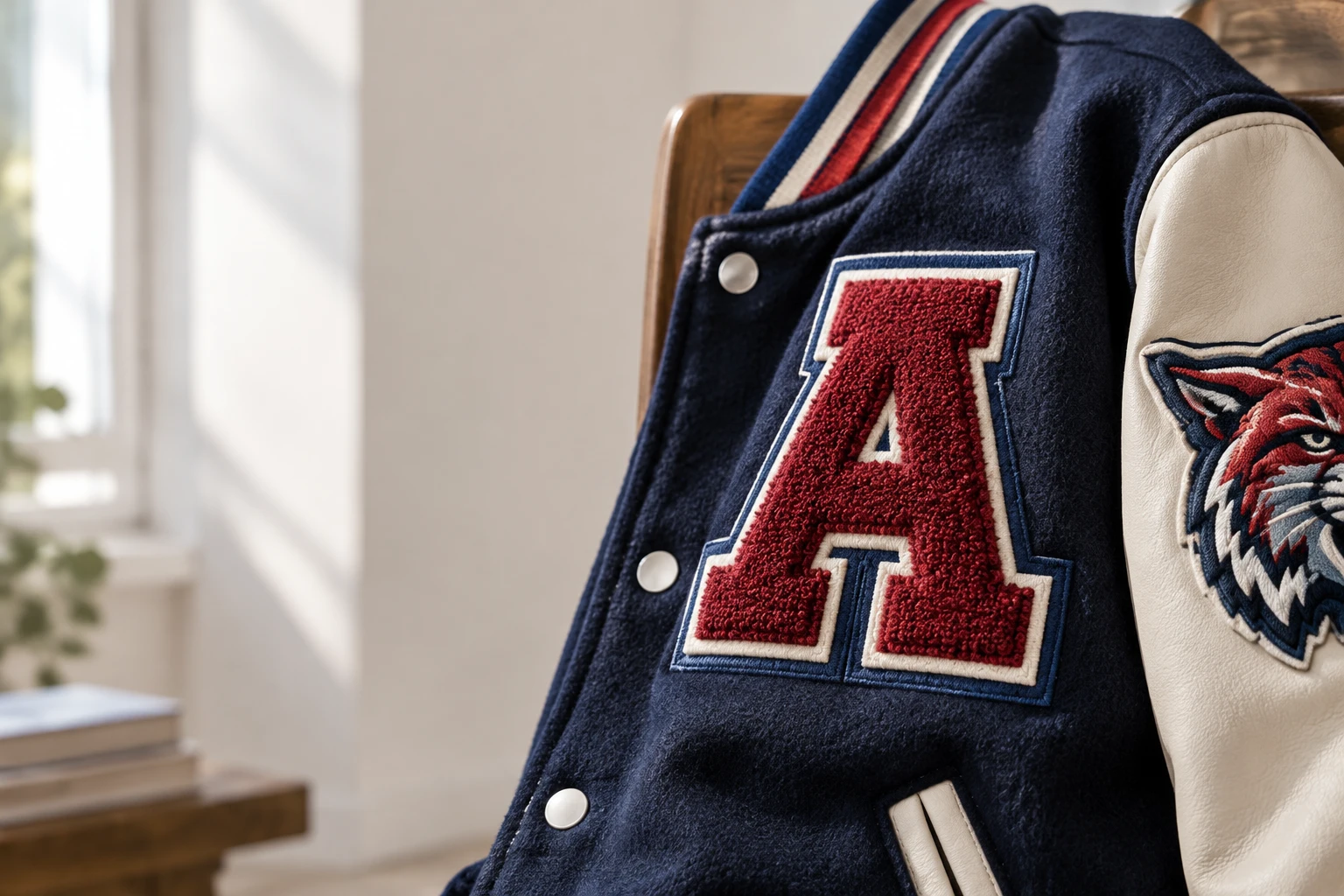
The best chenille patches Phoenix varsity teams can choose for traditional letterman jackets are bold, felt-backed letters with raised yarn, contrasting borders, and sew-on attachment. Keep names, graduation years, and fine mascot details in embroidery rather than forcing everything into chenille. The right specification depends on the actual garment, not just the school logo.
GetUSAPatches serves teams, brands, clubs, and businesses throughout the United States from Corona, CA. We have a 10-piece minimum and provide a free digital mockup before production. We produce only after approval and ship to all 50 states, including Arizona.
What Makes a Chenille Patch Right for a Varsity Team?
A varsity patch has two jobs: identify the school and look right on the jacket for more than one season. Chenille works because its raised yarn gives broad letters a soft, substantial face. It does not need a complicated design to be effective; a readable initial with a clean felt outline often does the job better than a crowded crest.
The best starting construction is a chenille letter or simple mascot on a felt foundation, with embroidery where the artwork needs sharper definition. That combination lets the big shape carry the school identity while a stitched year, sport name, or outline stays more controlled. See the chenille patches hub for the construction category, rather than assuming every raised patch is chenille.
Chenille and raised embroidery are not the same thing
Chenille uses yarn to create a fuzzy, raised surface. 3D embroidered patches use raised embroidery construction for a different look, commonly with firmer, more sculpted shapes. Neither is automatically better, but they should not be quoted as interchangeable products when the athletic director expects a traditional varsity letter.
- Choose broad letter strokes that leave room for yarn without closing the inside openings.
- Use a felt color that separates the letter from the jacket body, especially with dark school colors.
- Keep important small text in embroidery and judge it at the finished size.
- Specify the full patch dimensions, including visible felt, instead of measuring only the raised letter.
A useful supplier comparison starts with those construction notes. Two quotes can show the same letter and still describe different felt layers, borders, dimensions, or backing. Compare the finished specification before comparing the total.
Start With the Garment, Especially in Phoenix
Phoenix teams may issue traditional letterman jackets for awards while players spend much more time in lightweight travel gear. Those are different patch jobs. A thick chenille letter can look appropriate on a wool-blend jacket and feel awkward on a thin polyester warm-up top.
The first production-desk question is simple: what are we attaching this to? A jacket photo helps, but the brand, style number, fabric content, and care label help more. Nylon shells, coated fabrics, stretch panels, and lined jackets all change the attachment discussion.
Letterman jackets, wool coaches, and fleece
Traditional letterman jackets and heavier wool coaches can support the visual weight of a chenille letter. Still, the installer needs to check access behind the outer fabric and decide how to handle the lining. Sewing straight through every layer may leave visible stitching inside or pull the lining out of shape.
Heavy fleece hoodies can also work, but a large patch creates a stiff spot on a soft garment. Test the placement on the smallest size in the order and check how the hoodie hangs when worn. Do not assume the roomy adult XL sample represents a youth medium.
Nylon shells, polos, caps, and performance jerseys
On lightweight nylon shells, a smaller, flatter patch may be the better decision. Dense chenille adds bulk, while sewing can affect a coated shell and heat can damage unsuitable fabrics. Hospitality polos and performance jerseys raise the same practical issue: the decoration should not drag the fabric down or restrict normal stretch.
Caps add curvature and limited sewing access. Review hat patches for that placement rather than shrinking a jacket letter without checking its proportions. A team can keep the same colors and identity across garments without using the same patch construction everywhere.
How to Specify Chenille Patches Phoenix Teams Can Use
There is no single varsity-letter size that fits every jacket. Start with a paper outline, place it on the garment, and measure the space around the pocket, sleeve seam, zipper, and front opening. The outline needs to show the finished felt edge, not just the colorful center.
For an initial layout discussion, a chest letter around 4–6 inches tall can be a useful range to test on a traditional jacket. A smaller award piece might begin around 2–3 inches, while a back emblem may need a much larger area. These are planning examples, not fixed manufacturing limits or school standards.
Use contrast where the patch meets the jacket
A navy letter on navy felt on a navy jacket loses its outline quickly. One contrasting felt layer can create a readable edge without adding another detail inside the letter. If the school uses close colors, such as maroon and black, review a lighter separating border before increasing the patch size.
Layered felt can add depth, but it also adds thickness and increases the finished footprint. That matters near a pocket corner or armhole. The quote should identify the number of visible layers and the overall dimensions so the installer is not surprised by a wider piece.
Specify the edge instead of asking for a generic border
A visible felt outline, an embroidered outline, and an overlocked edge are different instructions. Merrowed crests familiar from uniforms do not automatically describe the edge you want on an irregular varsity letter. Ask which finish suits the shape and make sure the approved artwork shows what remains visible.
- Finished size: state width and height in inches, including every felt layer.
- Face construction: identify the chenille areas and the embroidered details.
- Colors: provide school color references and identify which color belongs to yarn, thread, and felt.
- Edge: describe the visible outline and request confirmation of the proposed finish.
- Attachment: name sew-on, heat-activated backing, or hook-and-loop if suitable and available for the design.
- Placement: include a garment photo with the intended position marked.
This is also the point to decide whether one design must fit every garment. Often it should not. A varsity jacket letter and a booster polo crest can share an identity while using different dimensions and materials.
Chenille vs. Other Patch Types for Team Apparel
The best patch is the one that preserves the important artwork and behaves properly on the garment. Chenille wins on traditional varsity texture, not on tiny lettering or minimum thickness. Printed is flatter; that is the point.
Use this comparison as a starting specification, then review the actual artwork. These are construction trade-offs, not claims that one material outlasts every other material under every wash routine.
| Patch type | Good varsity-team use | Main strength | Trade-off to check |
|---|---|---|---|
| Chenille on felt | Letterman chest letters, large award shapes, bold back emblems | Raised yarn gives broad school letters a traditional varsity appearance | Bulky on thin garments; fine text and narrow openings need special attention |
| Chenille with embroidered details | Letters with a sport name, year, or simple mascot accent | Combines a textured main shape with more controlled stitched detail | Small details still need enough space and can overcrowd the letter |
| Standard embroidery | Travel-jacket crests, polos, booster apparel, smaller team logos | Familiar stitched texture with more flexibility for medium-sized details | Dense stitching can stiffen light fabrics; tiny lettering remains a limitation |
| Woven | Detailed school crests and smaller text-heavy patches | Finer yarn construction supports detail in a flatter patch | Does not reproduce the plush look of a traditional chenille letter |
| Printed | Gradient mascots, illustrated event art, complex color transitions | Preserves artwork that does not translate cleanly into stitched shapes | Flat surface and different visual character from yarn or embroidery |
| PVC | Gear bags and selected outdoor or removable-patch applications | Molded construction offers a distinct dimensional surface | Different weight, feel, and attachment requirements from a varsity letter |
If the mascot has thin whiskers, small eyes, and curved text around its head, compare embroidered patches and woven patches before forcing the whole crest into chenille. For full-color illustrations, printed patches may preserve the design more faithfully. Keep chenille for the part of the uniform where its texture earns the extra bulk.
Prepare Artwork That Still Reads at Finished Size
A school logo can look clear on a laptop and fall apart as a small patch. Thin strokes disappear into the surrounding texture, narrow gaps close visually, and long names take over the available space. Review a printout at actual size before discussing decorative extras.
Supply the cleanest authorized artwork available, preferably a vector file if the school has one. A clear image can still start the conversation, but a screenshot of a screenshot leaves more to interpret. Identify the school-approved spelling, mascot version, and colors instead of asking production to choose between old files.
Give every element one job
For a hypothetical Phoenix basketball team, the large school initial could be chenille, the basketball seams embroidered, and the graduation year placed on a separate small patch. That is easier to read than placing the school name, player name, jersey number, sport, and year inside one letter. It also makes later additions easier to plan.
A marching band might keep the varsity letter identical across the group and add a separate section designation. The same production logic appears in How to Order Chenille Patches for Marching Bands in Los Angeles: shared identity and individual recognition do not have to occupy the same patch.
- Do not set a universal minimum text height without reviewing the lettering style and construction.
- Keep counters open in letters such as A, B, P, and R; their internal spaces are part of readability.
- Ask how loose fine details will be simplified before approving the design.
- Keep sponsor marks and required school identifiers large enough to remain recognizable.
- Separate personalized names from the common design if that makes replacements and roster changes easier.
A digital mockup confirms the proposed layout, dimensions, and construction notes. It does not let you feel the pile, test the attachment, or see an exact physical color match on every screen. If tactile approval or tight color matching is essential, ask about physical sampling options and their effect on cost and timing.
Choose Attachment for the Fabric, Not Convenience Alone
Sew-on is a practical starting recommendation for compatible varsity jackets because the attachment does not depend only on adhesive. The installer still needs an appropriate needle, thread, stitch placement, and access to the garment. A poorly sewn patch can pucker the fabric just as easily as an unsuitable heat application can damage it.
Heat-activated backing can be useful on approved fabrics, but it is not a universal shortcut. The garment, adhesive, press conditions, and care instructions all have to agree. Iron-on that peels after a dryer cycle is a real failure mode; it can result from an unsuitable fabric, incomplete application, or care outside the allowed conditions.
Do not guess at heat settings
Request application instructions for the specific backing and check them against the garment manufacturer's limits. A wool-blend body, synthetic lining, leather sleeve, and coated nylon shell may not tolerate the same process. If the two sets of instructions conflict, change the attachment plan rather than experimenting on the whole team order.
Hook-and-loop makes sense only where the garment and patch are designed for it. On public-safety uniforms, Velcro panels already define the usable size and mating surface; a normal letterman jacket usually has no such panel. Specify whether the quote needs hook backing only or a matching loop piece, and confirm that the chenille design is suitable.
The same restraint applies to fire-unit uniforms and protective workwear: do not assume a decorative patch or a new stitch line is approved for that garment. For ordinary nonprotective jackets, How to Sew On a Patch: A Step-by-Step Guide explains the basic preparation. Lined jackets and difficult placements may still be better handled by an experienced alterations shop.
What Drives the Price of a Varsity Chenille Order?
A useful chenille quote needs more than quantity and a logo. Finished area, shape, construction, felt layers, embroidered detail, backing, and design variations can all affect the work. Ask for the total in USD against a written specification, not a low starting number for an undefined patch.
GetUSAPatches has a 10-piece minimum. If you need several letters, separate sport emblems, or individually personalized pieces, ask how the minimum and pricing apply to those variations. Ten identical letters and ten different player-name designs are not the same production brief.
- Size: larger patches generally require more material and production work, but the full design still matters.
- Construction: extra felt layers and combined chenille-and-embroidery details add operations.
- Variation: names, numbers, and separate artwork versions may need additional handling.
- Quantity: shared preparation can be spread across more identical pieces, although savings must be confirmed in the quote.
- Attachment: special backing requirements and garment installation should be identified separately.
- Schedule and delivery: ask whether any requested service or shipping option changes the total.
Budget beyond the loose patch. As a hypothetical planning example, 30 jackets with an outside installation charge of $5 each would add $150 to the project; that is arithmetic, not a GetUSAPatches installation quote. The same check belongs on a cap run, a biker vest order, or a set of hospitality polos.
Reduce cost by simplifying what does not help recognition, not by making the school letter too small to read. One shared base design with separate award pieces may be easier to manage than a different elaborate patch for every athlete. How Much Do Custom Patches Cost? What Drives the Price offers a broader framework for comparing complete quotes.
Ordering and Lead Times: Work Backward From the Ceremony
Give the required in-hand date, not just the date of the awards banquet. If an alterations shop needs the jackets beforehand, that earlier appointment is the deadline that matters. Leave room for checking counts, sorting personalized pieces, and correcting an installation issue before presentation night.
Production time and shipping time are separate parts of the schedule. Artwork revisions, approval delays, quantities, and construction can affect the first; destination and shipping service affect the second. Shipping from Corona, CA, to Phoenix does not make an unapproved order ready to leave the building.
A clean order follows a short approval chain
- Collect one authorized artwork file, the garment details, placement measurements, and a count by design.
- Send the dimensions in inches, attachment preference, Phoenix delivery ZIP code, and required in-hand date.
- Review the quote for construction, quantity, variations, shipping, and any services that are not included.
- Check the free digital mockup for spelling, school colors, letter proportions, felt edges, and backing notes.
- Have one designated school or team representative give final approval after internal review.
- Confirm the production schedule and shipping plan, then arrange garment installation around the expected arrival.
We produce only after approval. That protects the team from receiving a run based on an old mascot, a misspelled athlete name, or the wrong year. It also means a proof waiting in someone's inbox is not moving through production.
For timing questions, How Long Do Custom Embroidered Patches Take to Arrive in Phoenix, AZ? is a useful related planning guide, but do not treat an embroidered-patch schedule as a chenille promise. Request timing for your actual construction and approved quantity. We ship nationwide to all 50 states, so split destinations should also be discussed before the shipping plan is finalized.
Care and Installation Checks After the Patches Arrive
Open the shipment while there is still time to check it. Count pieces by design, compare spellings and dimensions with the approved specification, and lay a representative patch on the intended garment. Do this before the installer has attached half the order.
For a team run, approve the first completed garment before repeating the placement. A letter that sits correctly on a flat table may look too close to the armhole when worn. Mark the position consistently, but check size changes rather than blindly copying one measurement across every jacket.
- Follow the garment care label and the patch or attachment instructions; do not assume the patch makes a jacket machine-washable.
- Avoid aggressive brushing or picking at raised yarn, which can disturb the surface.
- Do not apply a hot iron directly to the chenille face without specific approved instructions.
- Check lifting edges, loose stitches, and snags early instead of waiting until the patch catches on something.
- Store jackets clean and dry, and keep hook surfaces from rubbing against the chenille pile.
Phoenix heat is another reason not to use a parked vehicle as long-term garment storage. More broadly, sun exposure, moisture, abrasion, and cleaning affect the whole jacket, not just the patch. Ask for care guidance tied to the finished garment rather than expecting one universal washing instruction.
Three Practical Specifications to Start a Team Quote
These examples are starting briefs, not fixed packages or promises that every design will work at the listed size. Each one gives production enough information to raise the right questions. The dimensions still need to be tested against the garment.
Traditional varsity jacket letter
Start with one bold school initial, approximately 5 inches tall including its felt outline, for a wool-blend letterman jacket. Specify chenille for the main fill, a contrasting felt border, and sew-on attachment. Keep the graduation year separate if adding it inside the letter makes the design crowded.
Cheer or spirit-team hoodie emblem
Test a roughly 4-inch-wide simple emblem on a heavyweight fleece hoodie, beginning with the smallest size. Use chenille for the broad shape and embroidery for a short identifier. If the patch makes the chest area too rigid, reduce the footprint or compare a flatter construction rather than adding more adhesive.
Lightweight travel-jacket crest
For a nylon travel shell, begin by comparing an approximately 3-inch embroidered or woven crest against a chenille version. Inspect the fabric, coating, lining, and attachment restrictions before choosing the winner. Using chenille on the award jacket and a flatter patch on travel gear is a coordinated uniform decision, not a compromise in school identity.
For another school-focused reference, read Chenille Patches for High Schools in Houston: Design and Pricing Tips. The city changes, but the useful questions stay the same: what garment, what dimensions, what artwork, what quantity, and what deadline? Answer those first, and the quote becomes much easier to compare.