
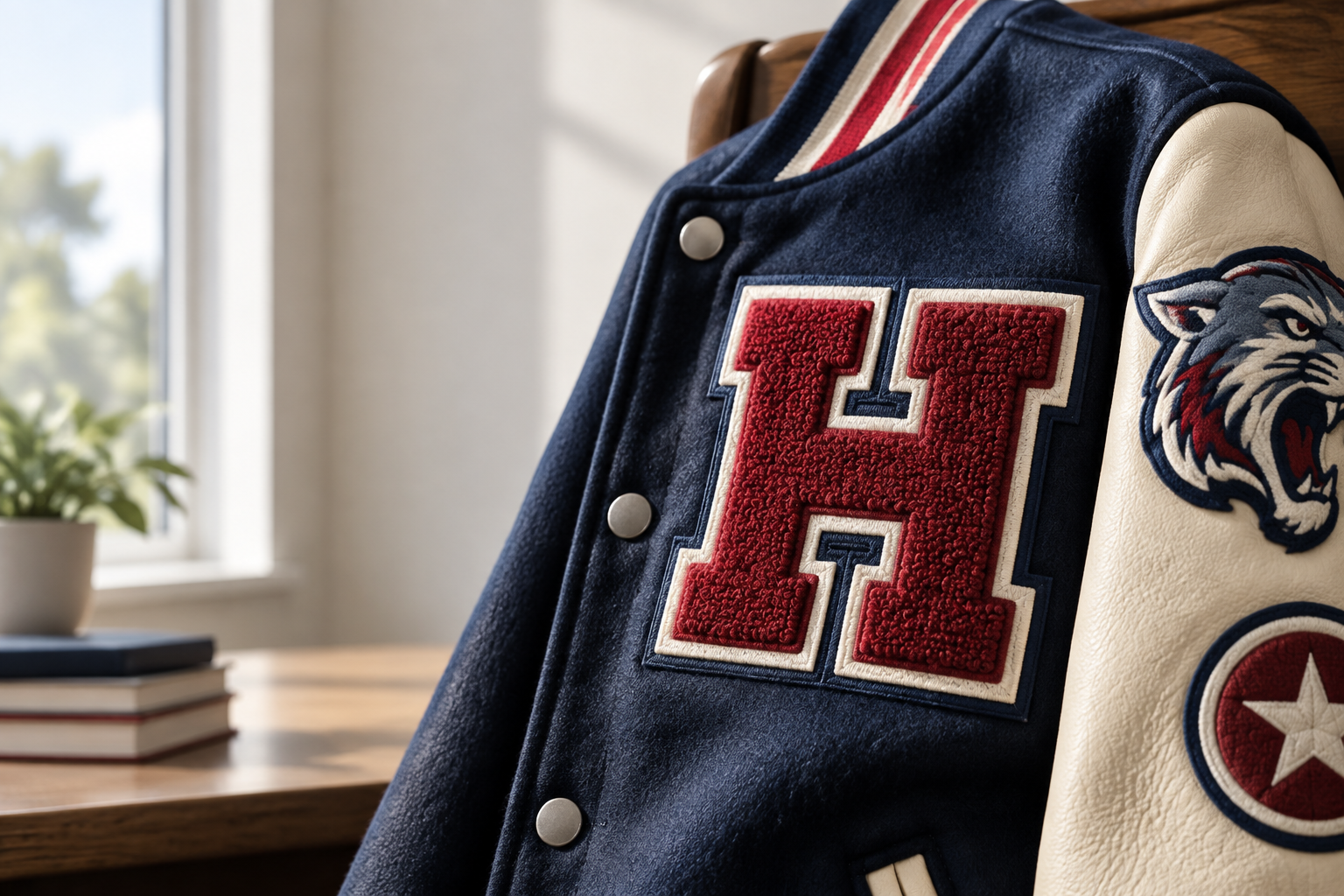
Chenille patches Houston high schools order for letterman jackets work best with bold letters, open shapes, and attachment suited to the jacket fabric. Pricing depends on finished dimensions, felt layers, embroidered details, backing, and quantity—not just the number of colors. Start with a full-size paper template and a written specification so competing quotes cover the same patch.
GetUSAPatches has a 10-piece minimum and provides a free digital mockup before production. We produce only after approval and ship from Corona, CA, to all 50 states in the United States. For a Houston awards night, that means planning the artwork decision, production, transit, and local sewing as separate parts of the schedule.
Designing Chenille Patches for Houston High Schools
Chenille gets its varsity character from raised yarn, usually worked over a felt foundation. That soft surface gives a block H, interlocking initials, or a large paw a different presence than a flat stitched badge. It also takes space, so a detailed school seal rarely translates cleanly without some simplification.
On the quote desk, the useful first question is not how many colors the mascot has. It is what the patch must communicate from a few feet away. A varsity letter, school identity, sport, and graduation year cannot all have equal visual weight on a small jacket chest.
Give the main letter room to work
Use chenille for the broad areas and reserve embroidery for details that need a cleaner edge. A large letter can carry the texture while an embroidered banner handles VOLLEYBALL or a short year designation. Tiny mascot teeth, thin script connections, and closely spaced outlines are candidates for redrawing, not promises to squeeze everything in.
- Choose one primary element: a varsity letter, a simplified mascot, or a short wordmark.
- Keep internal openings visible, especially in letters such as A, B, P, and R.
- Separate the yarn color, felt color, and embroidered accent colors in the brief.
- Use embroidery for smaller wording only after checking it at the actual finished size.
- Ask the school to approve logo use and award wording before the production approval.
For example, a band award might use one bold school letter with an embroidered instrument silhouette and a separate year tab. That arrangement is easier to update than a dense one-piece design containing every instrument, the full school name, and an annual slogan. The same thinking helps cheer, football, debate, robotics, and academic award programs.
Start with the chenille patches hub if varsity texture is the main requirement. The patch design guide is useful when the original artwork was created for a website or scoreboard rather than a stitched object. Screen graphics often need fewer details and stronger spacing before they become good patches.
Size the Patch on a Jacket, Not on a Laptop
A mockup enlarged on a monitor can make small lettering look perfectly readable. The garment gives you the honest answer. Print or cut a paper silhouette, place it on a representative jacket, and look at it both up close and from several feet away.
For initial layout discussions, a school might compare a 4-inch-tall chest letter with a 5-inch-tall version. Those are starting points, not standard sizes that fit every jacket. A narrow letter and a wide interlocking monogram occupy very different amounts of chest space at the same height.
Measure the finished outside edge
State dimensions as finished width by finished height in inches, including the outer felt border. If the art shows a 4-inch letter surrounded by felt, clarify whether the overall patch is larger than 4 inches. This small distinction can affect both the quote and the space left between the patch and the jacket closure.
- Measure the smallest garment size in the order as well as a typical size.
- Keep the proposed patch clear of pockets, snaps, zippers, seams, and ribbed trim.
- Check left-chest placement while the jacket is worn and closed.
- For sleeve awards, measure the usable panel rather than the sleeve circumference.
- Reserve space for future year tabs, captain bars, or sport identifiers.
- Photograph the paper template with a ruler visible so the artwork review has a scale reference.
A wider felt reveal can improve contrast against a dark jacket, but it also increases the footprint. An extra felt layer may give school colors a clearer separation while adding thickness and construction work. Ask to compare the actual outside dimensions instead of treating borders as a free visual addition.
The custom patch size guide helps organize those measurements. For a mixed run of youth and adult jackets, do not assume one large chest letter will sit comfortably on every garment. Two sizes can solve the fit problem, but they may change how the order is priced and grouped.
Match Backing and Construction to the Actual Garment
A traditional letterman jacket, a lightweight nylon shell, and a fleece team hoodie are three different attachment jobs. Their fabrics respond differently to heat, needle holes, and the weight of a raised patch. Send the garment brand or style information and a photo of the care label if there is any uncertainty.
Sew-on is often the practical starting point for a substantial chenille letter on a suitable jacket panel. Stitching provides mechanical attachment, although the installer still needs to choose a needle, thread, and sewing path appropriate to the fabric. A lined jacket may require access between layers so the patch does not accidentally catch a pocket or pull the lining.
Iron-on convenience has limits
Do not assume a household iron can safely attach every chenille patch to every jacket. Heat can damage some nylon shells, coatings, synthetic trims, leather, or imitation-leather panels, and a thick patch can make adhesive activation less straightforward. Use only an attachment method and heat settings confirmed for both the backing and the garment.
Iron-on that peels after a dryer cycle is not necessarily a bad patch; it can be a mismatch among adhesive, fabric, application, and care. That still leaves the family with a loose corner. For a keepsake jacket expected to remain in service for years, discuss permanent stitching and the jacket's cleaning instructions before choosing adhesive for convenience.
Hook-and-loop belongs on a compatible receiving panel
Velcro panels on public-safety uniforms solve a removable-identification problem, but that does not make hook-and-loop the right choice for a varsity letter. The garment needs a compatible receiving panel, and the combined layers add bulk. Confirm whether the quote includes the hook side only or both mating pieces.
A wool coach's jacket may accept a sewn award nicely, while a thin hospitality polo can sag under the same patch. A biker vest brings its own access and needle concerns, especially around leather and existing club layouts. The lesson is consistent: specify the garment before selecting the back, then consult the backing options guide for the attachment trade-offs.
Chenille, Embroidery, Woven, or Printed: Choose by the Job
Not every item in a school apparel program needs the same patch construction. The varsity jacket can use chenille while the booster cap uses embroidery and a detailed commemorative badge uses a flatter process. Keeping the artwork related is usually more useful than forcing identical construction across every garment.
Use this comparison to narrow the specification before asking for prices. These are practical design tendencies, not universal limits; the finished size, artwork, and garment still need review. A patch type that suits a large letter may be a poor answer for a tiny sponsor name.
| Construction | Useful school application | Detail and surface | Main trade-off |
|---|---|---|---|
| Chenille on felt | Letterman chest letters, bold mascot awards, large spirit designs | Raised yarn texture with broad, readable shapes | Small text and narrow gaps need simplification or embroidered details; thickness may overwhelm light garments. |
| Chenille with embroidery | Varsity letters carrying a short sport name, date, or accent | Yarn for the main shape and stitched detail where needed | More construction detail can increase cost; the smallest text still needs a size review. |
| Embroidered | Team crests, coach jackets, booster caps, club badges | Visible thread texture and defined outlines | Dense miniature artwork can become crowded; stitch coverage and size affect the result. |
| Woven | Detailed school crests and smaller uniform or club labels | Flatter construction with finer detail than typical embroidery | It does not provide the raised varsity-yarn appearance of chenille. |
| Printed | Full-color artwork, gradients, illustrated event badges | Flat image reproduction suited to color transitions | Printed is flatter; that is the point. It will not imitate the physical loft of chenille. |
| PVC | Outdoor club gear and suitable equipment panels | Molded shapes with raised or recessed elements | It has a different weight and feel from textile patches and is not a traditional varsity-letter substitute. |
For a booster cap, embroidered patches often make more sense than shrinking a large chenille letter without changing its proportions. If a crest contains several lines of small lettering, compare woven patches before deleting half the wording. Use printed patches when color transitions or an illustration matter more than thread texture.
Edge construction needs its own discussion, too. Merrowed crests have a wrapped perimeter that suits many conventional badge shapes, but a layered felt letter with tight inside corners is a different construction problem. Ask which edge treatment fits the outline rather than requesting the same border on every item in the school store.
What Drives Chenille Patch Pricing?
There is no useful universal price for a Houston school chenille patch without a specification. A plain letter and a layered mascot award can share the same height yet require different work. Get the size, construction, backing, and quantity settled enough that the dollar figure describes an actual product.
Larger dimensions usually mean more material and production work, but size is only one input. Felt layers, intricate outlines, embroidery, personalization, and order structure can all change the quote. Quantity may spread preparation costs across more pieces, although the exact savings need to come from the quoted order rather than an assumed discount.
- Finished size: provide width and height, including the outer border.
- Design complexity: identify interior openings, narrow extensions, and detailed mascot features.
- Construction: list chenille areas, embroidered areas, and requested felt layers.
- Colors: separate yarn, felt, and embroidery colors rather than giving only a total.
- Backing: name sew-on, adhesive, or hook-and-loop requirements and any mating panel.
- Quantity: break out each design, size, colorway, and personalized version.
- Services and delivery: ask what artwork work, samples, shipping, taxes, and any rush handling are included.
Ask what the 10-piece minimum covers
GetUSAPatches has a 10-piece minimum. Do not assume that ten unrelated names or ten different mascots are priced as one identical ten-piece run. If your order includes varsity, junior varsity, and senior-night versions, ask how the minimum and pricing apply to each variation.
Personalization deserves its own line on the quote. One standard school letter for 40 students is different from 40 unique letters carrying individual names or jersey numbers. A shared base letter with separate name or year tabs may be easier to manage, but the total cost still needs comparison.
Compare landed and installed cost
The patch unit price is not necessarily the amount the booster club spends per finished jacket. Add applicable shipping and tax, then include local installation if sewing is handled separately. Ask whether individual packaging, sorting by student, or a physical sample would add charges instead of discovering those costs after the budget is approved.
For a deeper breakdown of quote inputs, use How Much Do Custom Patches Cost? What Drives the Price. Keep the comparison fair: a quote for one felt layer and no installation is not directly comparable to a layered patch with local sewing included. The lower number may simply cover less work.
Build a School Budget Without Guessing at a Price List
Use a worksheet before collecting money from families. The useful formula is patch subtotal plus applicable fees, shipping, tax, and installation, divided by the number of finished garments being supplied. Add a separately identified reserve if the school expects replacement awards or late roster changes.
Here is a planning example only, not a GetUSAPatches price quote: suppose 40 patches were quoted at $12 each, freight at $25, and local sewing at $6 per jacket. The calculation would be $480 plus $25 plus $240, or $745 before tax and any other charges. That is about $18.63 per finished jacket, not $12.
Those example numbers are deliberately separated so you can replace each one with an actual quote. If a school needs two patch sizes or several personalized versions, use separate rows rather than averaging the differences away. A clean worksheet makes it easier for a treasurer to explain why the final cost differs from the first rough estimate.
Trim cost where the design can tolerate it
- Compare one strong felt border with a multi-layer version before cutting the main letter smaller.
- Remove fine decorative elements that do not read at the actual size.
- Use a shared award design where school policy allows, with separate year or activity tabs.
- Ask for quantity comparisons based on realistic enrollment, not an inflated order you cannot use.
- Consider a different construction for caps or lightweight apparel rather than adapting an expensive jacket patch poorly.
- Keep a written record of optional features so the school can approve the base specification first.
Do not reduce the patch until the school initials stop reading just to hit a target number. A simpler 4.5-inch design may serve the jacket better than a crowded 3-inch version, though neither dimension is a universal recommendation. The best economy is removing work that does not improve the finished garment.
Keep the award program in view as well. A dated championship patch can become unusable excess stock, while a standard varsity letter may support future eligible recipients. Order spare quantities intentionally and follow the school's award rules rather than treating every price break as a reason to buy more.
Order Around the Approval Date, Not Just the Banquet Date
A delivery schedule starts with a complete brief and an agreed production approval, not merely the day someone first requests a price. Artwork revisions, purchasing approval, production, transit, receiving, and local sewing all take calendar space. Ask for the current schedule for your exact specification; do not rely on a generic turnaround promise.
GetUSAPatches ships from Corona, CA, to Houston and all 50 states. We are not a Houston pickup counter, and the shipping origin should not be confused with a claim about the country of origin of every material. If your district requires sourcing or purchasing documentation, request it before authorizing the order.
Send one complete quote brief
- Attach the school-approved artwork and explain which elements must remain unchanged. A clear vector file is useful, but ask for review if you only have a high-resolution image.
- Give finished width and height in inches, the garment type, and a placement photo with a paper template.
- List quantities by design, size, and personalization. Identify extra pieces separately from the student allocation.
- Specify requested yarn, felt, embroidery colors, felt layers, and backing. Include a physical color reference if matching an existing award is critical.
- Provide the delivery ZIP code, campus or residential receiving address, event date, and sewing deadline. Mention office closures and receiving restrictions.
- Identify one person authorized to approve the artwork and confirm any purchase-order or invoice requirements early.
A purchasing office may need a written quote before issuing a purchase order; that paperwork should not be assumed to reserve production time. Ask what is required to release the order and how changes affect the schedule. The artwork file guide can help avoid delays caused by low-resolution logos or missing design details.
Treat the mockup as an approval document
GetUSAPatches provides a free digital mockup before production and produces only after approval. Check spelling, year, dimensions, outside border, construction notes, and backing—not just whether the picture looks good. A digital mockup shows the proposed design, but it cannot reproduce yarn feel or guarantee that every screen displays color identically.
If matching an older varsity letter is especially important, ask whether a physical sample or material reference is available and what it adds to cost and timing. Send photos of the existing patch alongside measurements; a camera image alone can distort both color and scale. Do this before final approval, not after the order has entered production.
Separate the carrier's estimated arrival from the date jackets must be ready to hand out. A Friday box delivery does not leave much room for sorting, checking, and sewing before a Saturday banquet. Confirm whether the quoted transit estimate is guaranteed or estimated, and leave room for receiving problems and installation corrections.
Receive, Install, and Care for the Finished Patches
Inspect the shipment before distributing patches to families or handing every jacket to a sewing shop. Count quantities by version and compare the finished pieces with the approved specification. Check spelling, dimensions, border consistency, backing, and any student-specific information while the order is still together.
A little surface variation is part of a yarn-based construction, but that does not excuse a wrong year or missing detail. Photograph any concern clearly and contact the supplier before installation. Sewing first can make a straightforward order issue harder to assess.
- Provide the installer with a placement measurement rather than saying only left chest.
- Approve one installed jacket before the entire run is sewn.
- Check pocket access, lining movement, and clearance around closures.
- Use the approved sewing margin without crushing or trapping unnecessary yarn.
- Keep personalized patches and jackets labeled during sorting.
- Retain a copy of the care guidance with the school order records.
The sew-on patch guide covers the basic attachment sequence, but thick letterman jackets and leather panels may warrant an experienced alteration shop. Do not sew through a pocket simply because the outer placement looks right. Fit and function matter after the jacket leaves the table.
Care should follow the most restrictive instructions for the garment, patch, and attachment. A wool-and-leather jacket should not receive a generic machine-wash recommendation written for a cotton sweatshirt. If a professional cleaner is involved, point out the patch and its attachment rather than assuming the cleaner can identify the backing by looking at the front.
Keep Reorders Consistent Across Teams and School Years
Save the approved artwork, finished dimensions, construction notes, color references, backing, and original order number in a shared school folder. Staff and booster officers change. A photo labeled last year's patch is not enough to reproduce the specification reliably.
Record which details are permanent and which change each season. The school letter may stay the same while the year tab, sport banner, or award level changes. Separating those decisions helps prevent an annual revision from accidentally changing the size or border on every jacket.
Reorders should still receive a current quote and approval, especially if quantities, materials, or deadlines have changed. Do not assume the previous unit price or turnaround automatically applies. If different production batches will be worn side by side, discuss acceptable color variation and any reference sample before proceeding.
For a broader school apparel plan, the sports teams and clubs buyer's guide connects patch selection with uniforms, caps, and club merchandise. The practical goal is simple: one recognizable school identity, with the right construction for each garment. Chenille can carry the varsity tradition without being forced onto every item.