
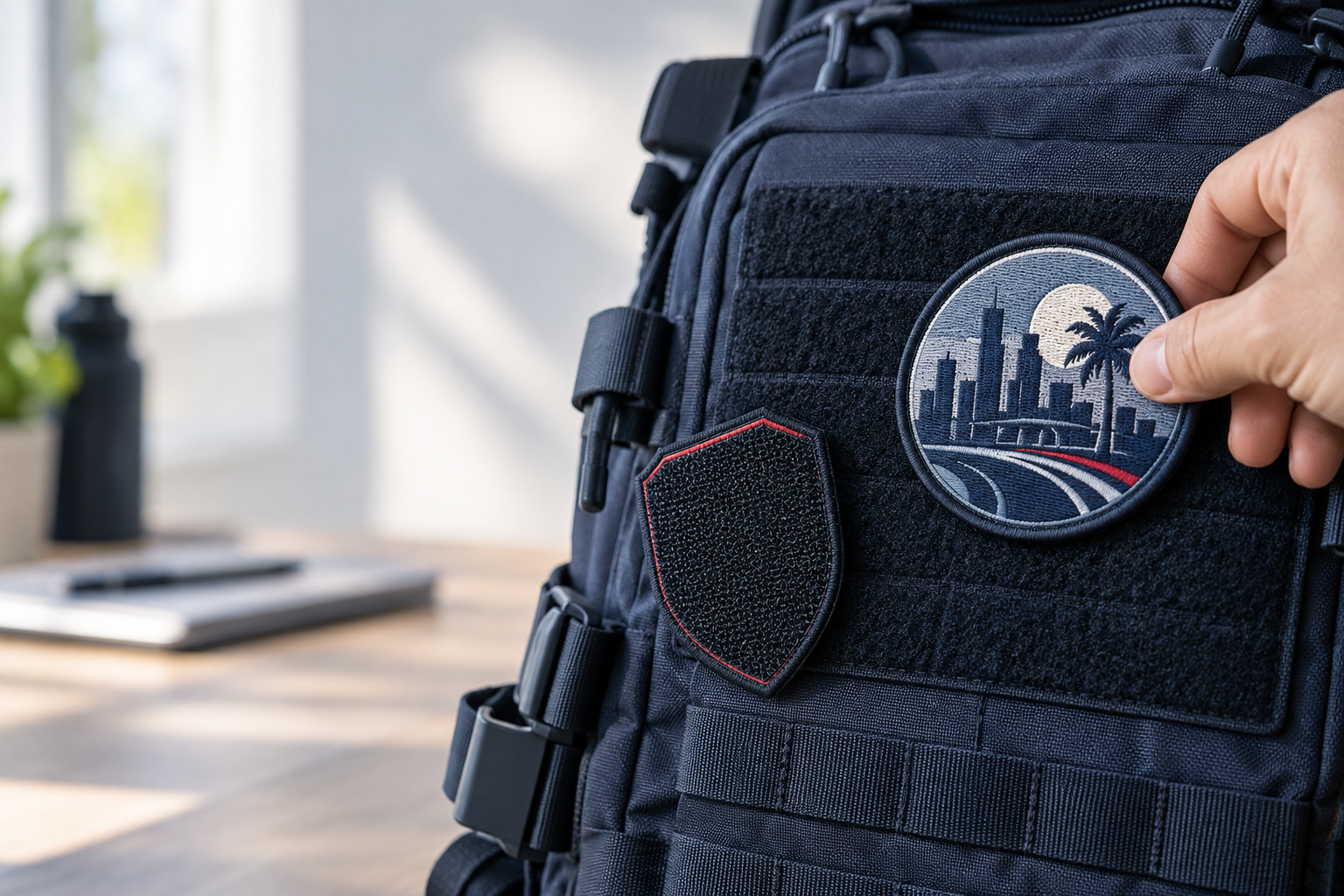
The best custom velcro patches Los Angeles police departments can order are the ones that match approved insignia, fit the actual uniform panel, and keep identification readable. Embroidered patches are a strong starting point for traditional shoulder crests; woven patches suit finer lettering, while PVC makes sense where a wipe-clean face is useful. Specify hook backing for an existing loop panel, not just “Velcro” on the purchase order.
GetUSAPatches works from Corona, CA, and ships throughout the United States, including all 50 states. We have a 10-piece minimum, provide a free digital mockup before production, and produce only after approval. The useful question at the quote desk is not which patch is best on its own; it is which construction fits your approved design, issued garment, and replacement routine.
Start With the Uniform Assignment, Not the Patch Catalog
A patrol shoulder crest, a removable name strip, and a large identification panel do different jobs. They should not automatically share the same material, thickness, or border. Start by writing down where the patch goes and what someone must recognize from it.
For a traditional uniform shirt, matching the existing department crest may settle most of the specification before a quote begins. An outer carrier introduces other questions: panel dimensions, nearby equipment, flex, and how frequently the patch will come off. A jacket can introduce a third set of constraints, particularly if its shell fabric is thin or treated.
Treat Department Approval as a Separate Requirement
There is no single patch construction that this guide can certify for every police department in Los Angeles County. Confirm current requirements with the person responsible for uniform approval or purchasing. An approved-looking crest is not the same thing as an approved crest, and a vendor’s digital proof does not replace that decision.
- Duty uniform: confirm the authorized emblem, wording, colors, dimensions, and placement before changing materials.
- Outer carrier: measure each relevant panel and check that pockets, straps, or garment folds will not cover the lettering.
- Training garment: distinguish training identification from duty insignia and keep the purchasing specifications separate.
- Recruiting or community-event apparel: use the approved event design rather than assuming duty artwork can be altered freely.
- Replacement stock: identify the existing version so a reorder does not quietly introduce a different border, blue, or letter shape.
That same garment-first approach applies to high-school sports teams, fire and public-safety units, and hospitality polos. A patch can look right on a screen and still be wrong on the shirt. Our guide to custom patches for uniforms and workwear covers those placement and construction decisions in more detail.
Choose the Patch Face: Embroidered, Woven, PVC, or Printed
Hook-and-loop describes the attachment system, not the visible face of the patch. You still need to choose what carries the lettering and emblem. Compare that face at the finished size, because enlarging artwork on a monitor hides the problems that appear on a small sleeve crest.
Embroidery for Traditional Crests and Clear Lettering
Embroidered patches use stitched thread to build the design, giving department crests the familiar textured appearance many uniform programs already use. Broad letters, solid shapes, and simplified seals generally give the production team more room to work. The compromise is fine detail: tiny counters inside letters and closely spaced lines can close up as stitches accumulate.
A stitched shield with a substantial outer border can look appropriate on a duty jacket without reproducing every line in a detailed municipal illustration. Do not shrink the whole seal and assume thread will sort it out. Request a version that protects the approved identity while keeping the important features legible.
Woven Construction for Finer Lettering
Woven patches form the design within a woven fabric structure rather than building it with embroidery stitches. They generally support finer lines and a flatter face, making them worth comparing for compact crests with several words. They still have production limits, and a crowded design remains crowded even when its smallest features reproduce.
The trade-off is visual as much as technical. Woven fabric does not have the same raised thread character as embroidery, so a replacement can look different beside older issued patches. Get that change approved rather than treating it as an invisible substitution.
PVC for a Wipe-Clean Face
PVC patches have a molded face that can be useful on outer gear exposed to dust or splashes. Raised and recessed areas can give simple lettering good definition, but deep detail can also hold dirt. The assembled patch still includes backing and attachment components, so a wipe-clean face is not a promise that the whole assembly tolerates every cleaner or wash cycle.
PVC also changes the feel of the garment. A thicker design may be noticeable on a flexible sleeve or a tightly curved panel. Specify the intended application and discuss construction rather than assuming that more thickness means a better duty patch.
Printed Fabric for Artwork That Depends on Color Detail
Printed patches are useful when the artwork depends on gradients, small illustrations, or color transitions that thread would simplify. Printed is flatter; that is the point. For an approved event patch or detailed commemorative design, preserving the image can matter more than adding stitched texture.
For primary uniform identification, evaluate readability and care requirements before choosing print just because the digital artwork looks identical. Ask about the actual fabric, print process, border, and backing assembly being quoted. The broader embroidered, woven, and PVC comparison helps explain why no material wins every application.
Compare the Materials Against the Actual Job
Use this table to narrow a quote, not to override the uniform specification. Two patches made from the same face material can perform differently because of their size, border, backing attachment, and artwork. The finished assembly is what goes on the garment.
| Patch face | Useful starting application | Main advantage | Trade-off to check | Question for the quote |
|---|---|---|---|---|
| Embroidered | Traditional department shoulder crest or bold unit emblem | Familiar thread texture and clear, substantial shapes | Dense lettering and miniature seal details may need simplification | Can the approved lettering remain readable at the proposed finished size? |
| Woven | Compact crest with finer lettering or closely spaced linework | Flatter fabric face with finer detail than typical embroidery | Appearance may differ from existing embroidered uniform stock | Will this change in texture and border match the approved uniform program? |
| PVC | Approved outer-gear identification or simple unit design | Molded face that can be wiped clean | Thickness, flex, recessed dirt, and backing care need review | What face thickness, hook attachment, and cleaning instructions are proposed? |
| Printed | Approved detailed event, commemorative, or color-rich design | Reproduces artwork that depends on gradients and illustration | No raised thread texture; abrasion and care depend on construction | What print process, fabric, edge finish, and care limits apply? |
For a conventional crest with bold text, embroidery is a sensible first quote. For a compact seal with fine text, compare woven construction before increasing the stitch density. For an outer-gear patch that needs routine surface cleaning, compare PVC while checking that its profile is acceptable on that specific garment.
Specify Custom Velcro Patches Los Angeles Units Can Reorder
VELCRO is a brand name; hook-and-loop is the general attachment type. Buyers often use “Velcro patches” to mean any removable hook-backed patch. If procurement requires branded fasteners or a particular component specification, state that explicitly and have availability confirmed in writing.
Most existing uniform loop panels receive a patch with the rough hook side on its back. A separate loop piece is only necessary if the garment needs a receiving surface or the order requires both halves. “Velcro backing included” is too vague if one buyer expects hook only and another expects a matched pair.
Measure the Usable Panel, Not the Catalog Illustration
Lay the actual garment flat and measure the available loop area in inches. Account for rounded corners, raised seams, curved edges, and adjacent pocket openings. A panel described as 4 × 2 inches may not offer that entire rectangle as an unobstructed contact area.
A 3.5 × 2-inch patch is an example size, not a police standard. Trace the proposed outline on paper and place it on the uniform before approving dimensions. If exposed hook extends beyond the receiving panel, it can catch nearby fabric; if the patch is oversized, its edges can lift or interfere with movement.
- Finished dimensions: list maximum width and height, including the border, in inches.
- Face construction: identify embroidery, woven fabric, PVC, or print rather than writing only “patch.”
- Backing: state hook only or hook plus a separate loop piece, and request the proposed attachment method.
- Outline and edge: identify the approved shape and whether the border should resemble current issued patches.
- Colors: provide department references or an existing approved sample, not just a screen capture.
- Versions: list full-color, subdued, name, rank, or unit variations separately, with quantities for each.
Also ask about finished-size tolerances if the fit is tight. Hook density, engagement, and edge stiffness can differ among components, so physical fit checks matter for demanding applications. The hook-and-loop attachment guide explains the backing arrangement, while the patch size guide helps turn a garment measurement into a usable brief.
Match the Assembly to Carriers, Nylon Shells, and Uniform Shirts
A removable patch does not solve every garment problem. It needs a suitable receiving panel, and that panel must be attached appropriately to the garment. If a carrier already has loop fabric installed, replacing only the removable patch is a different job from adding loop material to an unmodified jacket.
Nylon shells deserve particular care. Heat can damage some fabrics or finishes, and sewing can affect a shell’s construction or weather resistance. Check garment instructions and any manufacturer restrictions before adding a panel; do not treat an outer shell like a plain cotton work shirt.
Do Not Substitute Iron-On for a Removable System
Iron-on adhesive and hook-and-loop solve different problems. An iron-on that peels after a dryer cycle often points to a mismatch among adhesive, application, garment, or care routine. It is not a reason to stack another unapproved adhesive behind a duty patch and hope the assembly holds.
For a new receiving panel, ask the uniform supplier or qualified alteration provider how it should be attached. Keep stitching away from any area the garment manufacturer prohibits, especially on protective equipment. Our patch backing options guide explains the differences without assuming that one attachment method fits every fabric.
Why the Same Crest Behaves Differently on Different Garments
The production questions change between hospitality polos, wool coaches’ jackets, biker vests, and letterman jackets. A heavy merrowed crest may look right on wool but pull at a lightweight polo; a stiff rectangle can bridge the curve of a cap instead of sitting against it. Uniform carriers introduce similar fit questions even though their purpose is different.
For a department cap, measure the cap’s own loop panel and check the crown curvature. Do not automatically reuse the shoulder crest dimensions. The hat patch guide is useful here because cap structure, seams, and limited front space can force a separate layout.
Make the Lettering Readable Before Adding Texture
The first artwork review should happen at actual size. Print the proposed design at 100%, place it on the garment, and look at it from the distance relevant to its job. A name strip read at conversational distance and a larger identification panel are not interchangeable design assignments.
There is no honest universal minimum letter height for every patch process, font, and material. A simple block letter can survive a size reduction that destroys a narrow serif letter. Ask the production team to flag strokes, gaps, and enclosed spaces that may not reproduce cleanly.
Protect Contrast and Approved Color Relationships
Dark gray letters on a black face can look distinct on a bright screen but become difficult to separate on the uniform. If a subdued version is authorized, review that version on its own rather than merely darkening the full-color proof. Keep the approved role of the patch in mind; decorative subtlety and easy recognition can pull in opposite directions.
Screen colors also do not establish a physical thread match. Use department color references or an approved physical patch when available, and discuss acceptable variation before a reorder. The thread color matching guide explains why artwork values and actual thread need separate attention.
Choose an Edge That Fits the Outline
Merrowed borders give many conventional crests a substantial, familiar edge, but tight internal corners and intricate outlines may call for a different finish. A cut edge can follow shapes that a thick wrapped border cannot reproduce as neatly. Review the border comparison guide before approving a complicated silhouette.
Extra dimension is not automatically helpful on identification. 3D embroidered patches can suit bold decorative lettering, but raised foam embroidery is usually a different design direction from a detailed uniform seal. Choose it only when that appearance is intended and approved, not as a default upgrade.
Understand What Changes the Quote
A useful quote compares the same finished specification across quantities. If one price includes a matching loop piece and another includes hook only, the unit prices are not directly comparable. The same problem appears when one quote assumes a simple rectangle and another includes an intricate custom outline.
GetUSAPatches has a 10-piece minimum. Ask how that minimum applies to separate designs, names, sizes, or colorways rather than assuming every variation can share one minimum. Ten identical shoulder crests and ten individually named strips create different production questions.
- Size and shape: larger dimensions and more complicated outlines can change material use and finishing work.
- Face construction: embroidery setup, woven development, printing, and molded PVC involve different production requirements.
- Artwork complexity: dense stitching, fine detail, or multiple molded levels may affect feasibility and cost.
- Backing assembly: hook coverage, the method of attachment, and separate loop pieces must be included in the comparison.
- Quantity by version: the total order count alone does not explain how many distinct items need production.
- Packaging and delivery: confirm sorting, labeling, shipping charges, and any requested schedule accommodation in the written quote.
Compare the approved order total in USD, then divide by the number of usable patches. As a math example only, a $360 total for 60 patches equals $6 per patch; that is not a GetUSAPatches price quote. Ask whether the stated total includes shipping, applicable tax, setup, and any other line items.
Stock planning matters as much as the first unit price. Separate the initial issue quantity from replacement stock and expected additions, but do not buy an arbitrary percentage of extras without checking how the department uses them. What drives custom patch pricing provides a fuller comparison of the variables to put on the quote request.
Order From Corona, CA, With a Clear Approval and Delivery Plan
Ordering custom Velcro patches in Los Angeles starts with a complete brief, not a request for the fastest possible date. Send the approved artwork, actual panel measurements, face material preference, backing requirement, quantities by version, and delivery ZIP code. Include the date the patches need to be in hand and the date they will actually be issued.
GetUSAPatches ships from Corona, CA, to Los Angeles and all 50 states. A nearby destination does not remove artwork review or manufacturing from the schedule. Confirm production time and carrier transit separately, and do not assume local pickup or same-day service is available.
A Practical Five-Step Ordering Sequence
- Collect the approved source files. Vector artwork is helpful for clean shapes, but send the best available file and any physical reference instead of recreating an emblem from a poor screenshot.
- Document the garment. Provide straight-on photos, usable panel dimensions in inches, and notes about curves, seams, or nearby equipment.
- Request a written specification and quote. Include face material, border, hook backing, any separate loop piece, quantities, packaging needs, and the destination.
- Review the free digital mockup. Check spelling, orientation, width, height, color references, backing notes, and every version that will be produced. Route it to the actual department approver.
- Approve the final version and confirm the schedule. GetUSAPatches produces only after approval; retain the approved proof and order specification for receiving checks and later reorders.
The free digital mockup shows the proposed design and layout before production. It does not physically test hook engagement, garment flex, cleaning resistance, or the feel of a molded patch. If those characteristics determine acceptance, ask about physical sampling, availability, cost, and timing before authorizing the full run.
For a deadline, plan backward through delivery, production, final approval, and revisions. Ask what happens to the projected delivery date if approval arrives later than planned. The production timeline guide separates those stages, and the artwork file guide helps prevent avoidable file problems.
Keep one final approver and one current proof version whenever the purchasing process allows it. Conflicting comments from several people can leave the vendor holding two different instructions for the same order. For issue-day planning, give receiving staff time to count and inspect the delivery before the patches go onto uniforms.
Inspect the Delivery and Keep Removable Patches Working
At receiving, compare the patches with the retained specification rather than someone’s memory of the design. Check counts by version, spelling, dimensions, border finish, visible color consistency, and backing coverage. Lay representative patches on the intended garments before distributing the full order.
Look for lifting edges, excessive stiffness, an outline that crosses the panel boundary, or text hidden by a pocket or strap. A patch can pass a flat tabletop inspection and still sit poorly on a worn carrier. Report discrepancies with clear photographs, dimensions, and the order reference.
Separate Face Cleaning From Fastener Maintenance
Lint and debris can interfere with hook-and-loop engagement. Inspect both mating surfaces and clean them using methods appropriate to the supplied components. Avoid aggressive picking or scraping that damages the hooks or pulls out loop fibers.
Follow the care instructions for the entire patch assembly and the garment. Where those instructions call for it, remove the patch before laundering and protect exposed hook from contacting delicate fabrics. A washable face material does not prove that its adhesive, stitching, border, and backing tolerate the same treatment.
- PVC faces: use the recommended cleaning method; do not assume strong solvents or disinfectants are compatible.
- Embroidered faces: inspect for loose threads and avoid pulling them, which can disturb neighboring stitches.
- Woven and printed faces: avoid abrasive scrubbing that can damage a fine fabric surface or printed image.
- Hook-and-loop contact: inspect for flattened hooks, worn loop areas, trapped lint, and incomplete contact at the edges.
- Stored replacements: protect faces and fasteners from snagging each other, and keep versions labeled for accurate issue.
If retention becomes inconsistent, inspect the garment panel as well as the removable patch. Replacing the patch alone will not repair a worn receiving surface. The patch washing and care guide offers a useful starting point, but the supplied product and garment instructions should guide the actual routine.
The Best Choice Is the One You Can Approve, Issue, and Repeat
For many traditional police crests, start with an embroidered face and the hook backing required by the issued garment. Move to woven construction when approved detail needs finer reproduction, compare PVC for an outer-gear application with surface-cleaning needs, and consider print when the artwork depends on illustration or gradients. Those are selection principles, not a substitute for a department specification.
A good reorder file is plain and complete: approved artwork version, finished dimensions, color references, face material, border, backing, and quantities by variation. Keep photographs of the accepted patch on the actual uniform, too. That record is more useful six months later than a purchase order that says only “same police patches as last time.”
The patch does not need every available feature. It needs the right face, a compatible fastening system, and an approval trail that purchasing and uniform staff can both follow. Get those decisions settled before production, and the order becomes easier to inspect, distribute, and repeat.