
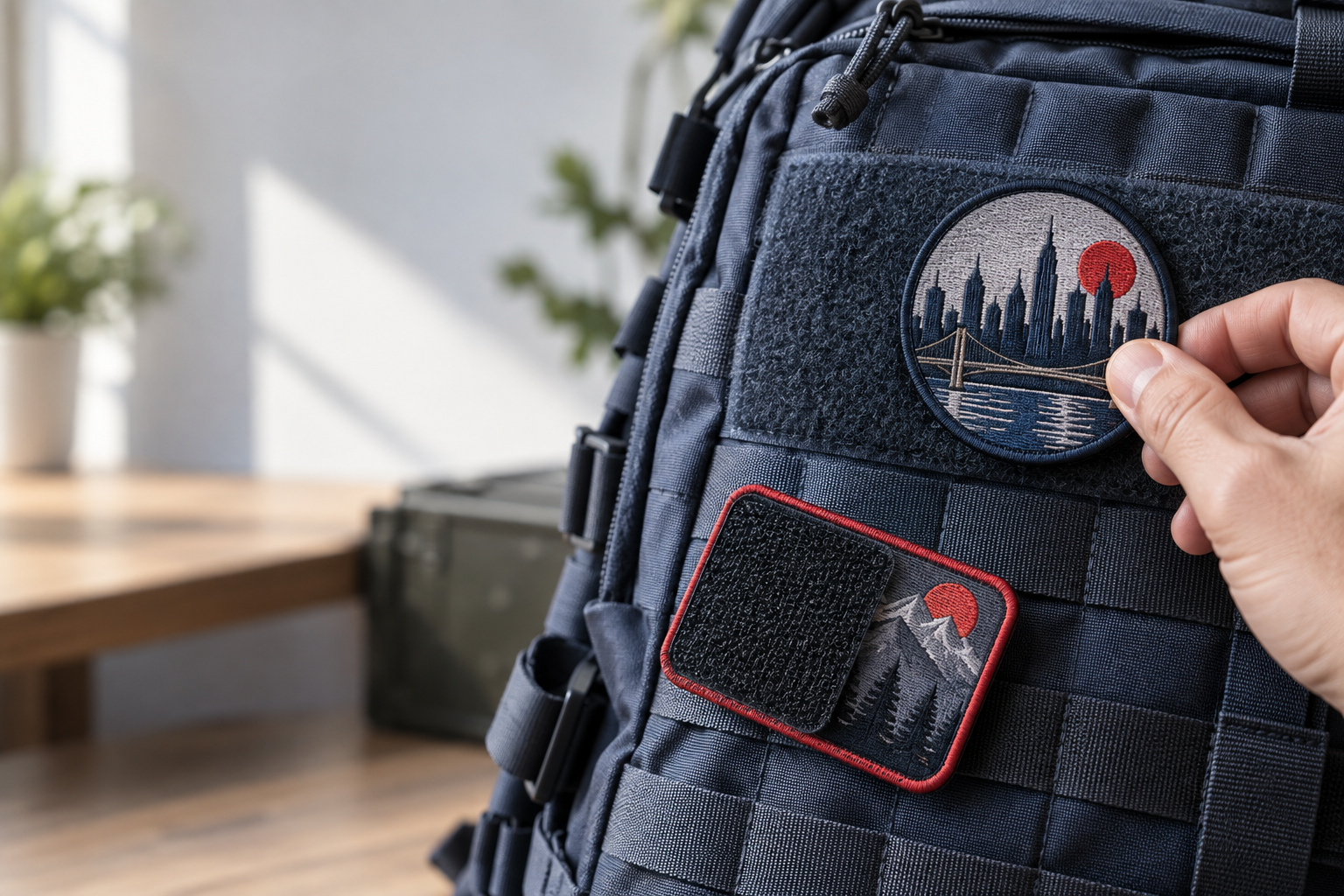
For custom velcro patches New York airsoft teams can use across rigs, sleeves, and caps, start with the receiving panel: measure it, choose a readable face material, and specify hook backing. GetUSAPatches has a 10-piece minimum and provides a free digital mockup before production. We produce only after approval and ship from Corona, CA, to all 50 states.
The useful quote is not just a price for a logo. It accounts for the patch dimensions, border, face construction, backing, quantity, and the date your team needs the finished order in hand. A crest that works on a letterman jacket can become a crowded little knot of thread on a cap, and a patch that fits one plate carrier may hang past the loop panel on another.
Start with the gear, not the logo file
Put the actual equipment on the table before deciding on a size. Measure the usable loop area on a plate carrier, chest rig, combat shirt sleeve, or tactical cap, staying inside seams and away from buckles. The listed dimensions of the garment are not the dimensions of its patch panel.
A 3-inch-wide by 2-inch-high rectangle is a useful starting point for a design conversation, not a universal airsoft standard. Some panels accept a wider identification strip; others have rounded corners or interrupted stitching. Cut a paper outline and place it on the gear before treating any measurement as final.
Hook goes on the patch; loop usually lives on the gear
The hook side has the small gripping elements. The loop side is the softer receiving surface commonly sewn onto tactical equipment. A hook-backed patch will not attach properly to plain nylon, another hook surface, or a sleeve that only looks textured.
Specify hook backing only if your equipment already has a compatible loop panel. Ask for a separate matching loop piece if you need to add a receiving panel, and confirm that its cost is included. Velcro is a brand name; if branded VELCRO® material is required rather than generic hook-and-loop, put that requirement in writing and confirm availability.
- Plate carriers: check the usable panel with pouches, straps, and hydration equipment installed.
- Combat shirt sleeves: inspect curvature and nearby pocket openings before selecting a large, stiff face.
- Tactical caps: test the finished outline on the curved front panel, not just a flat photograph.
- Team jackets: determine whether a receiving loop panel must be sewn on before ordering removable patches.
For the attachment details, use Velcro® Patches: How to Attach and Use Hook-and-Loop Backing. It is worth resolving the receiving surface first; changing the face artwork will not fix the wrong backing.
Choose the face material for the way your team plays
Velcro describes the attachment request, not the decorated face. An embroidered patch and a PVC patch can both have hook backing, but they differ in texture, flexibility, detail, cleaning, and setup. Choose the face for the design and field use, then confirm the complete construction.
Embroidered patches are a sensible starting point for bold team crests, block lettering, and familiar uniform texture. Thread gives the design depth, but it also occupies space. Tiny compass markings and tightly packed slogans often need to be simplified rather than forced into the stitch file.
| Face material | Strongest use | Main trade-off | What to confirm on the quote |
|---|---|---|---|
| Embroidered | Bold team names, shields, and traditional unit-style crests | Raised thread can snag; fine lettering may need enlargement or simplification | Thread colors, coverage, border, finished size, and hook backing |
| Woven | Compact identification patches and logos with finer lettering | Flatter appearance with less of the raised embroidered texture | Small-text readability, edge finish, color matching, and backing assembly |
| Printed | Gradients, illustrated event art, and photographic effects | Printed is flatter; that is the point, but the surface has different abrasion limits | Print substrate, color expectations, care instructions, border, and backing |
| PVC | Bold graphics intended for frequent surface cleaning | Molding setup and thickness can be less attractive for a small, detailed run | Mold or setup charges, relief levels, dimensions, colors, and hook attachment |
Woven patches deserve a look when the team name has a lot of letters and the available panel is small. They can resolve finer detail than conventional embroidery, but they cannot make microscopic text readable across a staging area. The physical letter height still matters.
Printed patches make sense for event artwork with shading or a city skyline fading into the background. PVC patches suit simplified artwork and a face that can be wiped down after muddy play. Neither choice makes the entire patch assembly indestructible; the edge, backing attachment, and receiving panel still do work.
For a side-by-side material discussion, see Embroidered vs. Woven vs. PVC Patches: Which Should You Choose?. New York weather does not automatically mean PVC is the only answer. An indoor team, an outdoor woodland group, and a club ordering merchandise may have three different priorities.
Build a design that survives actual patch size
A logo can look excellent at 12 inches across on a monitor and fail at 3 inches on a sleeve. Start with a clear hierarchy: team name first, main symbol second, optional location or year third. If all three elements demand equal attention, the patch usually needs fewer details.
Print the proposed design at its intended finished size. Look at it at arm's length, then from several feet away, under ordinary room light rather than a bright screen. This simple check catches cramped wording, disappearing outlines, and a mascot that turns into an unrecognizable dark shape.
Lettering and contrast matter more than another decorative line
For an initial embroidered layout, text around 0.25 inch tall is a useful discussion point, not a universal production limit. Font shape, thread, stitch direction, and the background all affect the result. Ask for an artwork review instead of assuming a fixed minimum works for every design.
Open block lettering gives small characters room to form. Thin scripts, narrow counters inside letters, and distressed fonts can close up or become uneven when translated into thread. If the full team name cannot fit comfortably, move the location to a second line or use an abbreviation the members actually recognize.
A subdued patch sacrifices visibility by design. Dark olive lettering on black may suit the uniform palette, but it should not be expected to read like white lettering on navy. For identification at an event, follow the organizer's requirements instead of relying on a low-contrast team crest to perform a separate identification job.
Keep operational details separate from the permanent crest
Consider a shared team crest plus separate removable name or role tabs. Putting every player's name into the main artwork creates individual variants, adds approval work, and makes replacement stock less useful. A common crest can move to a new member without redesigning the whole patch.
The same distinction helps with event dates and squad assignments. Put temporary information on a separate piece when possible, and avoid graphics that could be mistaken for real public-safety credentials. How to Design a Custom Patch: 10 Tips for a Great Result expands on simplifying artwork without losing its identity.
Specify custom velcro patches New York teams can reorder accurately
A complete specification should survive a change in team captain. Write down finished width and height in inches, orientation, face material, border, colors, and backing. Save the approved artwork and order reference where the next person handling merchandise can find them.
Border choice is part of that specification. Merrowed crests have a raised wrapped edge that suits many circles, shields, and rectangles. Fine points and deep inward cuts often need another edge treatment, subject to the face material and the approved shape.
- Finished size: state width by height, including the border, and identify any maximum panel dimensions.
- Shape: include corner treatment and any unusual cuts rather than relying on a rough description.
- Face: specify embroidered, woven, printed, or PVC instead of writing only “Velcro patch.”
- Backing: confirm hook only or hook plus a separate matching loop piece.
- Edge: identify the intended border and ask whether it suits the shape.
- Colors: list the team colors and any reference codes, while recognizing that thread, ink, and PVC render color differently.
- Variants: separate full-color, subdued, named, and event-specific quantities.
Use Merrowed vs. Hot-Cut vs. Laser-Cut Borders: What's the Difference? to frame the edge discussion. Do not choose a complicated silhouette only because the source logo has one. A compact outline often sits better against a carrier and leaves fewer exposed points to catch.
Also distinguish a digital proof from a physical sample. A digital mockup shows the proposed layout, colors, dimensions, and specified construction, but it does not let you feel thickness or test grip on your exact equipment. If physical sampling is needed, ask about availability, charges, and timing before the order schedule is settled.
Pricing: compare the finished order, not an isolated unit price
There is no responsible single price for every airsoft patch with hook backing. Size, quantity, face construction, embroidery coverage, border, setup, and variants change the work involved. The quote also needs to establish whether matching loop pieces, individual packaging, shipping, and applicable tax are included.
GetUSAPatches has a 10-piece minimum. That makes a small team run possible, but it does not mean ten separate designs automatically share the same pricing as ten identical patches. Ask how the minimum and setup apply to color changes, names, and separate sizes before collecting payments from members.
The main cost drivers on a team order
- Quantity of each design: setup is spread across more identical pieces as the run grows, though the actual price breaks require a quote.
- Finished dimensions: a larger patch uses more material and may require more stitching or printing area.
- Face construction: embroidery, weaving, printing, and molded PVC involve different preparation and production work.
- Artwork demands: dense embroidery, small details, relief levels, and unusual shapes can change production requirements.
- Backing assembly: hook backing and a separate loop receiver are not the same specification as a plain sew-on patch.
- Variants and sorting: individual names, multiple colorways, and member-by-member packaging add work beyond making one repeated crest.
- Schedule and delivery: ask whether the requested date changes available production or shipping options.
The clean comparison is delivered order total divided by the number of usable patches received. If one quote includes hook backing and another is for a plain sew-on face, their unit prices do not describe the same product. How Much Do Custom Patches Cost? What Drives the Price explains the broader pricing inputs.
A dollar example for comparing quotes
The figures below are invented arithmetic examples, not GetUSAPatches prices, estimates, or offers. They show why a team should compare the complete order rather than the largest-looking number on a quote. Both examples assume 30 otherwise equivalent patches with hook backing included.
| Illustrative line item | Example quote A | Example quote B |
|---|---|---|
| 30 finished patches | 30 × $6.00 = $180 | 30 × $5.00 = $150 |
| Setup | $0 separately listed | $45 separately listed |
| Shipping | $20 | $20 |
| Total before applicable tax | $200 | $215 |
| Effective cost per patch before tax | $6.67, rounded | $7.17, rounded |
In that example, the lower unit price produces the higher order total. A real comparison also needs matching construction, delivery terms, and quantities; arithmetic cannot compensate for different specifications. Get those details in writing before presenting a per-member cost to the team.
Ask for pricing at your required quantity and at the next practical stock level. For example, a team needing 24 crests might compare 24 with 30 so replacements are available, but the larger order still has to fit the budget. An extra box of patches is not a saving if it sits unused while the team changes its name.
Three planning examples for New York airsoft teams
These are planning scenarios, not customer stories. The point is to show how different equipment and order goals change the specification. A New York City indoor group should not copy an outdoor team's patch solely because both play airsoft.
A 12-player indoor team using mixed equipment
Start by checking the smallest usable panel across the group. A bold embroidered crest may work well if the design has a short name and one clear symbol, while a woven face may be easier to read if the name is longer. Keep individual names separate so spare crests remain useful.
The ordering trap is assuming everyone needs exactly one patch. One player may want a sleeve crest and a cap patch, while another only has a carrier panel. Collect placement and dimensions alongside the roster rather than multiplying the player count by a guess.
A Hudson Valley woodland group
Frequent mud and repeated surface cleaning make PVC worth comparing, especially for a simple shield with broad lettering. Embroidery remains an option if the team values thread texture and accepts more careful cleaning. Compare actual construction rather than calling either one weatherproof without qualification.
A full-color club version and a subdued field version can share a general layout, but they need separate color review. They may also be treated as separate variants for pricing. The Custom PVC Patches in New York, NY: Complete Guide for Tactical Teams is a useful next read for molded designs.
A statewide club ordering event merchandise
A detailed event illustration may be better suited to a printed patch than an embroidered crest. A flatter face preserves the intended artwork instead of turning every shadow into a thread-color decision. Keep the permanent club identity separate if you want leftover stock to remain useful after the event.
If the same mark is going onto hat patches, make a cap-specific layout rather than shrinking everything mechanically. A patch for a curved cap front and a patch for a flat admin panel solve different fit problems.
Ordering and lead times: work backward from the field date
Use the date you need the order in hand, not just the date of the game. Leave time to count the shipment, distribute patches, and address a problem before the team leaves home. An event in Buffalo and a pickup point on Long Island may also involve different internal distribution plans after the parcel reaches your organizer.
GetUSAPatches ships nationwide across the United States from Corona, CA, including all 50 states. A New York-focused design does not mean the shipment starts in New York. Provide the destination ZIP code and request the current production estimate and shipping options for that specific order.
- Collect the gear measurements and quantities. Separate the main crest from name tabs, cap versions, and color variants.
- Send the best artwork available. Include the finished dimensions, preferred face material, border, backing, and receiving-panel photos.
- State the delivery destination and needed-in-hand date. Explain any earlier deadline for team distribution.
- Review the quote for scope. Check setup, backing, matching loop pieces, variants, shipping, and applicable tax.
- Review the free digital mockup. Check spelling, orientation, colors, dimensions, shape, and the written construction notes.
- Give explicit approval after corrections are complete. GetUSAPatches produces only after approval.
- Confirm the current production and shipping schedule. Do not assume the first email or first mockup started the production clock.
Send useful artwork, even if it is not perfect
A vector file is helpful because shapes can be inspected and resized without the pixelation of a small screenshot. A clear PNG or JPG can still be a starting point, but missing detail should be identified rather than guessed. Send a clean logo file instead of a photograph of a patch clipped from a social post if you have the original.
Keep the logo file separate from reference photos, and identify which image controls the final wording and layout. The Artwork File Guide for Custom Patches: Vector, PNG, JPG and More explains what makes an art file useful. Converting a blurry image into a different file extension does not restore lost detail.
Approve the specification, not just the picture
A team captain should check every letter, the finished dimensions, the patch count, and the backing notes before approving. Ask another member to proofread names and dates; people tend to overlook mistakes in familiar wording. Color displayed on a phone is not a physical thread or PVC sample.
No fixed delivery promise belongs in a general guide because material, quantity, revisions, and shipping service affect the schedule. Ask for current timing at the quote stage and reconfirm it after any substantial change. Custom Patch Production Timeline: From Artwork to Delivery separates the approval, production, and transit stages.
Attachment and care: avoid the failures that start at the garment
A properly specified patch can still perform poorly on worn or lint-filled loop material. Seat the full hook surface against the panel instead of leaving corners unsupported, and check that straps are not repeatedly lifting an edge. Remove debris gently according to the material's care instructions rather than scraping aggressively at the backing.
Remove detachable patches before laundering when the garment and patch instructions call for it. Exposed hooks can catch other clothing in the load, while high heat may affect parts of the patch assembly. Keep hook faces covered by compatible loop material during storage when practical.
Do not solve every attachment problem with heat
An iron-on that peels after a dryer cycle is not a reason to apply more heat blindly. Nylon shells can be heat-sensitive, and coated fabrics may not accept an adhesive as expected. If the jacket has no loop panel, decide how the receiving panel will be attached before ordering the removable crest.
Wool coaches' jackets, hospitality polos, biker vests, high-school warmups, and letterman jackets do not belong under one attachment rule. Fabric stretch, lining, finish, thickness, and access behind the panel affect the method. Sewing a receiver onto a weather-resistant shell may also alter that garment's performance, so consult its care guidance or a qualified alteration shop.
For an existing compatible loop panel, there is no reason to add iron-on adhesive to a hook-backed patch. If the group is ordering both removable field patches and permanent jacket crests, specify them as separate backing requirements. Patch Backing Options Explained: Sew-On, Iron-On, Velcro® & More helps keep those orders distinct.
PVC faces can often be wiped clean, but dirt around raised details and along the backing edge still needs attention. Thread faces may need a gentler approach to avoid snagging. Follow the construction-specific guidance in How to Wash and Care for Patches, and let cleaned pieces dry before putting them into storage.
Receive the order like equipment, not loose merchandise
Count the delivery before distributing it. Compare the received pieces with the approved specification, separate variants, and check the finished dimensions and backing. Test a representative patch on each gear style the team actually uses rather than checking only the captain's carrier.
- Confirm the quantity for every design, colorway, and individual name.
- Check spelling, orientation, border shape, and the agreed finished size.
- Inspect the edges and backing attachment without pulling the assembly apart.
- Check fit and attachment on clean, compatible receiving panels.
- Photograph any apparent discrepancy and contact the supplier before altering the affected pieces.
- Store approved artwork, written specifications, and the order reference with the team's merchandise records.
Hold a few unassigned crests if the order budget allows. New members, lost equipment, and a second cap can create replacement requests faster than a team expects. On a reorder, use the saved reference but still confirm the current price, materials, color expectations, and timeline.
The best first order is the one that makes the second order easy. A readable crest, a measured panel, and a complete specification do more for that result than adding another small detail to the artwork. Settle those decisions before production and the team gets a patch built for its gear, not just its screen.