
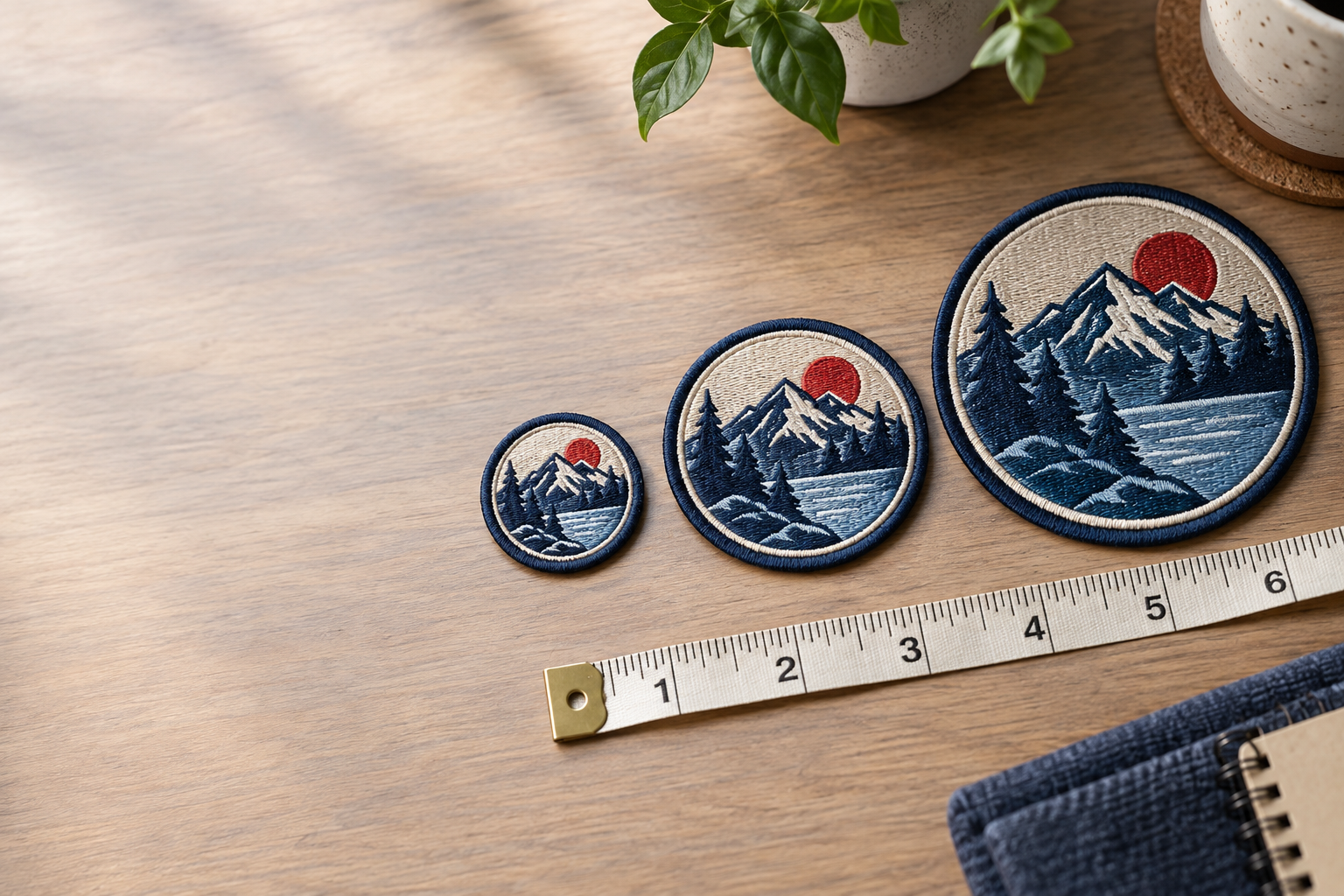
For custom woven patches New York orders, price depends on finished size, quantity, artwork, border, and backing—not the state name alone. For budget math, $80 for 10 patches equals $8 each, while $250 for 100 equals $2.50 each; these are illustrative scenarios, not current GetUSAPatches quotes. GetUSAPatches has a 10-piece minimum, so a small team or first brand run can start without buying hundreds.
We provide a free digital mockup before production and produce only after approval. Orders ship from Corona, CA to all 50 states, including New York, serving buyers throughout the United States. To turn an example budget into a usable price, send the artwork, dimensions in inches, garment type, quantity, and delivery ZIP code.
Custom woven patches New York: sample budgets and what they include
A patch price without specifications is only half an answer. A 2-inch sew-on label for a canvas tote is not the same order as a 4-inch shield with hook-and-loop backing for a public-safety jacket. Even if the artwork looks similar on a screen, the material area, finishing, attachment, and production work differ.
The table below is a worksheet, not a price list or a claim about prevailing New York rates. Each row is an independent hypothetical patch-only budget, with shipping, applicable tax, garment application, and any separately quoted charges left out. It shows how to check the arithmetic before comparing actual written offers.
| Example quantity | Hypothetical patch-only total | Calculated cost per patch | Planning question |
|---|---|---|---|
| 10 patches | $80 | $8.00 | Does a small paid run let you test the garment and design without carrying excess inventory? |
| 25 patches | $125 | $5.00 | Does this cover the current roster and a few replacements? |
| 50 patches | $175 | $3.50 | Will the extra pieces be used before the logo or uniform changes? |
| 100 patches | $250 | $2.50 | Is the lower example unit cost worth the higher total cash outlay? |
| 250 patches | $500 | $2.00 | Is demand established enough to support a larger inventory commitment? |
Do not read the difference between rows as a promised volume discount. Actual quantity breaks must come from a quote for the same approved specification. Ask for two or three realistic quantities, such as 25, 50, and 100, rather than requesting 1,000 solely to obtain an attractive per-piece number.
For a broader look at construction and pricing, use How Much Do Custom Patches Cost? What Drives the Price. Woven construction deserves its own comparison because its fine yarns and relatively flat face solve different design problems than raised embroidery.
What the 10-piece minimum means for a New York order
GetUSAPatches has a 10-piece minimum. That is useful for a high-school booster committee testing a crest, a hospitality business replacing a few uniform pieces, or a club ordering its first small batch. It does not mean every combination of names, sizes, colors, and shapes can automatically be combined into one ten-piece production setup.
If you need five black patches and five red patches, identify that split before the quote. The same goes for ten individual names or a mixture of sleeve-size and back-size artwork. Ask how the minimum applies to your variations and whether each version needs separate preparation or pricing.
Small runs protect cash; larger runs can lower unit cost
There is real preparation behind a small order: artwork review, production file work, proof checking, and order handling still happen. Spreading that work over more patches can reduce the unit cost, but the total invoice normally rises as you buy more. A lower unit price is not a saving if half the order stays in a drawer.
- Count garments, not just people. A 12-person restaurant team with three polos each has 36 patch placements before replacements.
- Separate current demand from possible demand. A confirmed school roster is different from an estimated fundraiser audience.
- Budget for a sensible replacement reserve if uniforms are issued throughout the year.
- Keep changing dates or sponsor details off a reusable crest when the design allows it.
- Request quantity breaks using identical dimensions, backing, border, and artwork so the comparison means something.
The bulk ordering guide is helpful when several departments share an order. One purchasing contact and one approved specification usually prevent more trouble than chasing a few cents while different people send conflicting versions of the logo.
The specifications that move a woven patch quote
Finished dimensions and usable artwork space
Give both width and height in inches. Saying “about palm size” leaves too much room for interpretation, especially for an oval or a long rocker. A 3-inch-wide rectangular patch and a 3-inch round patch do not provide the same layout space, and the border consumes part of that space.
Measure the garment before enlarging the artwork to rescue tiny text. A patch that reads beautifully at 4 inches may not fit between a polo placket and sleeve seam. Print the proposed outline at actual size, cut it out, and place it on the garment; the Custom Patch Size Guide offers more placement detail.
Lettering, colors, and fine details
Woven construction can hold finer detail than many embroidered designs, but it does not make microscopic lettering readable. Narrow script, tight counters inside letters, and low-contrast colors still cause problems. A long school motto wrapped around a small shield may need fewer words, more space, or a larger finished patch.
Color requirements can affect production planning, particularly when a buyer expects an exact brand match or unusual thread effects. Identify required colors and ask what is included rather than assuming every extra color carries a fixed charge. Thread is physical material viewed under changing light, not a backlit screen.
Borders, shapes, and finishing
A merrowed border wraps the edge with thread and gives a traditional framed finish. It is a familiar choice for round badges and merrowed crests, but tight inside corners and intricate silhouettes may need a cut-edge approach. Ask which finish fits the shape instead of choosing a border by name alone.
The edge also changes the visual balance. A heavy border can make a small chest patch feel crowded even when the central artwork is technically producible. Compare the options in Merrowed vs. Hot-Cut vs. Laser-Cut Borders and make sure the chosen finish appears in the written specification.
Choose woven for the artwork, not just the lowest number
Woven is a strong candidate for compact lettering, clean linework, and a cloth patch that should sit relatively flat. Think of a small brewery emblem on a work shirt, a detailed school seal on a warm-up jacket, or a streetwear label on a cap. Start with woven patches when those are the requirements.
Raised thread has a different job. Embroidered patches give bold lettering and simple symbols a more textured face, which can suit a traditional department crest or club emblem. Neither construction wins every quote; the useful question is which one preserves the logo and fits the garment.
| Construction | Good reason to choose it | Trade-off to check | Typical garment or use |
|---|---|---|---|
| Woven | Fine linework and compact lettering with a relatively flat cloth face | Less raised texture than embroidery; tiny text still needs review | Hospitality polos, detailed cap logos, lightweight uniform jackets |
| Embroidered | Raised thread texture and bold traditional crests | Dense small lettering may need simplification or more space | Work shirts, team jackets, club vests |
| Printed | Gradients, photographic elements, and artwork intended to look flat | Does not reproduce the dimensional look of stitched lettering | Illustrated event patches and full-color promotional designs |
| PVC | Molded relief and a nontextile patch face | Different flexibility, weight, and setup considerations | Compatible tactical panels, bags, outdoor gear |
| Chenille | Lofty varsity texture and large block shapes | Not the first choice for tiny lettering or fine linework | Letterman jackets and large school letters |
If the logo depends on a sunset gradient or a photograph, look at printed patches. Printed is flatter; that is the point. For a large varsity letter, chenille patches can provide the texture the design expects, while a woven secondary emblem can carry finer details elsewhere on the jacket.
Ask for a construction comparison only after setting the intended size and placement. Otherwise, you may compare a detailed 3-inch woven patch against a simplified 4-inch embroidered version and mistake different specifications for a straightforward price difference. The embroidered, woven, and PVC comparison guide explains those material distinctions.
Backing changes the patch price and the installation bill
Backing should follow the garment and how it will be used. A patch for a washable cotton work shirt has different attachment needs from one going on a coated nylon shell. Choosing the wrong back can create a much larger expense than the small difference between two patch quotes.
Price the complete attachment plan, including sewing labor or compatible loop material when needed. A patch delivered in a box is not yet a finished uniform. The backing options guide is a useful reference when your team is deciding who will apply the order.
Sew-on for a permanent installation
Sew-on is often a practical starting point for workwear, polos, denim, and club vests, provided the garment construction allows stitching. It avoids relying on a heat adhesive, but you still need access behind the placement area. A sleeve lining, pocket, or waterproof layer can complicate the job.
Get an installation quote from the person doing the sewing before approving a large batch. Ask whether the price changes for lined jackets, sleeves, or leather. Our patch sewing guide covers the basic sequence, but a finished uniform deserves a test placement on the actual garment.
Iron-on for heat-compatible fabrics
Iron-on can be convenient, but the adhesive and garment must be compatible. Follow the supplied application instructions and the garment care label; do not assume one temperature and dwell time work for every fabric. Coatings, water-repellent treatments, and heat-sensitive fibers deserve extra attention.
Iron-on that peels after a dryer cycle is not automatically a weaving defect. Inadequate bonding, unsuitable fabric, application errors, or later heat exposure can contribute. Test the attachment and laundering process before applying the entire run, and review How to Iron On a Patch the Right Way.
Hook-and-loop for removable identification
For a removable patch, specify hook backing, loop backing, or a matched set. Those are not interchangeable descriptions. If a jacket already has Velcro panels, measure the receiving panel and confirm which side is present before ordering.
A patch that overhangs its panel can catch at the edges and look poorly fitted. Extra attachment layers also add thickness, which matters on a soft cap or lightweight polo. See the hook-and-loop attachment guide for the difference between the two sides.
Match the patch to the actual New York uniform
The useful details on a quote request are often garment details rather than the buyer's industry. “Hospitality team” could mean cotton aprons, stretch polos, or lightweight polyester front-desk jackets. A photo of the placement area and the garment label can prevent a recommendation that looks sensible on paper but fails during application.
New York orders also cover very different wearing conditions: indoor restaurant shifts, outdoor school events, motorcycle rides, and public-safety work. Do not solve all four with the same backing by default. Describe laundering, removal needs, and exposure so the specification matches the job.
- High-school sports teams: check each warm-up jacket and cap model. Youth and adult garments may offer different usable placement areas even when the team wants one crest.
- Fire and public-safety units: use authorized artwork, verify lettering carefully, and follow department requirements. Do not modify protective garments without checking the garment maker's instructions and the unit's rules.
- Hospitality polos: choose a size that does not pull the knit out of shape. Test placement on a worn garment, not only on a shirt laid flat.
- Nylon shells: check heat sensitivity and coatings before selecting iron-on. Sewing can puncture a weather barrier, so attachment needs a garment-specific decision.
- Wool coaches' jackets and letterman jackets: inspect lining access and existing decoration. Keep a detailed woven crest separate from a large textured varsity letter if that preserves readability.
- Biker vests: plan the complete layout before fixing one patch in place. Leave room for rockers, existing insignia, pockets, and future additions.
- Caps and beanies: measure the decoration area on the actual style. Curved fronts, center seams, and stretchy knit surfaces can change how a flat patch sits.
For headwear, the hat patch guide helps narrow the size and construction. For a club vest, use the biker vest planning guide before ordering separate pieces. A coordinated layout is easier to approve before a sewing shop has already installed the first crest.
Compare delivered cost, not just the price beside the patch
New York City, Albany, Buffalo, and Long Island orders need a destination-specific shipping calculation, not a vague “New York delivery” allowance. We ship from Corona, CA, so confirm the delivery ZIP code, service, and arrival requirement. A lower patch subtotal may not remain lower after different shipping choices are added.
Use this formula: total project cost equals patches, separately quoted services, shipping, applicable tax, and installation. Divide that total by the number of patches you can actually use to understand the practical cost per installed piece. Keep quote exclusions visible rather than assuming a blank line means an included service.
A worked example with installation
Suppose an illustrative 50-piece patch order is $175, shipping is $18, and a local sewing shop charges $3 per garment. The combined amount is $343 before applicable tax: $175 plus $18 plus $150. That is $6.86 per installed patch, not the $3.50 patch-only figure.
Those figures are hypothetical and do not represent GetUSAPatches shipping or a local shop's current rates. The point is the method. If 20 patches will be held as inventory rather than installed immediately, separate today's sewing cost from the future application budget instead of charging labor against every piece at once.
- Does the quote list the same finished width and height on every option?
- Is the border style specified, rather than left as “standard” without explanation?
- Does hook-and-loop pricing include only the hook side or the matching loop piece too?
- Are artwork preparation, unusual finishing, packaging, or rush services included or separately priced?
- Are shipping and applicable tax visible in the total?
- Does the schedule describe dispatch or arrival, and what approval date does it depend on?
- If you want a physical sample, is its availability, price, and schedule confirmed separately from the free digital mockup?
A clear quote makes suppliers comparable without pretending their products are identical. Keep one specification sheet and send the same information for every comparison. For buyers still considering raised thread, the New York embroidered patch buyer's guide provides another construction-specific reference.
Ordering and lead time: work backward from the arrival date
Give us the date the patches must be in your hands, not just the day of the game, opening, or club ride. If a local shop needs time to sew them onto 40 jackets, patch delivery is an intermediate deadline. Add receiving, checking, and application time before the garments are issued.
There is no responsible universal turnaround promise for every woven patch specification. Artwork readiness, revision rounds, quantity, finishing, production availability, and shipping service all affect the schedule. Ask for the current timeline on your written quote and confirm how a later approval would change it.
- Send the artwork and intended garment. Include the clearest file available, a placement photo, and the material information.
- State dimensions in inches and list quantities by version. Identify any changes in color, text, size, or shape instead of burying them in a later message.
- Name the border and backing, or ask for a recommendation. Say whether a receiving loop panel already exists.
- Provide the New York delivery ZIP code and required arrival date. Mention separate installation time and any event deadline.
- Review the itemized quote and free digital mockup. Check the specification as carefully as the picture.
- Approve the final version only after the authorized decision-maker has checked it. GetUSAPatches produces only after approval.
- Confirm shipping details and plan a receiving check before the patches go to the sewing shop or uniform coordinator.
What to inspect on the mockup
Read every letter, including small ring text, punctuation, dates, and abbreviations. Check orientation, width, height, border treatment, and backing notes against the quote. For a school or public-safety crest, send the proof to the person authorized to approve that artwork rather than relying on a group chat.
A digital mockup shows the proposed design and specification; it is not a physical test of texture, adhesive performance, or garment fit. If a physical sample is required, discuss it before scheduling the full order. Its availability and any added cost or time need separate confirmation.
Vector artwork is useful, but send the best file you have rather than repeatedly enlarging a small screenshot. The artwork file guide explains the practical differences between vector files, PNGs, and JPGs. The production timeline guide helps separate artwork approval, manufacturing, and transit.
Keep a reorder file and avoid paying twice for the same mistake
The cheapest correction is usually the one made before approval. After production, a misspelled district name or a patch that does not fit the cap becomes a replacement order rather than an artwork adjustment. Assign one person to maintain the final approved proof and the matching specification.
Keep the order reference, dimensions, color references, backing, border, and approved artwork together. Save a garment photo showing placement and, if possible, retain one unused patch as a physical reference. A reorder still needs a fresh price and schedule; an old invoice does not automatically establish today's terms.
- Do not reduce the patch size to save money without rechecking lettering at the new size.
- Do not assume a second garment model tolerates the same heat application settings.
- Do not approve a proof on color alone while ignoring dimensions and backing notes.
- Do not order a large surplus of patches carrying a one-time event date unless demand supports it.
- Do not send an old screenshot when a previously approved production file or order reference is available.
- Do not distribute the entire run before checking a few patches for the approved spelling, size, border, and attachment type.
Care instructions should suit both the patch and the garment, with attention to whichever has the stricter requirements. Share application and washing guidance with the person issuing uniforms, especially if staff will launder them at home. The patch care guide is a useful starting point, not a replacement for garment-specific instructions.
A workable New York patch budget comes from a measured garment, readable artwork, an attachment plan, and a delivered total. Start with the quantity you will use, then compare a larger run only if the numbers justify it. That is how a small order stays practical without turning a lower per-piece figure into unnecessary inventory.