
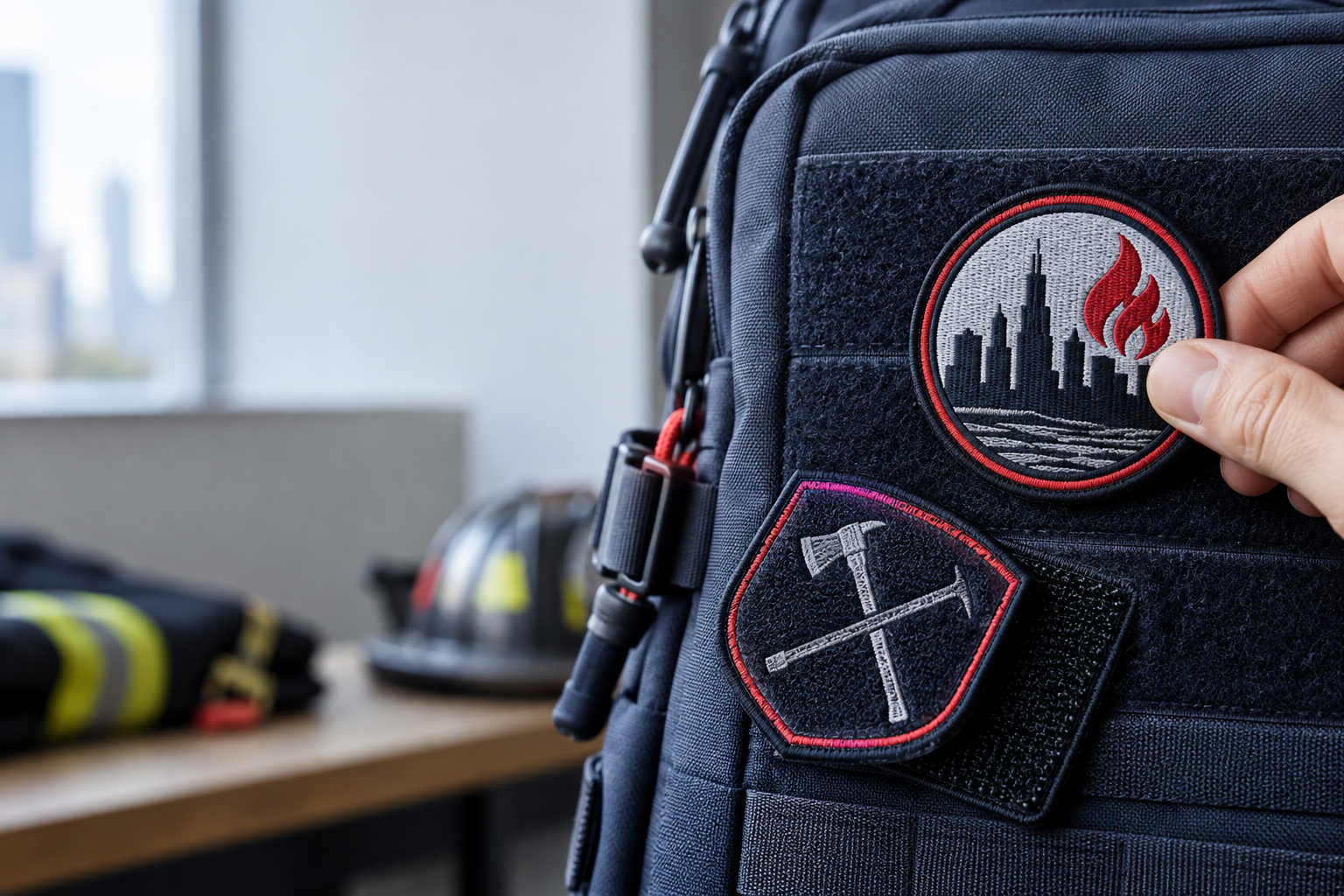
The best custom velcro patches Chicago fire crews can use include station crests, company numbers, name tapes, training identifiers, and approved anniversary designs. Match each idea to the actual jacket, cap, or bag panel, then choose embroidery, woven fabric, printing, or PVC for the artwork. These are removable identification and recognition pieces, not protective equipment.
At GetUSAPatches in Corona, CA, the quote starts with the garment and the job the patch needs to do. We have a 10-piece minimum, provide a free digital mockup before production, and produce only after approval. We ship to all 50 states, serving departments, teams, clubs, and businesses throughout the United States.
Start With the Assignment, Not the Artwork
A station jacket crest and a training-day identifier might both have hook backing, but they solve different problems. The crest can carry a little history and decoration. The identifier needs a short message that someone can read without walking up and studying the sleeve.
That distinction matters on the production desk. A design that looks good across the back of a biker vest may lose most of its detail on a 3-inch sleeve patch. The same happens when a full school crest moves from a letterman jacket to a cap: the artwork needs editing, not just shrinking.
For fire department work, confirm authorized symbols, wording, colors, and placement before building the design. Do not add unofficial role labels to operational clothing or alter turnout gear based on a patch recommendation. Department requirements and the equipment manufacturer’s instructions control those decisions.
Ideas 1–5: Everyday Identity for Stations and Companies
1. A Station Crest With One Strong Center Symbol
Start with a familiar shield or round crest, then give it one clear centerpiece: approved station artwork, an apparatus silhouette, or a simple company mark. A roughly 3.5-inch design can be a useful starting concept for a station jacket, but the existing panel decides the final size. Do not order from the concept dimension alone.
Use embroidered patches when the design relies on bold lettering and traditional stitched texture. Keep secondary dates and motto text under control. A merrowed crest has a substantial stitched perimeter, so leave room between the border and the lettering instead of pushing every element outward.
2. A Large Company Number With a Small Supporting Line
Make the company number the largest element, with the approved company designation beneath it. This concept suits rectangular bag panels and permitted outerwear locations because it reads quickly. Keep any fictional number used during design development clearly marked as a placeholder until the real assignment is confirmed.
A 3-by-2-inch concept might hold a large number and one short line comfortably; it is not a promise that every typeface will fit. Thin outlines around block numerals often add work without improving recognition. Put that space into a wider numeral and stronger background contrast.
3. Removable Name Tapes for Approved Station Wear
Name tapes are straightforward until the longest name arrives. Build the layout around that name first, not the shortest one on the roster. A 4-by-1-inch strip is a reasonable mockup starting point only if the garment already has a compatible panel.
For a narrow strip, woven patches may preserve small lettering more cleanly than a heavily stitched face. Keep capitalization, spacing, and any permitted initials consistent across the run. Ask how personalization affects pricing and the 10-piece minimum rather than assuming ten different names are priced like ten identical crests.
4. A Neighborhood-Inspired Station Patch
A neighborhood reference gives a Chicago patch local meaning without forcing an entire skyline into a small circle. Consider one approved bridge outline, a simple street-grid motif, or a recognizable architectural shape. Leave enough open space that the main company identity remains the first thing people notice.
Chicago flag-inspired colors or stars can work as supporting elements, subject to the department’s design approval. Do not imply an official city endorsement or copy another company’s identity. If the concept needs detailed architecture, compare woven or printed artwork against embroidery at actual size.
5. An Anniversary Patch That Keeps the Date Readable
For a station anniversary, choose one prominent anniversary number and one clear date range. The temptation is to add founding officers, an apparatus drawing, a motto, and several address lines. On a wearable patch, that usually becomes a collection of details nobody can read.
Separate the wearable version from a larger display version if the history needs more room. Hook backing makes sense for approved removable wear or a compatible display board, while a permanent garment may need another attachment. Confirm the dates with the department before approving the proof; attractive artwork cannot fix a wrong founding year.
Specs for Custom Velcro Patches Chicago Crews Can Actually Use
Velcro is a brand name often used for hook-and-loop fastening. On a patch quote, separate the face material from the backing: embroidery is the face, for example, while hook material is on the back. Also confirm whether the supplied fastener is VELCRO Brand or another hook-and-loop product if procurement requires a particular brand.
The scratchy hook side generally belongs on the removable patch; the soft loop side belongs on the garment. If the jacket already has loop panels, you may need only hook-backed patches. If it does not, ask about matching loop pieces and an approved installation method rather than assuming the patch package includes garment alteration.
| Patch face | Best fit for these ideas | Main trade-off | What to check before approval |
|---|---|---|---|
| Embroidery | Station crests, bold company numbers, anniversary marks | Traditional thread texture; tiny text and close lines may merge | Actual-size lettering, thread contrast, edge width, and hook coverage |
| Woven fabric | Name tapes, compact crests, more detailed line art | Fine detail with a flatter face; less raised texture than embroidery | Smallest lettering, line separation, border treatment, and panel fit |
| Printed fabric | Complex memorial art, shaded illustrations, event graphics | Printed is flatter; that is the point when artwork matters more than thread texture | Color expectations, smallest details, face finish, and cleaning instructions |
| PVC | Bold bag identifiers and approved utility-oriented designs | Raised molded shapes; thickness and flexibility need checking on small or curved panels | Relief levels, edge profile, backing construction, and intended cleaning method |
| 3D embroidery | Large simple numerals or recognition designs for suitable off-duty items | Extra dimension takes space and does not suit dense small text | Letter shapes, clearance, snag exposure, and suitability for the intended garment |
Choose PVC patches for a molded appearance, not because a custom PVC patch should be treated as heat protection. Likewise, printed patches can preserve shaded artwork, but ordinary printing is not reflective identification. Any required protective or visibility performance needs a separately verified specification.
Measure usable panel width and height in inches, including any rounded corners. The finished patch should stay fully supported rather than bridging a pocket opening or hanging over a seam. For layout help, the Custom Patch Size Guide explains why the visible artwork and finished outside dimension are not the same measurement.
A merrowed border works well on many simple shapes, but tight corners and narrow cutouts need a different edge discussion. Border style, face thickness, and hook backing all affect the finished profile. The material comparison guide is useful if two options still look equally good on screen.
Ideas 6–10: Training, Recognition, and Equipment Organization
6. A Training-Only Instructor or Participant Identifier
A removable training identifier can keep an exercise garment useful after the event. Use short, department-approved wording such as a training function or participant group, and make its purpose unmistakable. It must not compete with required identification or suggest a qualification the wearer does not hold.
Use contrast first and decoration second. A plain rectangular patch with one large word can do this job better than a decorated shield. Check the design against the actual training vest or jacket, including any required markings that must remain visible.
7. An Approved Specialty-Team Identity Patch
An authorized specialty team may want a distinct emblem for station wear, bags, or approved training apparel. Keep the team name clear and use one relevant symbol rather than a crowded collection of tools. The patch should identify an approved team, not make an unsupported performance or certification claim.
PVC can suit a bold utility-style design; woven fabric can suit a detailed existing crest. Neither choice settles where the patch may be worn. The Chicago rescue-team backing and size guide offers a useful companion discussion for approved bags and compatible panels.
8. A Memorial or Remembrance Patch
Keep a remembrance design restrained. A clear name, an approved symbol, and carefully checked dates usually carry more weight than a busy background. Ask the department’s designated reviewer to approve the wording and any portrait use before the art reaches final proof.
A portrait or soft tonal background may point toward printing rather than thread. If the patch is for a display board, note that separately from uniform use; the same image does not automatically have permission for both. Give names and dates their own proofreading pass, outside the general artwork review.
9. A Public-Education or Open-House Patch
An open-house design can use a friendly apparatus illustration, the event year, and an approved station name. Decide whether the patch is intended for staff apparel, collectors, or a public giveaway. Hook backing is useful for compatible panels, but recipients with ordinary T-shirts may not have anywhere to attach it.
That is a practical reason to compare backing options before ordering the whole event quantity. A collector version can carry more visual detail, while a staff patch should remain readable on its garment. Avoid wording that could make a souvenir look like an official operational credential.
10. A Gear-Bag Identifier With a Large Number or Name
For approved personal or station bags, use a large owner name, company number, or simple equipment category. Readability matters more than decoration when several similar black duffels sit together. Put the information people actually need on the patch instead of repeating a full department crest.
Measure the bag while it is filled, because a panel that lies flat on an empty duffel may curve under load. A thick patch can lift at the edges on a tight curve. Do not cover manufacturer labels, inspection information, or any required markings on bags or equipment.
Match the Patch to the Jacket, Cap, or Bag
Nylon shells need more care than their smooth surfaces suggest. Heat can damage some fabrics or coatings, and sewing can affect weather resistance. An existing manufacturer-provided loop panel is a different situation from adding a new panel, so send the garment model and attachment location with the quote.
For wool coaches’ jackets, heavier station jackets, and letterman-style garments, check lining access before planning a sewn loop panel. Stitching through an interior pocket is a real installation failure, not an artwork problem. A garment decorator should inspect the construction rather than treating every jacket like a flat fabric sample.
Hospitality polos teach the opposite lesson: a stiff, heavy patch can pull a light knit out of shape. The same concern applies to lightweight station polos. If removable identification is not required, a lighter permanent attachment may be more comfortable, subject to the uniform policy.
Caps bring curvature into the decision. A small flat patch can work on a cap designed with a loop panel, while a tall, stiff design may not sit correctly across the crown. Compare hat patches by finished footprint, not just the logo’s appearance on a flat mockup.
An iron-on that peels after a dryer cycle often points to a fabric, adhesive, application, or care mismatch. It is not a reason to add more heat to a technical garment. Review patch backing options before choosing an attachment, and do not heat-apply anything to protective equipment without the required authorization and manufacturer guidance.
Make the Artwork Read at Actual Size
The most common design problem is a full-size logo being squeezed into a small wearable space. High-school team orders run into it with mascots, and club orders run into it with long location rockers. Fire department crests have the same problem when several text rings surround a detailed center illustration.
- Give one element priority. Usually that is the company number, station name, or purpose of the patch.
- Print a paper version at the proposed finished size. Hold it against the actual panel instead of judging it at phone-screen zoom.
- Keep a clear gap between lettering and the border. The edge treatment needs room, especially on a compact crest.
- Use deliberate contrast. Dark red thread on a black ground may look attractive close up but lose distinction at a distance.
- Send the longest name and the most detailed design version first. They expose space problems before the rest of the set is built.
- Keep written color references with the artwork. A screen preview helps review layout, but it is not a physical thread or material sample.
Vector artwork is useful, but a clean image and a clear brief can still start the conversation. Do not enlarge a tiny screenshot and assume the missing detail has returned. The artwork file guide explains what to send and why lettering sometimes needs to be rebuilt.
A free digital mockup lets you check composition, wording, dimensions, and the proposed construction before production. It does not let you feel stiffness or test hook engagement. If physical evaluation is needed for procurement, ask about sample options, costs, and schedule separately.
Budget for the Whole Order, Not Just the Patch Face
GetUSAPatches has a 10-piece minimum. Final pricing depends on the quantity, finished dimensions, material, artwork complexity, border, backing, and any individual variations. A run of identical company crests is not automatically priced the same as a roster of individually named tapes.
Ask for the total in USD and an itemized explanation of what is included. Hook backing, matching loop pieces, artwork work, personalization, shipping, and any other applicable charges should be clear before approval. Do not assume a loop patch for the jacket is included just because the removable patch has hook backing.
For planning arithmetic only, a department with a $300 allocation for 30 patches has a $10-per-patch all-in ceiling. That is a budget example, not a GetUSAPatches price quote. If garment installation, taxes, or other costs must come from the same $300, the amount available for the patches themselves is lower.
Save money by simplifying a design that does not need extra detail, not by sacrificing readable text or correct backing. Quote realistic spare quantities for replacements and new members, but avoid padding an order with pieces likely to become outdated. The custom patch cost guide explains the variables worth comparing between quotes.
Ordering and Lead Time: Build the Schedule Around Approval
A useful deadline is the day the patches must be in hand, not simply the ceremony date. Leave room to count the delivery, check names, and arrange any approved garment work. Tell us the Chicago-area shipping ZIP code and receiving location rather than assuming every department address accepts packages the same way.
- Send the purpose and garment details. Include a panel photograph, usable dimensions in inches, and any department restrictions on colors, placement, or symbols.
- Supply the artwork and version list. Identify the station crest, number changes, names, anniversary dates, and any separate display or event versions.
- State the quantity and backing. Specify hook-backed patches, whether matching loop pieces are needed, and how many pieces belong to each variation.
- Give the actual in-hand date. Ask for the current artwork, production, and shipping schedule for that specification rather than relying on a general estimate.
- Review the free digital mockup. Check spelling, dimensions, material, edge, colors, and backing with the person authorized to approve the order.
- Approve the final version and confirm receiving details. GetUSAPatches produces only after approval, then ships from Corona, CA, to destinations in all 50 states.
Lead time is not one single block of factory time. Artwork review, revisions, approval, production, and transit are separate stages, and department review can take longer than expected. A late name change or a switch from embroidery to PVC can require a revised quote or schedule.
We do not turn an unconfirmed event date into a delivery promise. Request the current production window and available shipping options for the exact order, then get the schedule confirmed before committing. Nationwide shipping from Corona, CA, includes Chicago; the geographic focus does not mean local Chicago pickup or same-day service.
Check the Delivery and Keep Hook-and-Loop Working
On arrival, count the pieces by design and check personalized names against the approved roster. Compare the finished dimensions and backing with the order specification. Test a patch on the intended non-protective garment or approved panel before issuing the whole run.
Hook material collects lint, and loose edges can catch on other garments. Remove ordinary detachable patches before laundering when the patch and garment care instructions call for it, and protect exposed hooks during storage. Do not assume that a washable face material makes every backing, adhesive, and edge construction suitable for the same wash cycle.
For routine civilian or station apparel, follow the supplied care instructions and remove lint gently without damaging the fastener. Potentially contaminated fire-service gear belongs under the department’s established cleaning procedures, not generic patch-care advice. The hook-and-loop attachment guide covers ordinary attachment and handling.
Related Guides and Product Hubs for the Next Decision
Choose the next reference by the question still open. If the shape and identity are settled but the face material is not, compare construction first. If the material is settled but the patch will not sit flat, return to panel measurements and garment fit.
- Custom PVC Patches for Rescue Teams in Chicago: Backing and Size Guide is useful for molded designs and compatible equipment-bag panels.
- Velcro® Patches: How to Attach and Use Hook-and-Loop Backing explains the two-part attachment system and everyday handling.
- Embroidered vs. Woven vs. PVC Patches: Which Should You Choose? helps compare texture, detail, and construction before approval.
- Browse embroidered patches for traditional crests, woven patches for fine lettering, and printed patches for artwork built around shading.
The strongest Chicago fire department patch is not necessarily the most elaborate one. It is the approved design that fits its panel, communicates the right identity, and arrives with the correct backing. Get those three things right before adding another skyline, banner, or line of small text.